
Toyota Yaris Cross vs Renault Captur Australia: Which Small SUV Wins?

Choosing between the Toyota Yaris Cross and Renault Captur in Australia is a little more interesting than comparing two spec sheets. These compact SUVs approach the same job from almost opposite directions. The Toyota plays the efficient, sensible, hybrid-powered all-rounder. The Renault is the more muscular, European-flavoured alternative, bringing turbocharged performance, clever interior packaging and a surprisingly big boot.
There is also an important catch for Australian buyers in 2026: the Toyota Yaris Cross remains part of Toyota Australia's current range, whereas the previous-generation Renault Captur was sold locally through December 2025 and is no longer listed among Renault Australia's current models. In practical terms, anyone comparing them today is likely deciding between a new Yaris Cross and a used or remaining-stock Captur.
Does that automatically make the Toyota the better buy? Not necessarily.
The Captur still has several cards up its sleeve, particularly if performance, luggage space and second-hand value matter more than fuel economy. Let's put both under the microscope.
- Toyota Yaris Cross vs Renault Captur Australia: Quick Comparison
- Design: Conservative Japanese SUV or French Flair?
- Engine and Performance: Captur Lands the First Big Punch
- Fuel Economy: Toyota Strikes Back Hard
- Interior Space: Renault Makes Better Use of Its Footprint
- Boot Space: Renault Captur Wins
- Technology and Infotainment
- Safety: Both Have Strong Foundations
- Yaris Cross AWD vs Captur FWD
- Towing Capacity: Captur Wins by a Mile
- Servicing and Warranty
- Reliability and Resale Value
- Price and Value in Australia
- Toyota Yaris Cross Pros and Cons
- Which Is Better for Commuting?
- Which Is Better for Highway Driving?
- Which Is Better for a Small Family?
- Which Is Better for Buyers Who Keep Cars for 10 Years?
- Toyota Yaris Cross vs Renault Captur: Our Verdict
- FAQs
- 1. Is the Toyota Yaris Cross better than the Renault Captur?
- 2. Which is more fuel-efficient, Yaris Cross or Captur?
- 3. Does the Renault Captur have more boot space than the Yaris Cross?
- 4. Which is faster, Toyota Yaris Cross or Renault Captur?
- 5. Can you still buy a new Renault Captur in Australia?
Toyota Yaris Cross vs Renault Captur Australia: Quick Comparison
At a glance, these two small SUVs reveal very different personalities.
| Specification | Toyota Yaris Cross 2WD Hybrid | Renault Captur 1.3 Turbo |
|---|---|---|
| Engine | 1.5L 3-cylinder hybrid | 1.3L 4-cylinder turbo petrol |
| Combined output | 85kW | 113kW |
| Torque | Hybrid system; front motor 141Nm | 270Nm |
| Transmission | Auto CVT | 7-speed dual-clutch |
| Drive | FWD; AWD available on selected Yaris Cross grades | FWD |
| Combined fuel economy | 3.8L/100km | 6.6L/100km |
| Fuel requirement | 91 RON | 95 RON |
| Length | 4180mm | 4227mm |
| Width | 1765mm | 1797mm |
| Wheelbase | 2560mm | 2639mm |
| Boot capacity | Up to 390L in 2WD | 422L normally; up to 536L with rear bench forward |
| Towing capacity | 400kg | Up to 1200kg braked |
| Seats | 5 | 5 |
Toyota's current specifications give the Yaris Cross Hybrid 85kW of combined output, 3.8L/100km combined consumption for 2WD variants and 4.0L/100km for AWD versions. The Captur's Australian 1.3-litre turbo produced 113kW and 270Nm and claimed 6.6L/100km.
Already, the contest is clear. The Yaris Cross is the economy champion, but the Captur holds a large advantage in outright performance and towing capacity.
Design: Conservative Japanese SUV or French Flair?
Styling is subjective, but these cars certainly do not speak the same visual language.
The Yaris Cross looks tough for something so compact. Chunky wheel arches, short overhangs and a relatively upright stance give it a miniature-adventure-SUV personality. It feels as though Toyota took a city hatchback, put on hiking boots and sent it camping.
The Renault Captur is smoother and more fashion-conscious. Its sculpted sides, curved lighting signatures and cleaner proportions lean toward European sophistication rather than ruggedness.
Neither approach is wrong.
If we want something understated and likely to age gracefully, the Toyota makes sense. If we want our compact SUV to carry more visual personality, the Captur has an undeniable charm.
Which SUV Looks Bigger?
The Renault actually is slightly larger.
The Australian Captur measures 4227mm long and 1797mm wide, compared with 4180mm and 1765mm for the Yaris Cross. Its wheelbase is also longer at 2639mm versus 2560mm.
Those aren't enormous differences, but they matter inside.
The Toyota's narrower footprint can be useful in crowded Australian urban environments, tight shopping-centre car parks and narrow residential streets. The Captur occupies slightly more road but repays us with better cabin packaging.
Parking and Urban Manoeuvrability
Here we would lean toward the Toyota.
Compact exterior dimensions are one of the Yaris Cross's biggest strengths. Toyota effectively designed it around city life, and the current GX also includes useful equipment such as front and rear parking sensors, a reversing camera, blind-spot monitoring and Parking Support Brake.
The Captur isn't cumbersome, but the Toyota feels more naturally suited to dense urban environments.
Engine and Performance: Captur Lands the First Big Punch
This is where the Renault changes the conversation.
The Yaris Cross uses Toyota's 1.5-litre three-cylinder hybrid system. Current Australian versions produce 85kW combined, which is perfectly respectable for city traffic and everyday commuting.
But nobody is going to mistake the Yaris Cross for a hot hatch.
The Captur's 1.3-litre turbocharged four-cylinder sends 113kW and 270Nm through a seven-speed dual-clutch automatic.
That difference is substantial.
Put your foot down while joining a motorway, overtaking a truck or climbing a steep road with passengers aboard, and the Renault feels considerably more energetic. The turbocharged torque arrives with the sort of shove the Toyota simply doesn't provide.
Toyota Yaris Cross Hybrid Driving Experience
The Toyota's strength isn't acceleration. It is smooth, effortless efficiency.
Around town, the electric motor assists from low speed, making stop-start driving pleasantly relaxed. There's no traditional gearbox hunting through ratios, either. The hybrid CVT largely concentrates on keeping the powertrain operating efficiently.
Press hard, however, and the engine can become more vocal. That's common with hybrid CVT powertrains: speed builds, but not with the stepped mechanical rhythm some drivers prefer.
We would describe it as functional rather than exciting.
This content may interest you!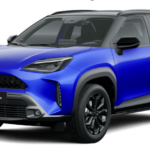 Toyota Yaris Cross or Similar Australia: What Are the Best Alternatives?
Renault Captur Driving Experience
The Captur feels more conventional—and more playful.
Its turbo engine has noticeably greater mid-range muscle, while the seven-speed dual-clutch transmission gives acceleration a more mechanical character. Contemporary testing put the Captur at roughly 8.6 seconds from 0-100km/h in some variants, which is lively territory for a small mainstream SUV.
The trade-off is that dual-clutch transmissions can feel less creamy than Toyota's hybrid system at crawling speeds.
Think of the Captur as the espresso shot and the Yaris Cross as the green tea. One wakes us up; the other calmly gets us through the day.
Fuel Economy: Toyota Strikes Back Hard
If petrol bills matter, the Yaris Cross walks away from the Captur.
Toyota quotes 3.8L/100km combined for 2WD models and 4.0L/100km for AWD versions under laboratory testing. Current specifications also list 91 RON regular unleaded as the recommended fuel.
The Captur's official combined figure is 6.6L/100km, and its turbo engine requires 95 RON premium unleaded.
That combination gives the Toyota two advantages: it burns less fuel and can use cheaper regular unleaded.
Which Is Better for Australian City Driving?
The Yaris Cross.
Hybrid technology is at its best in urban traffic, where regenerative braking can recover energy and the electric motor can take part of the workload away from the petrol engine.
In heavy stop-start commuting around Sydney, Melbourne, Brisbane or other congested cities, that advantage can become meaningful over several years.
Highway driving narrows the conceptual benefit because hybrids cannot exploit regenerative braking as frequently, but the Toyota remains impressively economical.
The Captur Still Has a Larger Fuel Tank
The Renault carries a 48-litre tank, whereas the current Yaris Cross uses a 36-litre tank.
So while the Toyota consumes much less fuel, the Renault's larger tank compensates somewhat when considering distance between refuelling stops.
Still, in operating-cost terms, Toyota wins convincingly.
Interior Space: Renault Makes Better Use of Its Footprint
Open the doors and the Captur starts justifying its slightly larger dimensions.
Its 2639mm wheelbase is 79mm longer than the Toyota's 2560mm measurement. On paper that sounds small, but wheelbase matters because those extra millimetres are positioned between the axles—exactly where passengers live.
The Renault's rear-seat arrangement is particularly clever because the bench can slide fore and aft, allowing owners to prioritise rear legroom or luggage capacity.
That's genuine everyday versatility rather than showroom gimmickry.
Rear-Seat Comfort
For adults regularly carrying adults, we'd favour the Captur.
Reviews of the Australian model found rear legroom surprisingly generous for a compact vehicle, with enough room for adults on shorter journeys and useful amenities including rear air vents.
The Yaris Cross can absolutely handle a small family, but its compact platform reveals itself more clearly in the second row.
If children occupy the rear seats most of the time, this difference may hardly matter. If you're regularly transporting four adults, it probably will.
Boot Space: Renault Captur Wins
The luggage contest goes to France.
A 2WD Yaris Cross offers up to 390 litres of VDA-measured cargo capacity, while AWD models drop substantially to 314 litres because of the additional drivetrain hardware.
The Captur provides 422 litres with its rear bench in its normal position, while sliding that bench forward and using the under-floor area can increase the quoted capacity to 536 litres. Fold the rear seats and capacity rises to 1275 litres.
That flexibility makes the Captur one of the cleverer little SUVs for carrying luggage.
Which Is Better for Families?
It depends on the age of the family.
Parents dealing with prams, shopping bags and holiday luggage may appreciate the Renault's adjustable rear bench and larger cargo area. Yet the Toyota counters with lower fuel consumption, strong active safety equipment and easy urban manoeuvrability.
This content may interest you! Renault Captur Reliability Australia: Is It a Dependable Small SUV?
For a couple with one child? Either works beautifully.
For regular four-person road trips? We would prefer the Captur's extra breathing room.
Technology and Infotainment
The latest Yaris Cross has become more competitive technologically.
The current GX includes an 8-inch multimedia display, wireless Apple CarPlay and Android Auto, Bluetooth and six speakers, while higher grades add progressively richer features. Toyota also provides connected functionality through the myToyota Connect ecosystem.
The Captur's cabin was arguably one of its strongest attributes when new. Higher variants offered digital instrumentation, larger infotainment interfaces, navigation and more premium presentation.
Later Australian examples also gained wireless Apple CarPlay and Android Auto across the range.
Renault, particularly in higher trim levels.
The Yaris Cross interior prioritises clarity and durability. Controls are relatively easy to understand, visibility is good and the whole environment feels engineered to survive years of daily use.
The Captur has more visual theatre.
Depending on specification, its vertical touchscreen, ambient details, sculpted dashboard and more European design give it a richer first impression.
Whether that matters after five years of ownership is another question—but during a test drive, the Renault can feel like the more expensive object.
Safety: Both Have Strong Foundations
Safety requires some context because the vehicles were assessed in different circumstances.
The Yaris Cross carries a five-star ANCAP rating based on 2021 testing, applicable to variants excluding GR Sport, with the rating valid until December 2027. It scored 86 percent for adult occupant protection, 86 percent for child occupant protection, 78 percent for vulnerable road-user protection and 82 percent for safety assist.
Its current standard safety equipment includes technologies such as pre-collision assistance, lane trace assist, active cruise control, road-sign assistance, blind-spot monitoring and safe-exit assistance, depending on the feature definition and grade.
The Australian Captur also achieved a five-star result when assessed under the 2019 ANCAP protocol, scoring a particularly strong 96 percent for adult occupant protection. However, that rating expired at the end of December 2025, and ANCAP now categorises this Captur generation as an old model.
That does not mean the Captur suddenly became unsafe on January 1, 2026. It means safety assessment standards evolve, and its original rating should not be interpreted as equivalent to a newly tested 2026 vehicle.
Yaris Cross AWD vs Captur FWD
Here's an advantage Renault cannot answer: Toyota offered—and continues to offer—electric all-wheel-drive variants of the Yaris Cross.
Toyota's AWD arrangement adds a small rear electric motor and automatically varies torque distribution according to conditions. Trail Mode can also help manage wheelspin on lower-grip surfaces.
We should keep expectations realistic. A Yaris Cross AWD is not a miniature LandCruiser.
But for wet roads, loose surfaces, gravel tracks and occasional trips to locations where extra traction provides confidence, it gives the Toyota another layer of versatility.
Every Australian Captur from this generation sends its power to the front wheels.
Which Is Better for Rural Australia?
The answer isn't quite as straightforward as AWD versus FWD.
The Yaris Cross has the traction advantage, but the Captur has far superior towing ability and much more power.
So if "rural driving" means gravel access roads and slippery surfaces, we'd choose the AWD Toyota.
If it means pulling a small trailer and travelling long distances on sealed highways, the Captur becomes much more appealing.
Towing Capacity: Captur Wins by a Mile
This might be the biggest numerical victory in the comparison.
The current Yaris Cross is rated to tow just 400kg braked or unbraked.
The Australian Captur could tow as much as 1200kg braked, with a 660kg unbraked rating quoted for some variants.
Anyone intending to pull anything remotely substantial should therefore put the Captur well ahead.
This content may interest you!Toyota Yaris Cross vs Corolla Cross Australia: Which Toyota SUV Should We Buy?The Toyota's rating is suitable only for very lightweight towing duties.
Servicing and Warranty
Toyota currently covers the Yaris Cross under its five-year/unlimited-kilometre Toyota Warranty Advantage program. Toyota's published information also specifies servicing every 12 months or 15,000km, with capped-price servicing applying according to its program conditions.
The Captur was also sold with a five-year/unlimited-kilometre warranty. Its scheduled service intervals were unusually generous at 12 months or 30,000km, whichever occurred first. Renault's published capped-price schedule for MY21-onward Captur models shows the historical servicing program applicable to eligible vehicles.
One caveat matters for used Captur shoppers: warranty and servicing coverage depends on the individual vehicle's age, purchase date and maintenance history.
Which Should Be Cheaper to Own Long-Term?
We would put our money on the Yaris Cross.
Fuel consumption is considerably lower, regular unleaded is acceptable, Toyota has a huge Australian dealer network, and the hybrid powertrain is supported within a product ecosystem that Toyota has sold locally in enormous numbers.
The Captur's servicing intervals are attractive, but a used European small SUV is a different ownership proposition from a new Toyota hybrid.
That does not make it a bad choice. It simply means condition and service history become more important.
Reliability and Resale Value
Toyota's reputation is one of the reasons Australians keep buying the brand.
A Yaris Cross is likely to appeal to a broad pool of future second-hand buyers because the Toyota badge, hybrid efficiency and compact-SUV body style are all easy to understand.
The Captur is more niche.
That can hurt resale values—but here's the interesting part: it can also help the buyer.
A used Captur may offer significantly more equipment and performance for the same money precisely because depreciation has already done some of the heavy lifting.
Sometimes poorer resale value is terrible news for the first owner and excellent news for the second.
Used Captur vs New Yaris Cross
This is arguably the most relevant version of the comparison in 2026.
Current Toyota material shows the Yaris Cross continuing with GX, GXL, Urban and GR Sport grades, all using the 1.5-litre hybrid powertrain.
Renault Australia's current vehicle range, by contrast, does not include the Captur. ANCAP records the Australian model's on-sale period as ending in December 2025.
So our shopping equation changes.
A new Yaris Cross provides a fresh warranty, current dealer support, exceptional fuel economy and predictable ownership.
A used Captur potentially offers more performance, more boot space and more equipment per dollar—but carries the additional uncertainty that accompanies any used vehicle.
Price and Value in Australia
Toyota previously published recommended retail pricing of $30,900 for the GX FWD, $33,950 for the GXL FWD, $36,880 for the Urban FWD and $36,930 for GR Sport FWD, before on-road costs, with AWD commanding extra money. Current drive-away pricing varies by location and dealer.
The 2024 Captur range started from $33,000 before on-road costs for the Life, progressing through Zen and Intens to $41,300 for the R.S. Line when that four-variant range was published.
But those aren't directly comparable today because the Captur has moved into used-car territory.
Rather than asking which had the lower list price when new, buyers should compare the actual price of the Captur they're considering with the drive-away price of an equivalent Yaris Cross.
Toyota Yaris Cross Pros and Cons
The Toyota's strongest arguments are easy to understand:
- Outstanding hybrid fuel economy, particularly around town
- Ability to run on 91 RON petrol
- Optional AWD on several grades
- Compact dimensions ideal for urban driving
- Strong current safety and driver-assistance package
- Current Australian-market availability
- Broad dealer support and potentially strong resale appeal
- Five-year/unlimited-kilometre warranty on a new example
Its compromises are equally clear: performance is modest, rear-seat space is not class-leading, towing capacity is extremely limited and AWD models lose a noticeable amount of luggage capacity.
The Captur counters with substantially more turbocharged performance, a larger and cleverly configurable boot, a longer wheelbase, greater towing capability and a cabin with plenty of European personality. Yet it uses more fuel, requires premium petrol, lacks AWD and is no longer part of Renault Australia's new-car lineup.
Which Is Better for Commuting?
Toyota Yaris Cross.
Few scenarios showcase the hybrid Toyota better than commuting.
This content may interest you!Toyota Yaris Cross vs C-HR Australia: Which Toyota Hybrid SUV Should We Buy?It is compact, economical and designed around low-speed efficiency. If we're travelling through stop-start traffic five days a week, paying for petrol repeatedly and squeezing into crowded car parks, the Yaris Cross makes tremendous sense.
The Renault is quicker, but commuters rarely get to enjoy 270Nm while sitting at a red light.
Which Is Better for Highway Driving?
Renault Captur—if performance matters more than fuel economy.
The Captur's 113kW and 270Nm give it a relaxed reserve of overtaking power that the Toyota cannot match. Loaded with passengers and luggage, that extra muscle becomes even more useful.
The Yaris Cross remains perfectly capable of highway travel and will use less fuel doing it. But ask which one we'd rather accelerate from 80km/h to highway speed in, and we'd reach for the Renault key.
Which Is Better for a Small Family?
This one is close.
The Captur makes a compelling family argument through its sliding rear bench, larger luggage capacity and longer wheelbase.
Toyota answers with exceptional efficiency, compact dimensions, available AWD and a strong current safety package.
For a family living deep inside the city, we'd choose the Yaris Cross.
For a family regularly carrying bulky gear or travelling longer distances, we'd be tempted by a well-maintained Captur.
Which Is Better for Buyers Who Keep Cars for 10 Years?
The Yaris Cross is the safer bet.
Long-term ownership isn't only about whether the engine survives. Parts supply, dealer accessibility, resale demand, fuel costs and ongoing manufacturer presence around a specific model all matter.
Because the Captur has left Renault Australia's current lineup, its proposition is now slightly more complicated.
We wouldn't avoid a Captur solely for that reason. A carefully inspected, correctly serviced example can still be appealing.
But if our mission is to buy a vehicle and worry about it as little as possible for the next decade, the Toyota's simplicity of ownership is difficult to ignore.
Toyota Yaris Cross vs Renault Captur: Our Verdict
The Toyota Yaris Cross wins this comparison for most Australian buyers, although not because it dominates every category.
Far from it.
The Captur is faster. Its 113kW/270Nm turbo engine leaves the 85kW Toyota hybrid behind when acceleration matters. It also has a larger, more flexible luggage compartment, more generous rear-seat packaging and dramatically better towing capability.
In isolation, the Renault can actually feel like the more substantial small SUV.
But ownership isn't lived on a specification sheet.
The Yaris Cross counters with approximately 3.8L/100km fuel economy in 2WD form, 91 RON compatibility, optional AWD, strong active-safety equipment, compact dimensions and the reassurance of being a current Toyota model in Australia.
And in 2026, that final point matters more than it once did.
The Captur is now primarily a used-car alternative. That makes it fascinating for bargain hunters. Find a low-kilometre example with documented servicing at the right price and we could get a stylish, quick and practical little European SUV for surprisingly sensible money.
But if we're walking into a showroom today wanting a brand-new compact SUV with low running costs and straightforward long-term ownership, the Yaris Cross is the more convincing all-round package.
The Captur wins our hearts in a few categories.
The Toyota wins the spreadsheet—and probably the ownership equation.
FAQs
1. Is the Toyota Yaris Cross better than the Renault Captur?
For most Australian buyers in 2026, we would choose the Toyota Yaris Cross because it offers far lower fuel consumption, available AWD, strong current safety technology and new-car availability. The Renault Captur remains attractive as a used purchase thanks to its stronger turbocharged performance and larger luggage capacity.
2. Which is more fuel-efficient, Yaris Cross or Captur?
The Toyota wins comfortably. Current 2WD Yaris Cross Hybrid models are rated at 3.8L/100km combined, compared with 6.6L/100km for the Australian-market 1.3-litre turbo Captur. The Toyota can also use 91 RON petrol, while the Captur specifies 95 RON premium unleaded.
3. Does the Renault Captur have more boot space than the Yaris Cross?
Yes. The Captur provides around 422L in its normal rear-seat configuration and can expand to 536L by sliding the rear bench forward and making use of the under-floor area. The 2WD Yaris Cross offers up to 390L, while AWD versions have 314L.
This content may interest you!Toyota Yaris Cross Hybrid Fuel Consumption Australia: Complete Guide4. Which is faster, Toyota Yaris Cross or Renault Captur?
The Renault Captur is substantially more powerful. Its Australian 1.3-litre turbo engine produces 113kW and 270Nm, whereas the current Yaris Cross hybrid system has a combined maximum output of 85kW. Buyers who prioritise overtaking performance and acceleration will probably prefer the Captur.
5. Can you still buy a new Renault Captur in Australia?
The Australian Captur generation discussed here is no longer part of Renault Australia's current model range. ANCAP records its local on-sale period as February 2021 to December 2025, while Renault Australia's current range lists models such as the Symbioz, Scenic E-Tech, Megane E-Tech, Koleos, Duster and Arkana hybrid instead. Used Capturs may therefore be the more realistic option for buyers in 2026.
Leave a Reply