
Mazda CX-30 Fuel Consumption Australia: Real-World Economy, Petrol Costs and Efficiency

The Mazda CX-30 has become a popular choice among Australian drivers looking for a compact SUV that combines attractive styling, a premium interior and enjoyable driving dynamics. However, before purchasing one, many buyers want to know exactly how much petrol it consumes.
So, is the Mazda CX-30 fuel-efficient in Australia?
The answer depends on the engine, drivetrain and driving conditions. According to Mazda's Australian specifications, the CX-30 achieves official combined fuel consumption figures ranging from 6.3 to 6.8 litres per 100 kilometres (L/100km).
The 2.0-litre G20 petrol engine offers the lowest fuel consumption, while the more powerful 2.5-litre G25 engine uses slightly more petrol, particularly when equipped with all-wheel drive.
Of course, official fuel consumption figures don't always reflect everyday driving. Heavy traffic in Sydney, Melbourne or Brisbane, frequent short trips and aggressive acceleration can all increase petrol consumption.
In this guide, we'll examine Mazda CX-30 fuel consumption in Australia, compare the different engines, calculate potential fuel costs and explain what drivers can realistically expect.
- Mazda CX-30 Fuel Consumption Australia: Official Figures
- Mazda CX-30 G20 Fuel Consumption: 2.0L Petrol Engine
- Mazda CX-30 G25 Fuel Consumption: 2.5L Petrol Engine
- Mazda CX-30 City vs Highway Fuel Consumption
- Mazda CX-30 Fuel Tank Capacity Australia
- How Far Can a Mazda CX-30 Travel on a Full Tank?
- Mazda CX-30 Fuel Costs in Australia
- Does the Mazda CX-30 Need Premium Petrol in Australia?
- Is the Mazda CX-30 Fuel-Efficient Compared With Other SUVs?
- Why Does My Mazda CX-30 Use So Much Petrol?
- How to Improve Mazda CX-30 Fuel Economy
- Mazda CX-30 G20 vs G25: Which Is Better for Fuel Economy?
- Mazda CX-30 Fuel Consumption by Model Year
- Is the Mazda CX-30 Economical for Australian Families?
- Frequently Asked Questions About Mazda CX-30 Fuel Consumption Australia
- Conclusion: Is the Mazda CX-30 Fuel-Efficient in Australia?
Mazda CX-30 Fuel Consumption Australia: Official Figures
Mazda offers the Australian CX-30 with two naturally aspirated petrol engines: a 2.0-litre Skyactiv-G and a 2.5-litre Skyactiv-G.
Both are paired with a six-speed automatic transmission, although fuel consumption varies depending on the engine and whether the vehicle uses front-wheel drive or all-wheel drive.
Mazda CX-30 Fuel Economy Comparison
| Mazda CX-30 Engine | Drivetrain | Official Combined Consumption |
|---|---|---|
| G20 2.0L petrol | FWD | 6.3 L/100km |
| G25 2.5L petrol | FWD | 6.6 L/100km |
| G25 2.5L petrol | AWD | 6.8 L/100km |
These figures apply to the updated Australian petrol powertrains, including the 2026 specifications. Earlier model years may have different ratings.
The differences might appear relatively small, but they can become more noticeable over several years of ownership.
For example, the G20 consumes approximately 0.5 litres less fuel per 100 kilometres than the G25 AWD model under official combined-cycle conditions.
Over 20,000 kilometres, that represents a theoretical saving of approximately 100 litres of petrol.
However, choosing the most economical engine isn't necessarily the right decision for every buyer. Performance, driving conditions and personal preferences also matter.
Mazda CX-30 G20 Fuel Consumption: 2.0L Petrol Engine
The Mazda CX-30 G20 is the most economical choice in the Australian petrol range.
Its 2.0-litre four-cylinder Skyactiv-G engine is designed to balance everyday performance with reasonable petrol consumption.
Official G20 Fuel Economy
The Mazda CX-30 G20 has an official combined fuel consumption figure of:
6.3 L/100km
This makes it an attractive option for drivers who spend most of their time commuting, shopping or travelling around metropolitan areas.
The G20 is particularly suitable for drivers who don't regularly carry heavy loads or require maximum acceleration.
Real-World G20 Fuel Consumption
Although Mazda quotes 6.3 L/100km, actual consumption depends on driving habits and road conditions.
As a broad planning estimate, G20 drivers might experience:
| Driving Conditions | Illustrative Consumption |
|---|---|
| Urban traffic | 7.5–9.5 L/100km |
| Open highways | 5.5–6.5 L/100km |
| Mixed driving | 6.5–8.0 L/100km |
These are indicative ranges rather than official figures or guaranteed results.
For example, a driver commuting through congested Melbourne streets during peak hour may experience higher consumption than someone travelling along relatively clear regional roads.
Short journeys can also increase fuel consumption because the engine spends more time operating before reaching its optimal temperature.
Is the G20 Powerful Enough?
For most everyday Australian driving situations, the G20 delivers adequate performance.
It should comfortably handle suburban roads, school runs and highway cruising.
However, drivers who frequently travel with passengers, luggage or challenging hills may appreciate the additional power of the G25.
The G20's main advantage is its combination of lower fuel consumption and generally more affordable entry pricing.
Mazda CX-30 G25 Fuel Consumption: 2.5L Petrol Engine
The Mazda CX-30 G25 uses a larger 2.5-litre four-cylinder petrol engine.
It offers stronger acceleration and additional torque, making it appealing to drivers who regularly travel on highways or prefer a more responsive driving experience.
The G25 is available with front-wheel drive or all-wheel drive in selected Australian variants.
Mazda CX-30 G25 FWD Fuel Consumption
The front-wheel-drive G25 achieves an official combined figure of:
6.6 L/100km
This is only 0.3 L/100km higher than the G20.
For drivers who value additional performance, the relatively small difference in official fuel consumption may make the G25 FWD an appealing compromise.
Mazda CX-30 G25 AWD Fuel Consumption
The all-wheel-drive G25 has an official combined consumption figure of:
6.8 L/100km
The AWD system adds mechanical components and weight, contributing to slightly higher fuel use.
However, AWD can improve traction in certain conditions, making it useful for drivers who regularly encounter wet, slippery or uneven roads.
It's important to remember that the CX-30 AWD is primarily a road-oriented SUV rather than a dedicated off-road vehicle.
Real-World G25 Fuel Consumption
As a general estimate, drivers might experience the following:
| Driving Conditions | Illustrative Consumption |
|---|---|
| Urban driving | 8.0–11.0 L/100km |
| Highway driving | 6.0–7.2 L/100km |
| Mixed driving | 7.0–9.0 L/100km |
Actual consumption will depend on traffic, terrain, acceleration, temperature and drivetrain configuration.
The larger engine can be relatively efficient when cruising steadily. However, frequent acceleration and stop-start driving can increase consumption considerably.
Mazda CX-30 City vs Highway Fuel Consumption
One of the most important factors affecting Mazda CX-30 fuel economy is where the vehicle is driven.
The same SUV can return very different consumption figures depending on whether it's operating in heavy traffic or travelling along an open highway.
City Driving in Australia
Urban driving typically involves frequent braking, acceleration, traffic lights and periods of idling.
These conditions can make fuel consumption significantly higher than official combined figures.
For example, driving through central Sydney during peak-hour traffic can require considerably more fuel than driving along an open section of the Pacific Highway.
Factors contributing to higher urban consumption include:
- Frequent acceleration from stationary positions.
- Long periods in slow-moving traffic.
- Short journeys with a cold engine.
- Air conditioning during hot weather.
- Steep hills and frequent changes in elevation.
- Additional passenger or cargo weight.
If most of your driving involves congested urban roads, we recommend evaluating real-world consumption rather than relying exclusively on Mazda's official figures.
Highway Driving
The Mazda CX-30 generally becomes more efficient when travelling at a consistent speed.
Highway driving reduces the frequency of braking and acceleration, allowing the engine to operate more efficiently.
However, fuel consumption can still increase at higher speeds because aerodynamic resistance rises significantly.
This content may interest you!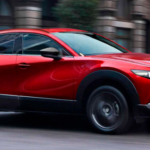 Mazda CX-30 Fuel Tank Size: How Many Litres Does It Hold?
Driving at a steady, moderate speed will generally use less fuel than repeatedly accelerating or travelling at unnecessarily high speeds.
For long-distance Australian road trips, both the G20 and G25 can deliver respectable fuel economy.
Mazda CX-30 Fuel Tank Capacity Australia
Fuel tank capacity is another important consideration because it affects how frequently drivers need to stop for petrol.
The Australian Mazda CX-30 has different fuel tank capacities depending on the drivetrain.
| Mazda CX-30 Version | Fuel Tank Capacity |
|---|---|
| G20 2.0L FWD | 51 litres |
| G25 2.5L FWD | 51 litres |
| G25 2.5L AWD | 48 litres |
The AWD model has a slightly smaller fuel tank than the front-wheel-drive versions.
Combined with its higher fuel consumption, this means the AWD model generally offers a shorter driving range between refuelling stops.
How Far Can a Mazda CX-30 Travel on a Full Tank?
We can estimate the Mazda CX-30's theoretical driving range by dividing its fuel tank capacity by its fuel consumption.
Using official combined figures produces the following results:
| Mazda CX-30 Version | Estimated Full-Tank Range |
|---|---|
| G20 2.0L FWD | 810 km |
| G25 2.5L FWD | 773 km |
| G25 2.5L AWD | 706 km |
These estimates assume the entire nominal fuel tank capacity is used at the official combined consumption rate.
In practice, drivers should expect a lower usable range because consumption varies, and it's advisable to refuel before the tank is completely empty.
Mazda CX-30 Range During Road Trips
Imagine planning a road trip from Melbourne to Canberra.
A CX-30 G20 travelling efficiently on highways could potentially cover a substantial portion of the journey without needing additional petrol.
However, driving range will depend on traffic, speed, weather and luggage weight.
For longer journeys through regional Australia, it's still important to plan refuelling stops rather than relying entirely on the estimated range displayed by the vehicle.
Mazda CX-30 Fuel Costs in Australia
Knowing fuel consumption is useful, but many Australian buyers are more interested in how much they'll actually spend on petrol.
We can estimate annual petrol expenses using the official combined consumption figures.
For this example, we'll assume:
- Petrol price: A$2.00 per litre.
- Annual distance: 15,000 kilometres.
- Consumption based on official combined-cycle ratings.
Estimated Annual Petrol Costs
| Mazda CX-30 Version | Annual Fuel Consumption | Estimated Annual Cost |
|---|---|---|
| G20 2.0L FWD | 945 litres | A$1,890 |
| G25 2.5L FWD | 990 litres | A$1,980 |
| G25 2.5L AWD | 1,020 litres | A$2,040 |
Under these assumptions, choosing the G20 instead of the G25 AWD could save approximately A$150 annually.
Over five years, the theoretical saving would be around A$750, assuming unchanged fuel prices, distances and consumption.
Interestingly, this illustrates that the fuel cost difference between the engines is relatively modest when using official figures.
Purchase price, insurance, maintenance and depreciation could have a greater impact on overall ownership costs.
What If Your Real-World Consumption Is Higher?
Suppose you drive 15,000 kilometres annually and average 8.5 L/100km instead of 6.3 L/100km.
At A$2.00 per litre, your annual petrol expense would rise to approximately A$2,550.
That's A$660 more than the official-rating calculation for the G20.
This is why real-world fuel economy is especially important for Australian drivers who regularly encounter heavy traffic.
One advantage of the Australian Mazda CX-30 petrol range is that it doesn't require expensive premium unleaded fuel for normal operation.
According to Mazda's Australian specifications, the G20 and G25 engines can use:
91 RON regular unleaded petrol or compatible E10 fuel.
This can help reduce running costs compared with vehicles that require 95 or 98 RON premium petrol.
Some drivers believe filling their CX-30 with 95 or 98 RON petrol will automatically improve efficiency.
However, higher-octane fuel doesn't necessarily deliver meaningful fuel savings in an engine designed to operate on regular unleaded.
Even if there were a small improvement under certain conditions, it might not offset the higher price per litre.
For normal driving, using the fuel grade recommended by Mazda is generally the most practical approach.
Always check the owner's manual and fuel-filler information for your particular vehicle.
Is the Mazda CX-30 Fuel-Efficient Compared With Other SUVs?
The Mazda CX-30 offers competitive fuel consumption among conventional petrol-powered compact SUVs, but it isn't necessarily the most economical option in its class.
Several competitors offer hybrid powertrains that can consume considerably less fuel, particularly in urban traffic.
Mazda CX-30 vs Toyota Corolla Cross Hybrid
The Toyota Corolla Cross Hybrid focuses strongly on fuel efficiency.
Its petrol-electric hybrid system can reduce fuel consumption significantly during stop-start driving.
Consequently, drivers who spend most of their time commuting through busy Australian cities may achieve lower petrol costs with the Corolla Cross Hybrid.
However, the Mazda CX-30 remains attractive because of its interior quality, conventional petrol powertrains and engaging handling.
Mazda CX-30 vs Hyundai Kona
The Hyundai Kona is another popular alternative in Australia's small SUV segment.
The Kona offers petrol and hybrid configurations, and fuel efficiency varies considerably between them.
A Kona Hybrid is generally a more economical choice for drivers whose priority is reducing fuel consumption.
On the other hand, buyers who prioritise steering feel, cabin presentation and traditional driving characteristics may prefer the Mazda.
Mazda CX-30 vs Kia Seltos
The Kia Seltos competes directly with the Mazda CX-30.
Both offer conventional petrol engines in the Australian market, although specifications vary by variant.
Fuel economy differences depend on engine size, transmission, drivetrain and driving conditions.
We recommend comparing equivalent versions rather than assuming one model is always more economical.
Why Does My Mazda CX-30 Use So Much Petrol?
Some owners may notice that their Mazda CX-30 consumes more fuel than expected.
For example, an indicated average of 9 or 10 L/100km can seem disappointing compared with an official figure of 6.3 L/100km.
However, increased consumption doesn't automatically indicate a mechanical problem.
Several factors can explain the difference.
1. Heavy Stop-Start Traffic
Driving in congested conditions requires frequent acceleration and braking.
This content may interest you! Chery Tiggo 4 Fuel Consumption Australia: Petrol vs Hybrid and Real-World Economy
This is one of the biggest reasons real-world fuel consumption can exceed laboratory ratings.
2. Aggressive Acceleration
Rapid acceleration requires additional fuel.
The G25's stronger performance can encourage more enthusiastic driving, which may increase petrol consumption.
3. Incorrect Tyre Pressure
Underinflated tyres increase rolling resistance.
Checking tyre pressures regularly can help maintain efficiency and support tyre longevity.
Always use the pressures recommended for your vehicle and load.
4. Short Journeys
Repeated short trips can increase petrol consumption because the engine may not reach its ideal operating temperature.
This is particularly relevant for drivers who only travel a few kilometres at a time.
5. Additional Vehicle Weight
Carrying heavy luggage, equipment or multiple passengers increases the energy required to accelerate and climb hills.
Although the difference may be small during occasional trips, regularly carrying unnecessary weight can affect efficiency.
6. Mechanical Maintenance
Dirty air filters, incorrect tyre pressures, worn spark plugs or other maintenance-related issues may negatively affect performance and efficiency.
If fuel consumption increases suddenly without an obvious explanation, having the vehicle inspected is a sensible precaution.
How to Improve Mazda CX-30 Fuel Economy
Fortunately, several straightforward driving habits can help reduce Mazda CX-30 petrol consumption.
Maintain a Consistent Speed
Avoid unnecessary acceleration and braking whenever possible.
Anticipating traffic conditions can make driving smoother and more efficient.
Check Tyre Pressure Regularly
Correct tyre pressures reduce unnecessary rolling resistance and help maintain predictable handling.
Checking them when the tyres are cold is generally recommended.
Reduce Unnecessary Weight
Remove heavy items from the boot when they're no longer needed.
Roof racks and external accessories can also increase aerodynamic drag, particularly during highway driving.
Avoid Excessive Idling
Leaving the engine running unnecessarily consumes petrol without covering any distance.
The CX-30's i-stop system can reduce fuel use during appropriate stationary conditions, although its operation depends on several factors.
Keep Up With Scheduled Maintenance
Following Mazda's recommended service schedule helps maintain engine performance and overall reliability.
Using the correct engine oil and ensuring the vehicle remains mechanically sound can also support efficient operation.
Use Air Conditioning Sensibly
Air conditioning increases engine load, especially during hot Australian summers.
There's no need to avoid using it, but selecting a reasonable temperature and avoiding unnecessary cooling can help manage fuel consumption.
Mazda CX-30 G20 vs G25: Which Is Better for Fuel Economy?
Choosing between the G20 and G25 depends on whether efficiency or additional performance matters more.
| Feature | Mazda CX-30 G20 | Mazda CX-30 G25 |
|---|---|---|
| Engine | 2.0L petrol | 2.5L petrol |
| Official combined fuel economy | 6.3 L/100km | 6.6–6.8 L/100km |
| Performance | Adequate for everyday driving | Stronger acceleration |
| Drivetrain | FWD | FWD or AWD |
| Petrol costs | Lower | Slightly higher |
| Ideal use | Urban commuting | Mixed driving and highways |
Why Choose the G20?
The G20 makes sense for buyers who want a comfortable small SUV without paying extra for engine performance they rarely use.
It provides adequate power for everyday driving and achieves the best official fuel economy in the Australian CX-30 range.
Why Choose the G25?
The G25 is worth considering if you regularly travel on highways, overtake slower vehicles or drive through hilly terrain.
Its additional power and torque can make the vehicle feel more relaxed under load.
Importantly, the official consumption penalty for choosing the G25 FWD over the G20 is relatively small.
For some buyers, the improved performance will justify the additional petrol expense.
Mazda CX-30 Fuel Consumption by Model Year
Not every Mazda CX-30 sold in Australia has exactly the same fuel consumption rating.
The model has received powertrain and equipment updates since its Australian introduction.
Earlier G20 versions had different official consumption figures from the updated models.
For example, previous 2.0-litre petrol variants were rated at approximately 6.5 L/100km, while updated G20 versions improved to 6.3 L/100km.
Australia also previously received mild-hybrid CX-30 variants, including G20e and X20 models, which are no longer part of the current Australian range.
Consequently, buyers considering a used CX-30 should check the exact model year, engine and drivetrain rather than assuming current specifications apply to older vehicles.
Is the Mazda CX-30 Economical for Australian Families?
For a small family, the Mazda CX-30 offers a reasonable balance between fuel economy, comfort and everyday practicality.
Its conventional petrol engines are relatively straightforward compared with some hybrid systems, and the ability to use regular unleaded petrol helps keep refuelling costs manageable.
However, the CX-30 is not designed primarily to deliver class-leading fuel consumption.
Families who travel long distances every year or spend substantial time in congested urban traffic may benefit financially from considering a hybrid alternative.
On the other hand, drivers who value the Mazda's cabin design, driving experience and build quality may be perfectly satisfied with its fuel economy.
Frequently Asked Questions About Mazda CX-30 Fuel Consumption Australia
1. What is the Mazda CX-30 fuel consumption in Australia?
The Australian Mazda CX-30 has official combined fuel consumption figures of 6.3 L/100km for the G20 2.0-litre FWD, 6.6 L/100km for the G25 2.5-litre FWD and 6.8 L/100km for the G25 AWD. These figures apply to the updated petrol powertrains.
2. Is the Mazda CX-30 good on petrol?
Yes, the Mazda CX-30 offers reasonable fuel economy for a conventional petrol-powered compact SUV. However, it generally consumes more fuel than comparable fuel-efficient hybrid SUVs, particularly in heavy urban traffic.
3. How many kilometres can a Mazda CX-30 travel on a full tank?
Using official combined consumption figures, the theoretical full-tank range is approximately 810 kilometres for the G20 FWD, 773 kilometres for the G25 FWD and 706 kilometres for the G25 AWD. Actual driving range varies and drivers should refuel before the tank is completely empty.
4. Does the Mazda CX-30 require 95 or 98 petrol in Australia?
No. The current Australian G20 and G25 petrol engines are compatible with 91 RON regular unleaded and suitable E10 petrol. Premium fuel is not required for normal operation, provided the vehicle is used in accordance with Mazda's recommendations.
5. Which Mazda CX-30 engine is the most fuel-efficient?
The Mazda CX-30 G20 2.0-litre petrol engine is the most fuel-efficient current Australian option, with an official combined consumption figure of 6.3 L/100km. The G25 uses slightly more fuel but offers stronger performance.
Conclusion: Is the Mazda CX-30 Fuel-Efficient in Australia?
The Mazda CX-30 delivers respectable fuel economy for a conventional petrol-powered small SUV, although it isn't the most efficient vehicle in its segment.
With official combined consumption ranging from 6.3 to 6.8 L/100km, the CX-30 strikes a reasonable balance between performance, practicality and everyday running costs.
For drivers who prioritise fuel efficiency, we believe the G20 2.0-litre FWD is the most sensible option. It offers the lowest official petrol consumption and should suit most urban and suburban driving requirements.
However, the G25 FWD deserves consideration because its additional performance comes with only a modest increase in official fuel consumption.
The G25 AWD is less economical, but its additional traction may appeal to drivers who regularly encounter challenging road conditions.
This content may interest you! Kia Tasman Fuel Economy Australia: Diesel Consumption, Real-World Range and Running Costs
Ultimately, the Mazda CX-30 is a good choice for Australian buyers who want a stylish, comfortable and enjoyable SUV with reasonable petrol costs, provided they understand that real-world consumption may be higher than Mazda's official figures.
If reducing fuel expenses is your absolute priority, a hybrid SUV may be worth comparing. But for buyers seeking a balanced petrol-powered compact SUV, the Mazda CX-30 remains a compelling option.
Leave a Reply