
Mazda CX-30 Weight: How Much Does the Mazda CX-30 Weigh in Australia?

The Mazda CX-30 is one of Australia's popular small SUVs, offering a combination of stylish design, comfortable driving dynamics and practical everyday performance. However, if you're considering buying one, you might be wondering: how much does the Mazda CX-30 weigh?
Understanding a vehicle's weight is useful for several reasons. It can influence fuel consumption, acceleration, handling, towing capability and even the amount of luggage and passengers you can safely carry.
The Mazda CX-30 weight in Australia ranges from approximately 1,458 kg to 1,533 kg for the updated 2026 model range, depending on the engine, drivetrain and equipment level.
The lighter versions generally feature a 2.0-litre petrol engine and front-wheel drive, while the heavier configurations combine a 2.5-litre petrol engine with all-wheel drive.
In this guide, we'll explore the Mazda CX-30's kerb weight across different variants, explain the difference between kerb weight and gross vehicle mass, and examine how vehicle weight affects performance, fuel efficiency and practicality.
- How Much Does the Mazda CX-30 Weigh?
- Mazda CX-30 Kerb Weight by Model in Australia
- What Is the Mazda CX-30 Kerb Weight?
- Mazda CX-30 G20 Weight
- Mazda CX-30 G25 Weight
- Mazda CX-30 AWD Weight vs FWD Weight
- How Does Mazda CX-30 Weight Affect Fuel Consumption?
- Does Mazda CX-30 Weight Affect Acceleration?
- Mazda CX-30 Weight and Handling
- Mazda CX-30 Weight and Towing Capacity
- Mazda CX-30 Payload Capacity
- Mazda CX-30 Weight in Pounds and Tonnes
- Mazda CX-30 Weight Compared With Other SUVs
- Mazda CX-30 Dimensions and Weight
- Does Mazda CX-30 Weight Change Between Model Years?
- Is the Mazda CX-30 Weight Good for Everyday Driving?
- Frequently Asked Questions About Mazda CX-30 Weight
- Conclusion: How Heavy Is the Mazda CX-30?
How Much Does the Mazda CX-30 Weigh?
The Mazda CX-30 is classified as a small SUV, and its weight reflects its balance between compact dimensions, passenger comfort and structural rigidity.
For Australian buyers, the updated 2026 Mazda CX-30 range includes two primary petrol engine options:
- G20: 2.0-litre Skyactiv-G petrol engine.
- G25: 2.5-litre Skyactiv-G petrol engine.
Most variants use front-wheel drive (FWD), although the G25 Astina is also available with Mazda's i-Activ all-wheel-drive system.
Here is a breakdown of the kerb weight for the updated Australian model range.
Mazda CX-30 Kerb Weight by Model in Australia
| Mazda CX-30 variant | Drivetrain | Kerb weight |
|---|---|---|
| G20 Pure | FWD | 1,458 kg |
| G20 Evolve | FWD | 1,458 kg |
| G20 Touring | FWD | 1,458 kg |
| G25 Evolve SP | FWD | 1,464 kg |
| G20 Astina | FWD | 1,469 kg |
| G25 GT | FWD | 1,475 kg |
| G25 GT SP | FWD | 1,475 kg |
| G25 Astina | FWD | 1,475 kg |
| G25 Astina | AWD | 1,533 kg |
These are Mazda Australia's published kerb-weight specifications for the updated range. Figures for earlier model years may differ. mazda.com.au
As we can see, the G20 models are generally lighter, while the AWD version of the G25 Astina is the heaviest configuration.
The difference between the lightest and heaviest versions is approximately 75 kg.
Although this might seem relatively small, additional vehicle weight can influence several aspects of everyday driving.
What Is the Mazda CX-30 Kerb Weight?
Before comparing different variants, it's important to understand what kerb weight actually means.
Kerb weight generally refers to the weight of a vehicle in its standard operating condition, including necessary fluids and fuel according to the manufacturer's measurement convention, but without passengers or luggage.
It is not the same as the maximum weight the vehicle is permitted to carry.
For example, a Mazda CX-30 G20 Pure with a published kerb weight of 1,458 kg will weigh more once we add passengers, shopping bags, luggage and other personal belongings.
Kerb Weight vs Gross Vehicle Mass
These two measurements are frequently confused.
Kerb weight describes the vehicle's weight in its specified unloaded condition.
Gross Vehicle Mass (GVM) represents the maximum permissible total weight of the vehicle when loaded, including passengers, luggage, cargo and accessories.
The difference between these figures helps determine how much additional weight the car can legally carry.
We should always check the exact vehicle's compliance information or official specifications before calculating its available payload.
Kerb Weight vs Tare Weight
Australian vehicle specifications sometimes include tare weight as well.
Tare weight and kerb weight are closely related, but they are not necessarily identical.
Tare weight is measured under a particular definition that may involve a specified amount of fuel and standard equipment.
Because measurement conventions vary, we shouldn't assume that tare weight and kerb weight can be used interchangeably.
Mazda CX-30 G20 Weight
The Mazda CX-30 G20 uses a naturally aspirated 2.0-litre four-cylinder petrol engine.
In the updated Australian range, this engine produces approximately 114 kW of power and 200 Nm of torque.
The G20 is generally the lighter engine option, making it an attractive choice for drivers who prioritise everyday commuting and fuel efficiency.
Mazda CX-30 G20 Pure Weight
The G20 Pure has a kerb weight of approximately 1,458 kg.
As the entry-level variant, it offers a relatively straightforward equipment package while retaining the main safety and comfort features expected from a modern Mazda SUV.
Its combination of a 2.0-litre engine and front-wheel drive makes it suitable for:
- Urban commuting.
- Everyday family transport.
- Highway journeys.
- Drivers seeking relatively economical running costs.
Mazda CX-30 G20 Evolve Weight
The G20 Evolve also has a published kerb weight of approximately 1,458 kg.
Despite offering additional convenience features compared with the Pure, its official weight figure remains the same.
This makes the Evolve an interesting option for buyers who want additional equipment without a substantial increase in vehicle mass.
Mazda CX-30 G20 Touring Weight
The G20 Touring weighs approximately 1,458 kg according to the updated Australian specifications.
Like the other G20 models, it combines the 2.0-litre engine with a six-speed automatic transmission and front-wheel drive.
Its weight contributes to the CX-30's balance between comfortable road manners and predictable handling.
Mazda CX-30 G20 Astina Weight
The G20 Astina is a more extensively equipped version of the 2.0-litre model.
It weighs approximately 1,469 kg, making it slightly heavier than the lower G20 variants.
Additional comfort features and equipment can contribute to this difference.
Nevertheless, the weight increase is relatively modest.
Mazda CX-30 G25 Weight
The Mazda CX-30 G25 features a larger 2.5-litre naturally aspirated four-cylinder petrol engine.
For Australian models, this engine produces approximately 139 kW and 252 Nm.
Compared with the G20, the G25 delivers stronger performance, particularly when accelerating onto highways or travelling with passengers and luggage.
The G25 versions generally weigh more than their G20 counterparts, although the difference in front-wheel-drive form is relatively small.
Mazda CX-30 G25 Evolve SP Weight
The updated G25 Evolve SP weighs approximately 1,464 kg.
This model combines the larger engine with front-wheel drive.
Despite its additional engine capacity, the G25 Evolve SP is only slightly heavier than the G20 Pure.
Mazda CX-30 G25 GT Weight
The G25 GT has a kerb weight of approximately 1,475 kg.
It offers a more premium equipment package, including additional comfort features.
The higher weight reflects the overall vehicle configuration rather than engine size alone.
Mazda CX-30 G25 GT SP Weight
The G25 GT SP also weighs approximately 1,475 kg.
This version features distinctive styling and a more sporting appearance.
However, its exterior design doesn't necessarily translate into a significantly different overall kerb weight.
This content may interest you!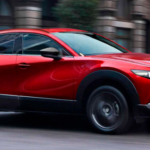 Mazda CX-30 Specifications Australia: Complete 2026 Guide
Mazda CX-30 G25 Astina Weight
The G25 Astina is available in both front-wheel-drive and all-wheel-drive configurations.
Its published kerb weights are:
- G25 Astina FWD: 1,475 kg.
- G25 Astina AWD: 1,533 kg.
The AWD version is approximately 58 kg heavier than its front-wheel-drive equivalent.
This additional weight primarily reflects the extra mechanical components required to distribute power to all four wheels.
Mazda CX-30 AWD Weight vs FWD Weight
One of the most important factors affecting Mazda CX-30 weight is the drivetrain.
Front-wheel-drive models use the front wheels to provide propulsion.
All-wheel-drive vehicles incorporate additional mechanical components to transfer power to the rear wheels when required.
These can include a driveshaft, rear differential, additional axles and related equipment.
G25 Astina: front-wheel drive vs all-wheel drive
FWD
1,475 kg
AWD
1,533 kg
AWD adds approximately 58 kg, or 3.9%, compared with the FWD G25 Astina.
Is the AWD Mazda CX-30 Too Heavy?
Not necessarily.
The extra weight of the AWD system can be worthwhile for drivers who regularly encounter slippery roads, wet conditions or changing traction levels.
Mazda's i-Activ AWD system is designed to improve traction by adjusting power distribution when required.
However, AWD doesn't eliminate the need for appropriate tyres or careful driving.
For motorists who spend most of their time travelling on sealed urban roads, the lighter FWD version may be sufficient.
How Does Mazda CX-30 Weight Affect Fuel Consumption?
Vehicle weight is one factor influencing fuel consumption.
Generally, a heavier vehicle requires more energy to accelerate, particularly when driving in stop-start traffic.
However, overall efficiency also depends on engine design, aerodynamics, transmission, drivetrain and driving conditions.
For Australian versions of the Mazda CX-30, the official combined fuel-consumption figures are approximately:
| Engine and drivetrain | Combined fuel consumption |
|---|---|
| G20 2.0L FWD | 6.3 L/100 km |
| G25 2.5L FWD | 6.6 L/100 km |
| G25 2.5L AWD | 6.8 L/100 km |
These are laboratory-based Australian test figures rather than guaranteed real-world results.
The lighter G20 models have a small fuel-efficiency advantage over the larger-engine variants.
However, the G25 offers additional power that some drivers may find worthwhile, especially when overtaking or travelling with a full load.
Does Extra Luggage Increase Fuel Consumption?
Yes, carrying additional weight can increase fuel consumption.
For example, a CX-30 travelling with four adults and luggage will generally require more energy than the same vehicle travelling with only the driver.
The effect is particularly noticeable during repeated acceleration.
We can help maintain efficiency by removing unnecessary items from the boot and avoiding carrying heavy equipment that isn't needed.
Does Mazda CX-30 Weight Affect Acceleration?
Weight influences how quickly a vehicle accelerates, but it should always be considered alongside engine output and gearing.
The G20 has less power but also generally weighs less.
The G25 is slightly heavier, although its substantially greater engine output can provide stronger acceleration.
This becomes particularly noticeable when:
- Joining a motorway.
- Overtaking slower vehicles.
- Travelling uphill.
- Carrying several passengers.
- Driving with a heavily loaded boot.
For drivers who frequently undertake long-distance highway journeys, the G25 may provide a more relaxed driving experience.
Nevertheless, the G20 remains capable of handling ordinary commuting and highway travel.
Mazda CX-30 Weight and Handling
The Mazda CX-30 has been designed to deliver car-like driving characteristics in a small SUV body.
Weight plays an important role in this behaviour.
A vehicle's total mass, weight distribution and centre of gravity all influence how it responds when steering, braking and cornering.
Is the Mazda CX-30 a Heavy SUV?
Compared with larger SUVs, the CX-30 is relatively compact and light.
Its kerb weight of approximately 1.46 to 1.53 tonnes places it within the expected range for a modern small SUV equipped with contemporary safety systems and comfort features.
We wouldn't consider the CX-30 excessively heavy for its class.
However, it is generally heavier than a smaller conventional hatchback with less ground clearance and fewer SUV-oriented features.
How Weight Affects Braking
A heavier vehicle carries more kinetic energy at a given speed.
This means additional vehicle mass can increase the demands placed on the braking system.
When travelling with passengers and luggage, drivers should allow adequate following distances and adjust their driving to suit the conditions.
Tyre condition, road surface, brake performance and vehicle speed remain particularly important.
Mazda CX-30 Weight and Towing Capacity
If you're planning to tow a small trailer, understanding the relationship between vehicle weight and towing capacity is essential.
The Australian Mazda CX-30 has published towing limits of:
| Towing specification | Maximum |
|---|---|
| Braked trailer | 1,200 kg |
| Unbraked trailer | 600 kg |
| Tow-ball download | 80 kg |
These ratings apply when the vehicle is fitted with the appropriate genuine Mazda towing kit and are subject to relevant regulations.
Can the Mazda CX-30 Tow a Trailer?
Yes, the Mazda CX-30 can tow a suitably sized trailer within its approved limits.
Potential applications include small utility trailers and lightweight recreational equipment.
However, the maximum permitted trailer weight is not determined by kerb weight alone.
We also need to consider the vehicle's GVM, gross combination mass where applicable, tow-ball load and the trailer's actual loaded weight.
Does AWD Increase Towing Capacity?
Not automatically.
This content may interest you!Mazda CX-30 Fuel Type Australia: Does It Need 91, 95 or 98 Petrol?Although the AWD system can provide additional traction, Mazda's published Australian CX-30 braked towing capacity is 1,200 kg across the updated range.
Therefore, buyers shouldn't assume that choosing the heavier AWD variant will allow them to tow a heavier trailer.
Mazda CX-30 Payload Capacity
Payload describes the additional load a vehicle can carry beyond its unloaded weight, within the manufacturer's mass limits.
This includes passengers, luggage, equipment and accessories.
For example, consider a family travelling in a CX-30 with:
- Driver: 80 kg.
- Front passenger: 70 kg.
- Two rear passengers: 120 kg combined.
- Luggage: 60 kg.
The total additional load would be 330 kg.
This figure must be assessed against the specific vehicle's permitted payload and axle limits.
It would be incorrect to assume that every Mazda CX-30 variant has an identical available payload.
Additional accessories, such as roof racks or towing equipment, can also reduce the remaining load allowance.
Can You Overload a Mazda CX-30?
Yes, like any passenger vehicle, the CX-30 can be overloaded.
Exceeding its permitted weight limits may compromise handling, braking, tyre performance and mechanical durability.
It can also create legal and insurance-related problems.
For this reason, we recommend checking the exact vehicle specifications before carrying unusually heavy cargo or towing.
Mazda CX-30 Weight in Pounds and Tonnes
Although kilograms are used in Australia, some international specifications express vehicle weight in pounds.
The updated Mazda CX-30 weighs approximately:
| Measurement | Weight range |
|---|---|
| Kilograms | 1,458–1,533 kg |
| Metric tonnes | 1.458–1.533 tonnes |
| Pounds | 3,214–3,380 lb |
This makes it straightforward to compare the Australian Mazda CX-30 with international vehicles.
Remember that specifications for overseas CX-30 models can vary due to different engines, drivetrains, equipment and market requirements.
Mazda CX-30 Weight Compared With Other SUVs
The CX-30 competes in a crowded Australian small SUV market.
Its competitors include the Toyota Corolla Cross, Hyundai Kona, Kia Seltos and Subaru Crosstrek.
Vehicle weight can vary significantly depending on whether a competitor uses a petrol engine, hybrid powertrain or all-wheel drive.
| SUV | General weight comparison |
|---|---|
| Mazda CX-30 | Around 1.46–1.53 tonnes for updated Australian models |
| Toyota Corolla Cross | Varies by petrol or hybrid configuration |
| Hyundai Kona | Varies by engine and drivetrain |
| Kia Seltos | Varies by engine and drivetrain |
| Subaru Crosstrek | AWD equipment contributes to overall weight |
Rather than comparing kerb weight alone, we should consider engine performance, fuel economy, handling and practicality.
A lighter vehicle isn't necessarily the better option.
Similarly, a heavier SUV may offer additional equipment, greater traction or different structural characteristics.
Mazda CX-30 Dimensions and Weight
Vehicle dimensions help explain how the Mazda CX-30 combines SUV practicality with manageable overall weight.
The updated Australian model has the following dimensions:
| Dimension | Measurement |
|---|---|
| Length | 4,395 mm |
| Width | 1,795 mm |
| Height | 1,540 mm |
| Wheelbase | 2,655 mm |
| Ground clearance, unladen | 180 mm |
| Boot capacity, VDA | 317 litres |
These measurements place the CX-30 firmly within the small SUV category.
Its overall length makes it relatively manageable for urban parking, while its elevated body provides additional ground clearance compared with many conventional passenger cars.
However, ground clearance and vehicle weight are separate measurements.
A higher ride height doesn't necessarily mean a vehicle is heavier, and overall mass depends on many factors beyond exterior dimensions.
Does Mazda CX-30 Weight Change Between Model Years?
Yes, Mazda CX-30 weight figures can vary between different production years and specifications.
Since the model's introduction, Mazda has made changes to the Australian range, including equipment updates, engine configurations and available variants.
For example, earlier CX-30 models included different engine and mild-hybrid configurations depending on the year.
These changes can affect kerb weight.
The updated 2026 Australian range also includes revised model grades and equipment packages.
If you're buying a used CX-30, we recommend checking the specifications for its exact model year rather than relying exclusively on current figures.
How to Find Your Mazda CX-30's Exact Weight
There are several ways to confirm the correct specifications.
- Check the official specifications for the exact model year and variant.
- Inspect the vehicle's compliance information and manufacturer identification labels for applicable mass ratings.
- Review the owner's manual for loading and towing requirements.
- Ask a Mazda dealership to confirm specifications using the vehicle identification number.
For practical loading calculations, it's particularly important to identify the correct GVM and axle limits rather than relying only on kerb weight.
Is the Mazda CX-30 Weight Good for Everyday Driving?
For most Australian drivers, the CX-30 offers a reasonable balance between overall mass, performance and practicality.
The G20 variants are relatively economical and well suited to daily commuting.
The G25 models offer more power while adding relatively little weight in front-wheel-drive configurations.
Meanwhile, the AWD Astina provides additional traction capability, although it is heavier than the FWD version.
We believe the best configuration depends more on your driving requirements than on the difference in kerb weight alone.
For city driving and everyday commuting, the G20 can be a sensible choice.
For drivers who frequently travel on highways or carry passengers, the G25's additional performance may be appealing.
And for motorists who value the traction benefits of AWD, the G25 Astina AWD is worth considering.
Frequently Asked Questions About Mazda CX-30 Weight
1. How much does a Mazda CX-30 weigh in Australia?
The updated Australian Mazda CX-30 has a kerb weight ranging from approximately 1,458 kg to 1,533 kg, depending on the engine, equipment and drivetrain. The G20 Pure is among the lightest variants, while the G25 Astina AWD is the heaviest.
2. How much does the Mazda CX-30 G20 weigh?
The G20 Pure, Evolve and Touring have published kerb weights of approximately 1,458 kg. The G20 Astina weighs around 1,469 kg in the updated Australian range. Figures may differ for earlier model years.
3. How much does the Mazda CX-30 AWD weigh?
The updated Mazda CX-30 G25 Astina AWD weighs approximately 1,533 kg. This is around 58 kg heavier than the equivalent front-wheel-drive G25 Astina, primarily because of the additional all-wheel-drive components.
4. Is the Mazda CX-30 heavier than the Mazda3?
Generally, the Mazda CX-30 is heavier than a comparable Mazda3 hatchback or sedan. The CX-30 has a taller SUV body and different chassis and equipment requirements. However, the exact difference depends on the engine, model year and specifications being compared.
5. What is the maximum towing capacity of the Mazda CX-30?
The updated Australian Mazda CX-30 has a maximum braked towing capacity of 1,200 kg and an unbraked towing capacity of 600 kg when appropriately equipped. The maximum permitted tow-ball download is 80 kg. Drivers must also comply with the vehicle's loading limits and relevant towing regulations.
Conclusion: How Heavy Is the Mazda CX-30?
The Mazda CX-30 weighs between approximately 1,458 kg and 1,533 kg in Australia's updated 2026 range, making it a relatively compact SUV with a balanced approach to weight, comfort and performance.
The G20 models offer the lightest configurations, while the G25 versions provide stronger engine performance with only a modest increase in weight. The G25 Astina AWD is the heaviest model, reflecting its additional drivetrain components.
Although weight can affect acceleration, fuel economy, braking and handling, it shouldn't be the only factor when choosing a vehicle.
For most buyers, engine performance, fuel efficiency, interior comfort, safety equipment and everyday practicality are equally important.
Overall, the Mazda CX-30 offers a sensible balance between vehicle mass and driving capability, making it an appealing option for Australian motorists looking for a refined small SUV.
This content may interest you! Subaru Crosstrek Weight: Kerb Weight, Payload and GVM Explained
Leave a Reply