
Ford Everest vs Toyota Fortuner Australia: Which 4WD SUV Is Better?

The Ford Everest vs Toyota Fortuner Australia comparison has always been a fascinating one. Both are seven-seat, ute-based SUVs built for families who don't want their adventures to end when the bitumen does. Both offer proper diesel grunt, low-range four-wheel drive and genuine towing ability. And both have earned loyal followings among Australian drivers.
But in 2026, there is a rather large elephant sitting beside the campfire: the Toyota Fortuner has officially been discontinued in Australia. Toyota states that the Fortuner was discontinued from April 2026 and is no longer available for purchase as a new vehicle. The Ford Everest, meanwhile, continues with a broad range of variants and both four-cylinder and V6 turbo-diesel options.
That doesn't make this comparison irrelevant. Quite the opposite.
Used Fortuners remain appealing, especially if we want proven mechanical hardware, serious off-road ability and potentially lower purchase prices. The Everest is the more modern proposition, offering stronger towing capability, substantially more power in V6 form and a cabin that feels much closer to a contemporary family SUV.
So, which should we choose?
Let's climb into both.
- Ford Everest vs Toyota Fortuner Australia: Quick Verdict
- The Biggest Difference in 2026: The Fortuner Is No Longer New
- Engine Performance: Everest Has the Muscle Advantage
- Towing Capacity: Ford Everest Wins
- Off-Road Ability: Much Closer Than You Might Expect
- Ride Comfort: Everest Feels a Generation Newer
- Interior and Technology: Ford Pulls Away
- Seven-Seat Practicality: Everest Is the Better Family Tool
- Fuel Economy: Fortuner Remains Respectable
- Safety: Modernity Favours Everest
- Reliability and Long-Term Ownership
- Everest vs Fortuner for Australian Touring
- Ford Everest vs Toyota Fortuner Price and Value
- Which One Is Better for Towing a Caravan?
- Which One Is Better Off Road?
- Which Is Better as a Used Car?
- Ford Everest vs Toyota Fortuner Australia: Pros and Cons
- Who Should Buy the Ford Everest?
- Who Should Buy the Toyota Fortuner?
- Ford Everest vs Toyota Fortuner Australia: Final Verdict
- Frequently Asked Questions
Ford Everest vs Toyota Fortuner Australia: Quick Verdict
If we want the shortest possible answer, the Ford Everest is the better all-round SUV for most Australian families, particularly buyers shopping new or prioritising towing, technology, refinement and third-row usability.
The Toyota Fortuner fights back with simplicity, proven 2.8-litre diesel performance and legitimate off-road hardware. It can make particularly strong sense on the used market.
Think of the Fortuner as a rugged hiking boot: straightforward, tough and ready to get dirty.
The Everest is more like a modern Gore-Tex adventure boot. It can still cross the mud, but it's considerably nicer to wear on the way there.
Ford Everest vs Fortuner Key Specifications
| Specification | Ford Everest | Toyota Fortuner |
|---|---|---|
| Seating | Up to 7 | 7 |
| Diesel engines | 2.0L turbo / 3.0L V6 turbo | 2.8L turbo |
| V6 output | 184kW / 600Nm | Not available |
| Fortuner output | — | 150kW / 500Nm |
| Transmission | 10-speed automatic | 6-speed automatic |
| Maximum braked towing | 3,500kg | 3,100kg |
| 4WD | Part-time or full-time, depending on variant | Part-time 4x4 |
| Low range | Yes | Yes |
| Rear differential lock | Available | Yes |
| New-car availability in Australia | Yes | Discontinued April 2026 |
Ford specifies up to 3,500kg braked towing for the Everest when properly equipped, while Toyota rated the final Fortuner at 3,100kg. Toyota's 2.8-litre turbo-diesel produced 150kW and 500Nm, while Ford's Everest 3.0-litre V6 produces 184kW and 600Nm.
The Biggest Difference in 2026: The Fortuner Is No Longer New
Before getting buried in kilowatts, touchscreens and differential locks, we need to address the biggest change.
Toyota Australia explicitly states that the Fortuner was discontinued from April 2026 and is not available for purchase new.
That reshapes the comparison.
Someone walking into dealerships looking for a brand-new seven-seat diesel 4WD can still order an Everest. Ford Australia's current range includes Active, Sport, Tremor, Wildtrak and Platinum grades, with 2.0-litre and 3.0-litre V6 configurations available depending on model.
A Fortuner buyer will instead be looking mostly at used vehicles or possibly residual dealer stock if any exists independently.
Does That Make the Fortuner a Bad Buy?
Not at all.
It simply changes the question from:
"Which new SUV should we buy?"
to:
"Should we buy a newer Everest or save money with a used Fortuner?"
And that second question can be much closer.
Engine Performance: Everest Has the Muscle Advantage
Under the bonnet, the Everest has the broader hand.
The headline engine is Ford's 3.0-litre V6 turbo-diesel, producing 184kW and 600Nm through a 10-speed automatic transmission. Ford pairs this engine with full-time four-wheel drive in applicable Everest variants.
The final Australian Fortuner uses Toyota's familiar 2.8-litre four-cylinder turbo-diesel, producing 150kW and 500Nm, connected to a six-speed automatic.
That means the V6 Everest has a substantial 34kW and 100Nm advantage.
And we can feel the philosophy behind those numbers.
Toyota Fortuner 2.8 Diesel: Familiar and Purposeful
The Fortuner doesn't try to win a drag race.
Its 500Nm output is plenty for touring, hills, loaded family trips and low-speed off-road work. Toyota also used essentially the sort of heavy-duty diesel formula Australian buyers have trusted in vehicles from the broader HiLux family.
Push the accelerator and the Fortuner responds with a traditional diesel character: purposeful rather than silky.
There's charm in that.
For some buyers, particularly those travelling remotely, complexity isn't automatically a selling point. They may actively prefer a familiar four-cylinder diesel and six-speed automatic.
Ford Everest V6: Effortless Performance
The V6 Everest feels like the drivetrain Toyota never gave the Fortuner.
There is simply more in reserve.
With 600Nm available, accelerating onto a highway, overtaking with passengers aboard or pulling a caravan feels less stressful. Rather than constantly asking the engine for everything it has, we have a deeper well of torque available.
It's the difference between carrying a heavy suitcase ourselves and putting it on wheels. Both approaches get it there, but one requires considerably less drama.
What About the Everest 2.0-Litre?
Not every Everest uses the V6.
Ford's current Australian build-and-price information shows 2.0-litre turbo-diesel versions of the Active and Sport alongside V6 alternatives, while Tremor, Wildtrak and Platinum are listed with the 3.0-litre V6.
That gives Everest buyers something the outgoing Fortuner never really offered: meaningful drivetrain choice within the same model family.
Towing Capacity: Ford Everest Wins
Here the scoreboard is straightforward.
The Ford Everest can tow up to 3,500kg braked when correctly equipped, while the Toyota Fortuner was rated to 3,100kg braked.
That's a 400kg advantage to Ford.
For a small box trailer, that difference means practically nothing.
For owners pulling a large caravan, horse float or heavy boat, it can mean quite a lot.
Why the Everest Makes More Sense for Serious Towing
Maximum towing capacity isn't the whole story. Gross vehicle mass, gross combined mass, tow-ball download, passengers, accessories and luggage all matter.
Ford itself warns that when towing near the Everest's maximum limits, occupants or luggage may need to be restricted so the vehicle remains within GVM and GCM limits.
Still, having a 3,500kg ceiling gives us greater flexibility.
And if we're choosing the V6, the additional 100Nm over the Fortuner is appealing when we're hauling something shaped like a small apartment behind us.
Towing verdict: Everest.
Off-Road Ability: Much Closer Than You Might Expect
Don't confuse the Fortuner's age with softness.
Toyota equipped it with genuine four-wheel-drive hardware, including low-range 4WD and a rear differential lock. Toyota specifically marketed the Fortuner as a real off-roader rather than an SUV merely dressed for Instagram.
That's important.
Many modern SUVs resemble hiking equipment but panic when confronted with a muddy paddock.
The Fortuner actually wants to go exploring.
Toyota Fortuner Off Road
The Fortuner's relatively traditional construction and drivetrain make it easy to understand.
Select four-wheel drive, engage low range when necessary, lock the rear differential when traction becomes ugly and keep moving.
For rocky climbs, forestry tracks, beaches and remote touring, that straightforwardness remains attractive.
It's less digital Swiss Army knife and more well-sharpened axe.
Ford Everest Off Road
The Everest approaches the same challenge with newer engineering.
Ford offers part-time 4x4 on some models and full-time 4WD on V6 configurations, with selectable drive modes and model-dependent off-road equipment.
The Everest Tremor pushes the formula further. Ford quotes 255mm of ground clearance and 800mm water-wading capability for the current Tremor, while fitting the V6 diesel and full-time four-wheel-drive system as standard.
Which Is Better in the Bush?
The Fortuner remains highly capable, particularly when tyres and driver skill are equal.
But Everest gives us more choice.
Want a family-focused model that occasionally explores gravel roads? Fine.
Want the V6?
Available.
Want the more off-road-focused Tremor?
Also available.
For that breadth, we'd give Ford the overall advantage, although a well-prepared Fortuner is certainly no toy.
Ride Comfort: Everest Feels a Generation Newer
Here the differences become easier to notice.
Both vehicles share the fundamental ute-based SUV recipe, so neither behaves like a low-slung luxury crossover. Physics still sends the invoice.
But the Everest's newer platform, wider stance and more contemporary tuning make it feel more composed and polished for normal Australian driving.
On corrugated roads and imperfect country highways, the Fortuner's rugged personality can be more obvious. Its suspension communicates its ladder-frame origins more openly.
Some owners won't mind.
Others will.
Around Town
School runs expose weaknesses that mountain tracks don't.
We notice steering weight. Parking visibility. Transmission smoothness. Screen quality. Seat comfort. Noise. How easily children can climb aboard.
This is where Everest begins building a meaningful lead.
It feels designed not merely to survive Monday-to-Friday family duty but actually to be pleasant during it.
The Fortuner feels like an off-roader adapting itself to suburban life.
The Everest feels more like a modern family SUV that happens to have serious off-road bones underneath.
Interior and Technology: Ford Pulls Away
One of the clearest differences between these vehicles is interior age.
The Fortuner's final Australian specification remained functional but relatively modest. Toyota listed an 8-inch display audio system with Apple CarPlay and Android Auto across GX, GXL and Crusade grades, while higher variants added equipment such as satellite navigation and upgraded audio.
It works.
But in an era where car dashboards increasingly resemble command centres, it doesn't feel particularly ambitious.
The Everest presents itself as a much newer vehicle.
The Fortuner Cabin Is Simple Rather Than Flashy
There is something refreshing about a cabin we can understand within thirty seconds.
Buttons look like buttons. Controls behave like controls. We don't need a software engineering degree to change basic settings.
That simplicity can be valuable for owners keeping a vehicle long term.
This content may interest you!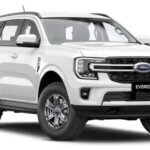 Ford Everest vs Ranger Australia: Which One Should We Buy?
Still, place a Fortuner beside a current Everest and the generation gap is hard to hide.
Everest's cabin architecture, digital interfaces and overall presentation bring it closer to road-focused family SUVs.
Higher variants push that impression further with more premium materials and technology.
If our 4WD spends 90% of its life commuting, carrying children and tackling holiday traffic rather than crossing the Simpson Desert, this matters enormously.
A rugged vehicle doesn't need to punish us for owning it.
Seven-Seat Practicality: Everest Is the Better Family Tool
Both vehicles can carry seven people. Toyota specifically promoted the Fortuner's flexible seven-seat configuration, while Ford continues to position Everest as a five- or seven-seat SUV depending on specification.
But merely having seven seatbelts isn't the same as being an excellent seven-seater.
Third-row accessibility, cabin width, luggage space with seats deployed and general packaging matter tremendously.
Everest for Growing Families
The Everest's newer packaging makes it easier to recommend for households intending to use all three seating rows regularly.
It simply feels more like the engineers expected families to spend substantial time back there.
If we're buying because we occasionally need two emergency seats for children, either vehicle can work.
If seven-seat use forms part of weekly life, we'd rather have the Everest.
Fortuner Still Works for Occasional Seven-Seat Duty
The Fortuner is perfectly useful when the rear seats are needed periodically.
And used examples could represent excellent value for buyers needing genuine 4WD ability plus seven seats without paying current-new-SUV money.
That's the Fortuner's emerging sweet spot in Australia.
Fuel Economy: Fortuner Remains Respectable
Toyota officially quoted 7.6L/100km combined for the final GX, GXL and Crusade versions under laboratory testing, while warning that real-world consumption will differ.
That's respectable for a diesel seven-seat ladder-frame 4WD.
Actual consumption for either SUV will vary dramatically with traffic, tyres, accessories, roof racks, towing, terrain, speed and payload.
And once we hitch a large caravan to the back, brochure fuel figures become more decorative than prophetic.
Still, buyers travelling huge annual distances should consider the Fortuner's relatively straightforward four-cylinder diesel as part of the ownership equation.
Safety: Modernity Favours Everest
Toyota equipped the final Fortuner with Toyota Safety Sense technology, including active cruise control, pre-collision safety, lane-departure alert and road-sign assistance. GX, GXL and Crusade also included seven SRS airbags according to Toyota's Australian specifications.
So this isn't a case of old vehicle equals no safety technology.
Far from it.
However, Everest's newer architecture and broader suite of contemporary driver-assistance and towing-related technology make it the model we'd prefer when comparing modern family transport.
Ford also offers towing-oriented driver aids on selected Everest models through optional equipment, including Pro Trailer Backup Assist on Sport, Tremor, Wildtrak and Platinum according to its current Australian disclosures.
Reliability and Long-Term Ownership
This category requires nuance.
It is tempting to simply write "Toyota wins reliability" and move on. That's too simplistic.
Toyota has enormous brand equity among Australian 4WD owners, and the Fortuner's 2.8-litre diesel drivetrain is familiar technology. That familiarity matters to people travelling beyond major cities, where mechanical simplicity and access to service knowledge can carry real value.
The Everest, meanwhile, offers more performance and technology, but more sophistication can also mean more systems for long-term owners to consider.
Why Used Fortuners May Become More Appealing
Discontinuation could actually sharpen the Fortuner's identity.
It is no longer trying to compete with newer vehicles on showroom sparkle.
Instead, it becomes a used-buy proposition for someone thinking:
"I want a proper seven-seat diesel Toyota 4WD, and I don't care whether the screen looks fashionable."
That's a compelling brief.
But we'd still insist on a detailed service history and pre-purchase inspection. A neglected 4WD wearing a Toyota badge remains a neglected 4WD.
Everest vs Fortuner for Australian Touring
Australia has a habit of turning simple road trips into endurance tests.
A weekend away can involve 600 kilometres of highway, 100 kilometres of rough road, a beach section, a caravan park, two tired children, one questionable servo sandwich and enough luggage to relocate a small household.
This is exactly where the Everest's versatility shines.
It is comfortable enough for the motorway, capable enough for difficult terrain and powerful enough for demanding towing.
The Fortuner performs the same tasks, but with a stronger emphasis on traditional ruggedness.
Choose the Everest If You Want One Vehicle to Do Everything
The Everest particularly suits us if we regularly mix:
- Family commuting and school runs
- Long-distance touring
- Caravan or boat towing
- Seven-seat passenger duty
- Off-road travel
- Modern infotainment and convenience features
- New-car ownership and current model availability
The Fortuner's case is narrower now, but still meaningful: it appeals to used-car buyers prioritising Toyota familiarity, traditional diesel 4WD hardware and potentially lower acquisition costs.
Ford Everest vs Toyota Fortuner Price and Value
Direct price comparisons have become awkward because Toyota no longer offers the Fortuner new in Australia.
Ford's current Australian range continues across Active, Sport, Tremor, Wildtrak and Platinum, while Ford directs buyers to its build-and-price system for current location-dependent pricing.
Toyota, by contrast, now lists Fortuner drive-away pricing as unavailable because the model has been discontinued.
That means value needs to be assessed vehicle by vehicle.
A clean late-model Fortuner at the right used price could be superb value.
But if its price creeps too close to a newer Everest, the equation becomes harder to defend because Ford offers newer design, more towing capacity, greater engine choice and considerably stronger V6 performance.
Which One Is Better for Towing a Caravan?
Everest.
Its 3,500kg maximum braked towing rating beats the Fortuner's 3,100kg, and the V6 supplies 600Nm rather than 500Nm.
That doesn't mean every Everest can automatically tow a 3.5-tonne caravan while filled with seven people and luggage. Payload, tow-ball download, GVM and GCM limits still need to be calculated carefully.
But as a starting platform for serious touring, Ford gives us more headroom.
Which One Is Better Off Road?
This one depends on the model and our priorities.
The Fortuner gets the basics spectacularly right: proper four-wheel drive, low range and rear differential lock.
Everest adds more modern 4WD technology and offers specialist configurations such as Tremor, which combines a V6, full-time 4WD, increased ground clearance and serious water-wading ability.
For traditional, no-nonsense off-roading, we still respect the Fortuner enormously.
For the broadest capability, Everest wins.
Which Is Better as a Used Car?
Now the Toyota gets more interesting.
Used-car decisions aren't just specification-sheet battles. Purchase price changes everything.
If a Fortuner is thousands or even tens of thousands of dollars cheaper than the Everest we're considering, suddenly its older cabin and smaller towing figure become easier to accept.
A carefully maintained Fortuner could be an excellent used touring wagon.
Meanwhile, used current-generation Everests will appeal to buyers prepared to spend more for better refinement, towing capability and technology.
The smartest buy therefore depends less on the badge and more on the individual vehicle's price, kilometres, condition and service history.
Ford Everest vs Toyota Fortuner Australia: Pros and Cons
The Ford Everest wins us over with stronger V6 performance, a 3,500kg towing ceiling, modern cabin design, greater drivetrain choice, excellent family usability and the simple fact that it remains available new. Its disadvantages are that desirable V6 and high-grade versions can command considerably more money, and its greater technological complexity may not appeal to buyers who prize mechanical simplicity above all else.
The Toyota Fortuner counters with a proven-feeling 2.8-litre diesel formula, 500Nm of torque, 3,100kg towing capacity, low-range 4WD and a rear differential lock. Its traditional personality makes sense for remote touring and straightforward ownership. The drawbacks are equally obvious: it feels older, trails the Everest for towing and outright performance, and — most importantly — Toyota discontinued it in Australia in April 2026.
Who Should Buy the Ford Everest?
Choose the Everest if we're buying new, regularly towing heavy trailers, want stronger performance or need a seven-seater that behaves comfortably in everyday suburban life.
It is also our pick for buyers keeping one vehicle for every job.
Rather than owning a comfortable family SUV and wishing it were more capable, or buying a traditional 4WD and wishing it were more refined, Everest finds an impressive middle ground.
The V6 especially transforms the experience.
Once we've driven a diesel 4WD with 600Nm available, going backwards can feel like trading an escalator for stairs.
Who Should Buy the Toyota Fortuner?
The Fortuner makes most sense now for used buyers.
Look for one if we value straightforward 4WD engineering, Toyota's established Australian support network, seven seats and the proven appeal of the 2.8-litre turbo-diesel configuration.
It can also be attractive as a dedicated touring or adventure vehicle where luxury isn't particularly important.
Buy the right Fortuner at the right price and its supposed weaknesses become less bothersome.
Do we really need the latest giant touchscreen while crawling through a creek?
Probably not.
Ford Everest vs Toyota Fortuner Australia: Final Verdict
The Ford Everest wins this comparison overall.
It is faster in V6 form, more powerful, better suited to heavy towing, more refined on the road and more convincing as an everyday seven-seat family SUV. Ford's current Australian range also gives buyers multiple grades and drivetrain configurations, while Toyota ended Fortuner sales in April 2026.
But the Fortuner shouldn't be dismissed as yesterday's news.
Its 150kW/500Nm 2.8-litre diesel, low-range 4WD, rear differential lock and 3,100kg towing capability still create a highly useful package.
The key is price.
If both vehicles cost similar money and are in comparable condition, we'd take the Everest.
If a tidy Fortuner costs substantially less, the Toyota becomes much harder to ignore.
That's the beauty of this comparison. The Everest is the objectively stronger all-rounder, but the Fortuner can still be the smarter purchase.
Sometimes winning the specification sheet and winning the buyer's wallet are two entirely different races.
Frequently Asked Questions
Is the Ford Everest better than the Toyota Fortuner in Australia?
For most buyers, yes. The Everest offers more modern technology, greater refinement, up to 3,500kg braked towing and a V6 turbo-diesel producing 184kW and 600Nm. The Fortuner remains appealing as a rugged used 4WD but was discontinued in Australia in April 2026.
Is the Toyota Fortuner still available in Australia?
Not as a new Toyota model. Toyota Australia states that the Fortuner was discontinued from April 2026 and is no longer available for purchase. Buyers will therefore mainly be considering used examples.
Which can tow more, Ford Everest or Toyota Fortuner?
The Ford Everest wins. Ford quotes up to 3,500kg braked towing capacity when correctly equipped, compared with 3,100kg for the final Australian Toyota Fortuner.
Which is better off road, Everest or Fortuner?
Both are genuine off-road vehicles. The Fortuner features low-range 4WD and a rear differential lock, while Everest offers modern drive systems and specialised models such as the Tremor. For straightforward traditional capability the Fortuner remains excellent, but Everest offers the broader overall package.
This content may interest you!Ford Everest vs Pajero Sport Australia: Which 4WD SUV Is the Better Buy?Should I buy a used Toyota Fortuner or Ford Everest?
If prices and condition are similar, we'd generally choose a current-generation Everest for its refinement, stronger towing capability and modern design. A well-maintained Fortuner becomes particularly attractive when it is substantially cheaper and the priorities are durability, off-road touring and straightforward diesel 4WD capability.
Leave a Reply