
Weight of Toyota Yaris Cross: Complete Guide by Model and Drivetrain

If you are trying to find the weight of Toyota Yaris Cross, you may quickly discover something slightly frustrating: there isn't one universal number.
Depending on the country, trim level, drivetrain, wheels, hybrid system configuration, and optional equipment, the Toyota Yaris Cross can weigh noticeably more or less than another apparently identical version.
As a general reference, Toyota documentation shows kerb weights ranging from roughly 1,175 kg to 1,360 kg (2,590–2,998 lb) in UK specifications. Current Australian specifications, meanwhile, list maximum kerb weights of approximately 1,235 kg for 2WD models and 1,305 kg for AWD versions.
That puts the Yaris Cross right where we would expect a modern compact hybrid SUV to sit. It's heavier than a conventional small hatchback, but significantly lighter than most mid-size SUVs.
And that seemingly mundane number matters more than we might think.
Vehicle weight influences fuel economy, acceleration, braking, handling, tyre wear, payload and even towing ability. So let's dig into exactly how much the Toyota Yaris Cross weighs and what those numbers mean in everyday driving.
- How Much Does a Toyota Yaris Cross Weigh?
- Toyota Yaris Cross 2WD Weight
- Toyota Yaris Cross AWD Weight
- What Does Kerb Weight Mean?
- Why Does the Toyota Yaris Cross Weight Matter?
- Weight and Performance
- Does Trim Level Change the Weight of a Yaris Cross?
- How Heavy Is the Yaris Cross Compared With a Regular Yaris?
- How Does Toyota Keep the Yaris Cross Relatively Light?
- Toyota Yaris Cross Weight and Passenger Load
- Toyota Yaris Cross Towing Weight
- Is the Toyota Yaris Cross a Heavy Car?
- Is a Lighter 2WD or Heavier AWD Yaris Cross Better?
- Toyota Yaris Cross Weight: What Owners Should Remember
- Conclusion: How Much Does the Toyota Yaris Cross Weigh?
- Frequently Asked Questions About Toyota Yaris Cross Weight
How Much Does a Toyota Yaris Cross Weigh?
The simplest answer is that most Toyota Yaris Cross models weigh somewhere around 1.2 to 1.35 tonnes in kerb-weight form.
Toyota UK's published specifications provide an overall kerb-weight range of 1,175–1,360 kg, depending on configuration. The same documentation lists gross vehicle weights between 1,690 and 1,775 kg.
Toyota Australia's May 2026 specification sheet gives more drivetrain-specific figures:
| Toyota Yaris Cross specification | Weight |
|---|---|
| 2WD maximum kerb weight | 1,235 kg |
| AWD maximum kerb weight | 1,305 kg |
| 2WD gross vehicle weight | 1,650 kg |
| AWD gross vehicle weight | 1,720 kg |
These Australian figures come directly from Toyota's May 2026 specification table.
The obvious pattern is that the AWD Yaris Cross is heavier than the 2WD model.
That's hardly surprising. Adding an all-wheel-drive system means adding extra mechanical and electrical components. Even when Toyota's AWD-i system is relatively compact, those components still bring additional kilograms along for the ride.
Toyota Yaris Cross Weight in Kilograms
If you're shopping in Australia, Europe or most countries using the metric system, kilograms are the most useful measurement.
Depending on specification, think of the Yaris Cross as roughly:
1,175–1,360 kg kerb weight
or about:
1.18–1.36 metric tonnes.
Toyota Australia currently quotes maximum kerb weights of 1,235 kg for 2WD and 1,305 kg for AWD.
That's a fairly modest weight by modern crossover standards.
Toyota Yaris Cross Weight in Pounds
For readers more comfortable with pounds, those figures translate approximately to:
| Weight | Approximate equivalent |
|---|---|
| 1,175 kg | 2,590 lb |
| 1,235 kg | 2,723 lb |
| 1,305 kg | 2,877 lb |
| 1,360 kg | 2,998 lb |
So we can broadly describe the Toyota Yaris Cross as a vehicle weighing around 2,600 to 3,000 pounds, depending on configuration.
That's surprisingly light when we remember that we're dealing with a five-seat crossover equipped with a hybrid powertrain, battery, safety systems and the structural reinforcement expected from a modern vehicle.
Toyota Yaris Cross 2WD Weight
The front-wheel-drive or 2WD Yaris Cross is normally the lighter version.
In Australia's current specification, Toyota lists a maximum kerb weight of 1,235 kg for 2WD models.
Why choose the lighter 2WD configuration?
For many drivers, especially those living in cities or relatively mild climates, front-wheel drive provides everything they realistically need while keeping weight and mechanical complexity down.
Less weight can also contribute to lower fuel consumption.
The Yaris Cross doesn't suddenly become a sports car simply because we remove the AWD hardware, of course. But every kilogram counts when engineers are trying to squeeze maximum efficiency from a compact hybrid.
Why the 2WD Yaris Cross Is Lighter
The reason is mostly mechanical.
An AWD vehicle requires equipment that the front-wheel-drive version doesn't need. In the Yaris Cross AWD-i, Toyota uses an additional electric motor to provide drive to the rear wheels.
That arrangement is more compact than a conventional mechanical AWD system with a driveshaft running the length of the vehicle, but the rear motor and associated hardware still add weight.
Think of it like packing for a trip.
One extra jacket doesn't seem heavy. Add shoes, chargers, toiletries and a laptop, though, and suddenly the suitcase feels completely different.
Cars work the same way. Individual components may not be enormous, but collectively they change the final kerb weight.
Toyota Yaris Cross AWD Weight
Toyota Australia's current specifications list the AWD Yaris Cross at a maximum kerb weight of 1,305 kg.
That makes it roughly 70 kg heavier than the quoted maximum for the 2WD model.
In practical terms, 70 kg is roughly equivalent to carrying another adult passenger.
Does that ruin fuel economy?
Not really.
Toyota lists official combined fuel consumption of 3.8 L/100 km for the 2WD version and 4.0 L/100 km for AWD models in its May 2026 Australian specification sheet. Those laboratory figures won't perfectly reflect real-world driving, but they illustrate how relatively small the official efficiency penalty is.
Is the Extra AWD Weight Worth It?
That depends entirely on where we drive.
Someone commuting through Sydney, London or another major city may gain relatively little from AWD.
Someone regularly driving through wet countryside, slippery roads, gravel surfaces or challenging winter conditions could find the additional traction useful.
The clever part is that the weight difference remains relatively modest.
Toyota hasn't turned the Yaris Cross into a lumbering off-roader. AWD simply adds another layer of capability.
What Does Kerb Weight Mean?
This is where vehicle specifications can get confusing.
When manufacturers discuss the Toyota Yaris Cross kerb weight, they're not describing the maximum possible weight of the vehicle.
Kerb weight essentially refers to the vehicle in road-ready condition with its standard equipment and necessary operating fluids, although precise definitions can vary slightly between jurisdictions and homologation standards.
It doesn't mean five passengers, a boot full of suitcases and a roof box loaded for a two-week holiday.
That's why kerb weight shouldn't be confused with gross vehicle weight.
Kerb Weight vs Gross Vehicle Weight
Here's an easy way to think about it.
Kerb weight is what the car weighs before we load it up.
Gross vehicle weight is the maximum permitted weight once occupants and cargo are added.
Toyota Australia's 2026 specifications list gross vehicle weight at:
1,650 kg for 2WD models and 1,720 kg for AWD models.
Toyota UK's published documentation gives an overall gross vehicle weight range of 1,690–1,775 kg, showing again why market-specific specifications matter.
The difference between kerb weight and gross vehicle weight effectively represents the room available for occupants, luggage and other permitted load, subject to the exact specification of the individual vehicle.
Why Does the Toyota Yaris Cross Weight Matter?
We often obsess over horsepower, touchscreen size, boot volume and fuel economy while barely noticing vehicle weight.
This content may interest you!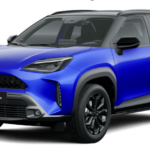 Toyota Yaris Cross vs Mazda CX-3: Which Small SUV Is Better?
Yet weight quietly influences almost everything.
A lighter vehicle generally needs less energy to accelerate. It places less strain on tyres and brakes, requires less energy to move through stop-start traffic and can feel more nimble when changing direction.
A heavier vehicle isn't automatically worse, though.
Extra weight can come from batteries, safety structures, additional equipment, larger wheels, sound insulation or AWD hardware — features buyers may genuinely want.
The goal isn't simply to make a car as light as possible.
It's to strike the right balance.
And that is one of the Yaris Cross's stronger characteristics: it provides an SUV-like driving position and hybrid technology without ballooning into the 1,600- or 1,800-kg territory common among larger crossovers.
Weight and Fuel Economy
This is probably the relationship most owners care about.
Every time we accelerate, the powertrain must move the mass of the vehicle. The more mass we're carrying, the more energy is generally required.
That matters especially in urban driving where the vehicle repeatedly slows down and accelerates again.
Toyota's hybrid system helps recover some kinetic energy through regenerative braking, but physics doesn't disappear.
This partly explains why keeping the Yaris Cross relatively lightweight complements its efficiency-oriented hybrid drivetrain.
Toyota Australia quotes combined fuel economy figures of 3.8 L/100 km for 2WD and 4.0 L/100 km for AWD under laboratory testing.
Real-world results naturally depend on traffic, speed, weather, tyres, driving style and vehicle load.
Does Carrying Extra Weight Increase Fuel Consumption?
Yes, particularly in stop-start driving.
Imagine repeatedly pushing an empty supermarket trolley around a car park. Now put several heavy bags of groceries inside it.
The second trolley requires more effort whenever we start moving.
A car behaves according to the same basic principle.
One passenger isn't going to transform consumption overnight, but routinely carrying unnecessary heavy cargo can gradually reduce efficiency.
Weight and Performance
The Yaris Cross isn't designed to chase lap records.
It's built to be efficient, practical and easy to drive.
Still, vehicle mass affects acceleration.
The hybrid powertrain has to accelerate every kilogram of vehicle weight, passengers and luggage. A lighter version therefore has a small theoretical advantage in responsiveness compared with an otherwise identical heavier version.
Drivers are unlikely to feel a dramatic difference between two closely related trims, though.
Powertrain calibration, tyre choice and drivetrain can matter just as much.
Weight and Handling
A relatively low kerb weight can make a compact SUV feel more agile.
That's especially important because crossovers are taller than hatchbacks. Extra height raises the vehicle's centre of gravity, while reduced weight helps engineers preserve responsive handling.
The Yaris Cross therefore occupies an interesting middle ground.
It gives us the higher seating position many buyers want without feeling like we're steering a small apartment building through every roundabout.
Weight and Braking
More mass means more kinetic energy at a given speed.
The braking system must dissipate that energy when we slow down.
That's another reason vehicle payload limits matter.
Loading a car beyond its permitted weight isn't simply a question of whether everything physically fits inside. Brakes, tyres, suspension and chassis components are designed around specified operating limits.
With a hybrid such as the Yaris Cross, regenerative braking also allows the vehicle to recover energy during deceleration and send some of it back toward the hybrid battery.
Does Trim Level Change the Weight of a Yaris Cross?
Yes.
Two Yaris Cross vehicles with the same engine and drivetrain don't necessarily weigh exactly the same.
Higher trims often add equipment.
That could include larger alloy wheels, electrically operated equipment, upgraded seats, additional speakers, panoramic roofs where offered, styling components or other convenience features.
Each addition might contribute only a few kilograms.
Pile enough of them together, though, and the difference becomes measurable.
That's why manufacturer's brochures frequently provide either a weight range or a maximum kerb-weight figure rather than claiming every Yaris Cross weighs exactly the same.
Do Larger Wheels Affect Vehicle Weight?
Potentially, yes.
Different wheels and tyres can change unsprung mass, although the exact difference depends on wheel construction and tyre specification.
More importantly for everyday driving, larger wheels can affect ride quality, tyre cost and sometimes efficiency.
Toyota UK documentation shows the Yaris Cross offered with 16-, 17- and 18-inch alloy wheels, depending on specification.
A buyer interested primarily in comfort and efficiency may therefore have different priorities from someone attracted to the appearance of the largest wheel option.
How Heavy Is the Yaris Cross Compared With a Regular Yaris?
Conceptually, the Yaris Cross sits above the regular Yaris hatchback.
It's longer, taller and designed to provide the more upright posture buyers expect from a crossover.
We should therefore expect additional weight.
The interesting point isn't that the Yaris Cross weighs more than a small hatchback. Of course it does.
What's more relevant is that Toyota has managed to keep its overall mass relatively restrained despite adding crossover proportions, hybrid technology, five-seat practicality and available AWD.
In this sense, the Yaris Cross feels more like a raised, practical small car than a shrunken version of a heavy traditional SUV.
How Does Toyota Keep the Yaris Cross Relatively Light?
Modern car design is a balancing act.
Manufacturers want rigid bodies, excellent crash protection, quiet cabins, strong equipment levels and electrified powertrains.
All of those things can increase weight.
At the same time, efficiency regulations and customer expectations push engineers in exactly the opposite direction.
Reducing unnecessary mass therefore becomes a game played one component at a time.
A few grams saved from one bracket won't matter to us as drivers. Multiply that philosophy across thousands of components and suddenly it does.
This content may interest you! Renault Captur Boot Space: Size, Practicality and Luggage Guide
The Hybrid System Adds Weight — But Also Efficiency
A hybrid vehicle carries hardware that an ordinary petrol-only car doesn't.
There's a traction battery, electric motor, power electronics and associated equipment.
That means hybridisation isn't weight-free.
But the purpose isn't simply to reduce weight. It's to reduce the amount of fuel needed to perform the same transportation job.
The electric side of Toyota's system can assist the petrol engine, allow periods of electric propulsion and recover energy during deceleration.
So while the hybrid hardware adds kilograms, it can still deliver substantially better urban efficiency than we'd expect from a conventional drivetrain.
Toyota Yaris Cross Weight and Passenger Load
Suppose we have five adults inside the car.
Even at an average of 70 kg per occupant, that's 350 kg of people before we've loaded a single suitcase.
Add luggage and we're rapidly moving much closer to the vehicle's permissible maximum mass.
This doesn't mean the Yaris Cross can't comfortably perform its role as a five-seat compact SUV.
It means we should understand that payload limits apply to small vehicles just as much as they do to vans and trucks.
For normal day-to-day driving, most owners will never come close to the limit.
But families packing for long holidays, drivers carrying heavy equipment or anyone towing should pay considerably more attention.
What Should You Check Before Carrying a Heavy Load?
Before heavily loading a Yaris Cross, we should check:
- The vehicle's identification plate and owner's documentation for the exact permitted weights.
- The specific kerb and gross vehicle weight for that model.
- Tyre pressures recommended for a fully loaded vehicle.
- The combined weight of passengers and cargo.
- Tow limits if attaching a trailer.
- Maximum axle loads where applicable.
- Any limits applying to roof racks, bike carriers or accessories.
Those numbers matter far more than estimating whether something simply "looks too heavy."
Toyota Yaris Cross Towing Weight
Towing is another area where market differences become particularly important.
Toyota Australia's May 2026 specifications list 400 kg braked and 400 kg unbraked towing capacity for eligible Yaris Cross configurations, with the GR Sport excluded from the stated 2WD towing specification.
Toyota UK's published specifications, by contrast, state 750 kg braked and 550 kg unbraked.
That's a perfect example of why copying a Yaris Cross specification from a foreign website can cause trouble.
The vehicle may look almost identical, yet certification and official limits can differ considerably.
Always follow the specifications applicable to the exact vehicle sold in your market.
Why Vehicle Weight Matters When Towing
Towing introduces forces far beyond simply moving extra kilograms down a straight road.
The tow vehicle must accelerate the trailer, control it through corners and stop the combined mass safely.
Vehicle manufacturers therefore establish limits based on engineering, testing and regulatory requirements.
Never assume that because another Yaris Cross elsewhere is permitted to tow a particular weight, yours automatically can.
Is the Toyota Yaris Cross a Heavy Car?
No — at least not by contemporary SUV standards.
A kerb-weight range around 1.2–1.35 tonnes places it firmly in compact-car territory rather than among heavier family SUVs.
And that's part of the formula.
A traditional SUV feeling usually comes with a price: bigger dimensions, higher fuel consumption and more mass.
The Yaris Cross tries to provide the useful bits — elevated seating, practical cargo space and crossover styling — without taking the full penalty.
It doesn't feel like Toyota took a large SUV and attacked it with a shrink ray.
Instead, it feels like the company started with a small-car philosophy and stretched it upward.
Is a Lighter 2WD or Heavier AWD Yaris Cross Better?
For most city drivers, the lighter 2WD version probably makes more sense.
It carries less drivetrain hardware, officially uses slightly less fuel in current Australian specifications and still provides the characteristics most Yaris Cross buyers want.
AWD becomes more interesting when traction is genuinely valuable.
People living in rural areas, driving frequently on loose surfaces or regularly encountering slippery roads may consider the extra weight a reasonable price for additional driven-wheel capability.
Neither configuration is inherently "better."
The best one is the version whose additional hardware we actually use.
Toyota Yaris Cross Weight: What Owners Should Remember
After all the numbers, the practical answer is surprisingly simple.
The weight of a Toyota Yaris Cross is generally around 1,175 to 1,360 kg, depending on model and market. Current Australian specifications quote maximum kerb weights of 1,235 kg for 2WD and 1,305 kg for AWD, while Toyota UK's documentation publishes a broader 1,175–1,360 kg kerb-weight range.
That relatively low mass helps explain several of the Yaris Cross's defining traits.
It can offer SUV-style practicality without behaving like an oversized SUV. It can carry a hybrid powertrain without becoming excessively heavy. And its modest mass works alongside the hybrid system to support strong fuel efficiency.
But there's one rule worth remembering.
Check the specifications for your exact vehicle.
Model year, trim, drivetrain, equipment and country can all affect official numbers.
A figure from an Australian GX AWD shouldn't automatically be applied to a British front-wheel-drive version — even if both vehicles have "Yaris Cross" written across the back.
Conclusion: How Much Does the Toyota Yaris Cross Weigh?
So, how heavy is the Toyota Yaris Cross?
Expect approximately 1.2 to 1.35 tonnes in typical kerb-weight form, with published figures spanning roughly 1,175–1,360 kg depending on market and specification.
For Australia, Toyota's May 2026 data provides especially straightforward numbers: up to 1,235 kg for 2WD models and 1,305 kg for AWD models, with respective gross vehicle weights of 1,650 and 1,720 kg.
That's a sweet spot for this sort of vehicle.
The Yaris Cross is substantial enough to offer the practicality and elevated seating position buyers expect from a crossover, but light enough that it doesn't abandon the economy-focused character associated with the Yaris family.
Weight may not be the specification that sells cars in a showroom.
Nobody walks around admiring a kerb-weight figure.
Yet behind the scenes, those kilograms shape the way the Yaris Cross accelerates, brakes, handles and consumes fuel.
Sometimes one of the least glamorous numbers on the spec sheet tells us the most about how a vehicle was designed.
Frequently Asked Questions About Toyota Yaris Cross Weight
1. What is the kerb weight of a Toyota Yaris Cross?
Toyota Yaris Cross kerb weight varies according to drivetrain, trim and market. Toyota UK specifications publish a range of approximately 1,175–1,360 kg, while Toyota Australia's May 2026 specifications list maximum kerb weights of 1,235 kg for 2WD and 1,305 kg for AWD models.
2. How much does a Toyota Yaris Cross weigh in pounds?
Depending on specification, approximately 2,590 to 3,000 lb is a useful general range. An Australian 2WD model with a quoted maximum kerb weight of 1,235 kg is roughly 2,723 lb, while the 1,305-kg AWD figure is approximately 2,877 lb.
3. Is the AWD Toyota Yaris Cross heavier than the 2WD?
Yes. In Toyota Australia's current specifications, maximum kerb weight is 1,235 kg for 2WD versus 1,305 kg for AWD, making the AWD version around 70 kg heavier at those quoted maximum figures.
This content may interest you!Toyota Yaris Cross Towing Capacity Australia: Complete Guide4. What is the gross vehicle weight of the Toyota Yaris Cross?
It varies by market. Toyota Australia currently lists 1,650 kg for 2WD and 1,720 kg for AWD. Toyota UK's specifications provide gross vehicle weight figures ranging from approximately 1,690 to 1,775 kg depending on configuration.
5. Does Toyota Yaris Cross weight affect fuel economy?
Yes. All else being equal, greater mass requires more energy during acceleration. Toyota Australia's current official laboratory figures illustrate the small difference between configurations: 3.8 L/100 km combined for 2WD and 4.0 L/100 km for AWD. Actual fuel consumption depends on speed, road conditions, traffic, weather, driving style and vehicle load.
Leave a Reply