
BYD Shark 6 Fuel Type Australia: Does It Use 91, 95 or 98 Petrol?

The BYD Shark 6 has attracted plenty of attention in Australia as a plug-in hybrid ute that challenges traditional diesel-powered models such as the Toyota HiLux and Ford Ranger. However, one of the most common questions among potential buyers is surprisingly simple: what fuel does the BYD Shark 6 use in Australia?
Unlike conventional diesel utes, the Shark 6 combines a turbocharged petrol engine with electric motors and a rechargeable battery. This means owners need to consider both petrol quality and charging habits when calculating running costs.
But does the BYD Shark 6 require premium unleaded petrol? Can you use regular 91 RON? Is E10 suitable? And will filling up with 98 RON improve performance?
In this guide, we'll explain everything Australian drivers need to know about the BYD Shark 6 fuel type, including recommended octane ratings, fuel economy, tank capacity and practical refuelling advice.
- What Fuel Does the BYD Shark 6 Use in Australia?
- Does the BYD Shark 6 Need Premium Unleaded Petrol?
- Can You Use 91 RON Petrol in the BYD Shark 6?
- Can the BYD Shark 6 Run on E10 Petrol?
- Can You Put 98 RON Petrol in the BYD Shark 6?
- BYD Shark 6 Premium vs Performance Fuel Type
- How Does the BYD Shark 6 Petrol-Electric System Work?
- BYD Shark 6 Fuel Tank Capacity Australia
- BYD Shark 6 Fuel Consumption in Australia
- BYD Shark 6 Petrol vs Diesel: Which Is Better?
- How Much Does It Cost to Fill the BYD Shark 6 in Australia?
- How to Reduce BYD Shark 6 Fuel Consumption
- How to Refuel the BYD Shark 6 Correctly
- What Happens If You Put Diesel in a BYD Shark 6?
- Is the BYD Shark 6 Fuel Type Suitable for Australian Conditions?
- Frequently Asked Questions About the BYD Shark 6 Fuel Type
- Conclusion: What Is the Best Fuel for the BYD Shark 6 in Australia?
What Fuel Does the BYD Shark 6 Use in Australia?
The BYD Shark 6 uses unleaded petrol and electricity, thanks to its plug-in hybrid electric vehicle (PHEV) powertrain.
Australian vehicle specification listings identify 95 RON premium unleaded petrol as the recommended fuel for the Shark 6, including the Premium and Performance variants. redbook.com.au+1
The vehicle does not use diesel, despite competing directly with diesel-powered dual-cab utes.
Here is a quick overview of its fuel specifications.
| Specification | BYD Shark 6 Australia |
|---|---|
| Fuel type | Unleaded petrol and electricity |
| Recommended petrol | 95 RON premium unleaded |
| Fuel tank capacity | 60 litres |
| Hybrid system | Plug-in hybrid (PHEV) |
| Premium engine | 1.5L turbo petrol |
| Performance engine | 2.0L turbo petrol |
| Battery capacity | 29.6 kWh |
| Diesel compatible | No |
| Electric-only driving | Yes |
These specifications apply to the Australian Shark 6 range as listed for 2026. Always check the fuel filler label and documentation supplied with your particular vehicle.
For Australian drivers, 95 RON premium unleaded is the straightforward choice for the BYD Shark 6.
RON stands for Research Octane Number, a measurement of petrol's resistance to engine knocking.
In Australia, most service stations offer three main unleaded petrol grades:
- 91 RON: Regular unleaded petrol.
- 95 RON: Premium unleaded petrol.
- 98 RON: Higher-octane premium unleaded petrol.
Higher-octane petrol is particularly relevant to turbocharged engines because they operate under conditions that can increase the risk of knocking.
Why Is 95 RON Recommended?
The Shark 6 uses a turbocharged petrol engine as part of its hybrid system.
Using the appropriate octane rating helps the engine operate as intended, particularly during periods of greater demand.
Potential benefits include consistent engine performance, reduced risk of knocking, and operation within the vehicle's specified fuel requirements.
However, 95 RON does not automatically make the Shark 6 more economical than every lower-octane alternative. Octane rating and energy efficiency are different measurements.
The most important consideration is using petrol that meets the requirements of your vehicle.
Can You Use 91 RON Petrol in the BYD Shark 6?
This is one of the more confusing questions surrounding the Shark 6 in Australia.
Many Australian vehicle databases specify 95 RON, while some owners have reported different information on fuel filler labels or in documentation.
The Australian/New Zealand owner's handbook instructs drivers to use unleaded petrol that meets local standards, but the fuel-selection wording does not specify a universal octane number. bydauto.co.nz
Consequently, we recommend the following approach:
- Check the fuel filler label on your particular Shark 6.
- Consult the Australian owner's documentation supplied with the vehicle.
- If the label and published specifications differ, ask an authorised BYD service centre to confirm the correct minimum octane rating for your model and build.
What Happens If You Use 91 Instead of 95?
If your particular vehicle requires 95 RON, regularly using 91 RON would mean operating below its specified fuel grade.
Potential consequences include reduced performance, increased tendency towards engine knocking and greater reliance on engine knock-control systems.
Modern engines can adjust ignition timing under certain conditions, but that does not mean a lower-octane fuel is automatically approved.
If you have accidentally added 91 RON, avoid heavy acceleration or towing until you have confirmed the appropriate procedure with BYD.
Can the BYD Shark 6 Run on E10 Petrol?
E10 is widely available throughout Australia and generally contains up to 10% ethanol blended with petrol.
It is often cheaper than premium unleaded, which makes it attractive to drivers looking to reduce fuel costs.
However, compatibility and octane rating are two separate issues.
Is E10 Safe for the Shark 6?
Australian E10 is commonly sold with an octane rating of approximately 94 RON, although the exact rating depends on the product.
If your Shark 6 requires a minimum of 95 RON, ordinary 94 RON E10 should not automatically be considered an approved substitute.
Even if an engine is compatible with ethanol blends, the fuel must still satisfy the manufacturer's octane requirements.
Before using E10, check that both the ethanol content and octane rating are approved for your specific vehicle.
Does E10 Reduce Fuel Economy?
Ethanol contains less energy per litre than conventional petrol.
As a result, E10 can produce slightly higher fuel consumption under otherwise similar driving conditions.
Whether the lower pump price offsets that difference depends on local petrol prices and how frequently the Shark 6 operates in hybrid mode.
For an owner who regularly charges at home, the financial difference between petrol grades may be relatively small because the petrol engine is used less often.
Can You Put 98 RON Petrol in the BYD Shark 6?
Yes. Australian 98 RON premium unleaded exceeds a 95 RON octane requirement.
Provided the fuel meets the manufacturer's other specifications, using 98 RON is generally acceptable.
However, that does not necessarily mean it offers worthwhile benefits.
Does 98 RON Improve Performance?
A higher octane rating does not automatically increase engine power.
The Shark 6's engine management system controls ignition, boost and other operating parameters.
Unless the engine is calibrated to take advantage of higher-octane petrol, the difference between 95 and 98 RON may be minimal.
Is 98 RON Worth the Extra Money?
For most Shark 6 owners, 95 RON is likely to offer the most practical balance of suitability and cost.
The potential advantages of 98 RON depend on engine calibration, driving conditions and fuel quality.
We would not expect a substantial improvement in electric range or overall hybrid efficiency simply from changing to 98 RON.
The Australian BYD Shark 6 range includes different engine configurations, but both the Premium and Performance models use petrol-electric hybrid technology.
| Feature | Shark 6 Premium | Shark 6 Performance |
|---|---|---|
| Petrol engine | 1.5L turbo | 2.0L turbo |
| Recommended petrol | 95 RON | 95 RON |
| Hybrid system | Plug-in hybrid | Plug-in hybrid |
| Battery | 29.6 kWh | 29.6 kWh |
| Fuel tank | 60L | 60L |
| Combined maximum power | 321 kW | 350 kW |
| Combined maximum torque | 650 Nm | 700 Nm |
The Performance model uses a larger engine and produces more combined power and torque.
That additional performance can contribute to greater petrol consumption, particularly during demanding driving.
The Dynamic Cab Chassis model also uses a petrol-electric plug-in hybrid system, with a 1.5-litre turbocharged engine.
How Does the BYD Shark 6 Petrol-Electric System Work?
One of the Shark 6's biggest advantages is that petrol is not its only energy source.
Its Dual Mode Off-road (DMO) system combines a turbocharged engine with electric motors and a rechargeable battery.
This allows the vehicle to operate differently depending on driving conditions and the amount of battery charge available.
EV Mode: Driving Without Using Petrol
When sufficient battery energy is available and operating conditions allow, the Shark 6 can drive using electricity alone.
This is especially useful for:
- Short daily commutes.
- School drop-offs.
- Urban driving.
- Local shopping trips.
- Regular journeys within electric range.
For drivers who can charge at home, EV mode can significantly reduce petrol consumption.
However, the engine may still start automatically when required by the hybrid system.
HEV Mode: Combining Petrol and Electricity
In hybrid mode, the petrol engine and electric motors work together to meet the vehicle's energy requirements.
The system manages power generation and battery usage automatically.
Depending on the situation, the petrol engine may generate electricity, contribute to propulsion or operate as part of the vehicle's overall hybrid strategy.
This makes HEV mode particularly useful for longer journeys where regular charging is unavailable.
What Happens When the Battery Gets Low?
The Shark 6 does not simply become a conventional petrol-only ute when the usable EV range is depleted.
Instead, its hybrid management system continues operating the petrol engine and electric motors while maintaining a controlled battery reserve.
However, fuel consumption generally increases when the vehicle can no longer rely heavily on externally charged electricity.
BYD Shark 6 Fuel Tank Capacity Australia
The BYD Shark 6 has a 60-litre petrol tank across the Australian range.
While that is smaller than the tanks fitted to some traditional diesel utes, the Shark 6 can supplement petrol with electricity.
This creates two different ownership experiences.
Drivers who recharge regularly may go long periods between petrol station visits.
Drivers who frequently travel long distances without charging will depend more heavily on the 60-litre tank.
Is 60 Litres Enough for Long Trips?
For ordinary highway driving, a 60-litre tank can provide useful range.
This content may interest you!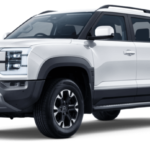 BYD Shark 6 Tyre Size: Complete Australian Guide to Wheels, Tyre Pressure and Upgrades
Nevertheless, fuel economy depends on several factors:
- Battery charge level.
- Driving speed.
- Vehicle load.
- Road gradient.
- Weather conditions.
- Tyre pressure.
- Towing weight.
Drivers travelling through remote parts of Australia should plan fuel stops carefully rather than relying exclusively on the advertised combined range.
BYD Shark 6 Fuel Consumption in Australia
The Shark 6's fuel economy is more complicated than that of a conventional petrol or diesel ute.
That's because a plug-in hybrid can use electricity supplied from the power grid before relying more heavily on petrol.
According to BYD's Australian specifications, the relevant laboratory figures are:
| Model | With sufficient battery charge | Low battery state of charge |
|---|---|---|
| Shark 6 Premium | 2.0 L/100 km (NEDC) | 7.9 L/100 km (NEDC) |
| Shark 6 Performance | 1.3 L/100 km (WLTP) | 10.5 L/100 km (WLTP) |
These are published test figures, not guaranteed real-world results. Importantly, NEDC and WLTP are different testing procedures and should not be compared directly as if the conditions were identical.
Why Does Fuel Consumption Change So Much?
The low petrol consumption figures depend heavily on the hybrid system using stored electricity.
If the vehicle begins a journey with a fully charged battery, it can complete part of that journey without burning much petrol.
As the battery's usable charge decreases, the engine becomes more important.
This explains why someone driving 30 kilometres daily with home charging may experience much lower petrol consumption than someone driving hundreds of kilometres on a highway.
Does Towing Increase Fuel Consumption?
Yes, potentially significantly.
Towing creates additional resistance and demands more energy from the powertrain.
In the Shark 6, towing a heavy trailer can cause the petrol engine to operate more frequently and at higher loads.
Fuel consumption will vary according to trailer mass, aerodynamics, speed, wind and terrain.
For Australians who regularly tow caravans over long distances, real-world fuel economy under load is far more relevant than the headline plug-in hybrid consumption figure.
BYD Shark 6 Petrol vs Diesel: Which Is Better?
The Shark 6 takes a different approach from diesel-powered competitors.
Instead of relying primarily on a large diesel engine, it combines a petrol engine with substantial electric assistance.
| Factor | BYD Shark 6 PHEV | Conventional diesel ute |
|---|---|---|
| Fuel | Petrol and electricity | Diesel |
| Home charging | Yes | No |
| Electric-only driving | Yes | No |
| Urban fuel consumption | Potentially very low with charging | Engine burns diesel |
| Long-distance efficiency | Depends on battery use and load | Often efficient on highways |
| Engine operation | Hybrid system controls engine usage | Conventional diesel operation |
| Fuel planning | Charging and petrol availability | Diesel availability |
Advantages of the Shark 6
For drivers with access to inexpensive charging, the Shark 6 may offer considerable savings on everyday urban journeys.
It can also provide a quieter driving experience when operating electrically.
Advantages of a Diesel Ute
A conventional diesel ute may be more straightforward for drivers who regularly cover remote highways, tow heavy loads or lack charging facilities.
Diesel availability and the efficiency of some diesel engines under sustained loads remain relevant considerations.
The best choice depends on how the vehicle will actually be used.
How Much Does It Cost to Fill the BYD Shark 6 in Australia?
The Shark 6's petrol cost depends on the prevailing Australian price of 95 RON unleaded.
With a 60-litre tank, the cost of a full refill increases as the price per litre rises.
Owners should also remember that a normal petrol station refill may be smaller than the tank's total capacity because fuel typically remains in the tank when the low-fuel warning appears.
Compared with regular 91 RON petrol, 95 RON usually costs more per litre.
However, the total running cost of a plug-in hybrid depends on much more than petrol prices.
For example, a Shark 6 owner who charges overnight at home and drives mostly short distances may use far less petrol than an owner who regularly travels long distances.
The electricity tariff, charging losses and petrol consumption all influence the overall cost.
How to Reduce BYD Shark 6 Fuel Consumption
The Shark 6 offers several opportunities to reduce petrol use through driving and charging habits.
1. Charge the Battery Regularly
Regular charging is one of the most effective ways to take advantage of the plug-in hybrid system.
Owners who can charge overnight may complete many everyday journeys primarily on electricity.
2. Use EV Mode When Appropriate
For shorter urban trips, EV mode can minimise petrol consumption.
However, always allow the hybrid system to manage the powertrain when conditions require it.
3. Avoid Unnecessary Acceleration
Hard acceleration increases energy demand.
Smooth acceleration and maintaining a steady speed can improve overall efficiency.
4. Maintain Correct Tyre Pressure
Underinflated tyres increase rolling resistance.
Keeping tyres at the recommended pressure helps maintain both efficiency and tyre life.
5. Plan Long-Distance Journeys
When travelling outside metropolitan areas, plan petrol and charging stops according to the route.
Do not assume that charging infrastructure will be available in every regional town.
6. Reduce Unnecessary Weight
Extra cargo increases the energy required to accelerate and climb hills.
Removing unnecessary equipment can help improve efficiency during normal driving.
7. Use the Correct Petrol Grade
Choose the octane rating specified for your particular Shark 6.
There is little financial benefit in using a cheaper fuel if it does not satisfy the vehicle's requirements.
How to Refuel the BYD Shark 6 Correctly
Refuelling a plug-in hybrid ute involves a slightly different process from refuelling a traditional petrol vehicle.
The Shark 6 uses a fuel tank pressure-management system, so the filler flap may not unlock immediately.
The general procedure is:
- Park safely beside the petrol pump and switch off the vehicle.
- Activate the fuel tank pressure-release control.
- Wait for the dashboard to indicate that the fuel filler is unlocked.
- Open the fuel filler flap and remove the cap.
- Add the appropriate unleaded petrol.
- Stop filling when the pump automatically shuts off.
- Refit the cap and close the filler flap securely.
Do not force the fuel filler open before the pressure-release process finishes, and do not attempt to refuel while the vehicle is connected to charging equipment.
What Happens If You Put Diesel in a BYD Shark 6?
Diesel should never be used in the BYD Shark 6.
Its internal combustion engine is designed for petrol, not diesel fuel.
Putting diesel into the tank can contaminate the fuel system and potentially cause significant mechanical problems.
If you accidentally put diesel in your Shark 6:
- Do not start the engine.
- Do not attempt to drive the vehicle.
- Contact roadside assistance or an authorised BYD service provider.
- Arrange for the incorrect fuel to be removed safely.
Starting the engine can circulate the incorrect fuel through the system and make repairs more complicated.
Is the BYD Shark 6 Fuel Type Suitable for Australian Conditions?
For many Australian buyers, the Shark 6's petrol-electric arrangement offers a useful combination of electric commuting and long-distance flexibility.
It is particularly attractive for drivers who live in cities or regional centres with convenient charging options.
The ability to use petrol for longer journeys removes the need to depend entirely on public charging stations.
However, the Shark 6 is not necessarily the ideal vehicle for every Australian driver.
People who regularly tow heavy trailers across remote highways should carefully consider fuel consumption under load, available petrol stations and the vehicle's usable range.
Similarly, anyone without access to regular charging may find that the plug-in hybrid system offers a smaller financial advantage.
Frequently Asked Questions About the BYD Shark 6 Fuel Type
1. Does the BYD Shark 6 use 91 or 95 petrol in Australia?
Australian vehicle specification listings commonly recommend 95 RON premium unleaded petrol for the BYD Shark 6. Some owners have reported different fuel label information, so check the requirements for your specific vehicle and confirm any discrepancy with BYD.
2. Can you use 98 unleaded petrol in the BYD Shark 6?
Yes. Standard 98 RON premium unleaded satisfies a 95 RON octane requirement. However, using 98 RON does not guarantee better fuel economy or additional power compared with 95 RON.
3. Is the BYD Shark 6 petrol or diesel?
The BYD Shark 6 is a petrol-electric plug-in hybrid ute. It uses a turbocharged petrol engine combined with electric motors and a rechargeable battery. It does not use diesel.
4. How big is the BYD Shark 6 fuel tank?
The Australian BYD Shark 6 has a 60-litre petrol tank. Its total driving range depends on fuel consumption, battery charge, driving conditions and whether the vehicle is towing.
5. Can the BYD Shark 6 drive without petrol?
The Shark 6 can drive using electricity alone when sufficient battery charge is available and operating conditions permit. However, it remains a plug-in hybrid rather than a fully electric ute, and the petrol engine may start automatically when required.
Conclusion: What Is the Best Fuel for the BYD Shark 6 in Australia?
The BYD Shark 6 uses unleaded petrol and electricity, making it fundamentally different from traditional diesel-powered dual-cab utes.
For Australian buyers, 95 RON premium unleaded is the safest general recommendation based on published vehicle specifications. Owners should nevertheless verify the fuel label and documentation for their individual vehicle, particularly where there is uncertainty about 91 RON or E10 compatibility.
While 98 RON petrol is an acceptable higher-octane alternative, it is unlikely to provide a major advantage for most drivers.
The Shark 6's greatest opportunity to reduce running costs comes from its plug-in hybrid technology rather than switching between premium petrol grades.
For Australians who can charge regularly and primarily drive shorter distances, the Shark 6 can dramatically reduce reliance on petrol. For long highway journeys or towing, understanding the vehicle's petrol requirements and real-world fuel consumption remains essential.
Ultimately, choosing the correct petrol grade, keeping the battery charged and adopting efficient driving habits will help owners get the most out of the BYD Shark 6.
This content may interest you!
Leave a Reply