
Kia EV5 vs EV3 Australia: Which Electric SUV Should You Buy in 2026?

Choosing between the Kia EV5 and Kia EV3 in Australia is more complicated than simply deciding which electric SUV looks better. Both vehicles share Kia's futuristic design language, advanced technology, practical interiors and impressive electric driving capabilities. However, they target slightly different buyers.
The Kia EV3 is a compact electric SUV designed to deliver excellent efficiency, impressive driving range and everyday practicality at a relatively affordable price. Meanwhile, the Kia EV5 is a larger, more family-oriented electric SUV offering additional passenger space, a bigger boot and more substantial road presence.
Interestingly, the EV3 can travel further on a single charge than the larger EV5, despite having a smaller battery. The EV5, however, offers greater cargo capacity and a more powerful all-wheel-drive system.
So, is the Kia EV5 worth the extra money, or does the smaller EV3 offer better value for Australian drivers?
In this comprehensive Kia EV5 vs EV3 Australia comparison, we'll examine pricing, dimensions, battery capacity, real-world driving range, charging speeds, interior space, performance, safety, running costs and overall practicality to determine which electric SUV deserves a place in your driveway.
- Kia EV5 vs EV3 Australia: Quick Comparison
- Kia EV5 vs EV3 Price in Australia
- Kia EV5 vs EV3 Dimensions: How Much Bigger Is the EV5?
- Kia EV3 vs EV5 Boot Space and Practicality
- Kia EV5 vs EV3 Battery Size
- Kia EV5 vs EV3 Driving Range Australia
- Kia EV3 vs EV5 Charging Speed
- Kia EV5 vs EV3 Performance and Acceleration
- Kia EV3 vs EV5 Interior and Technology
- Kia EV5 vs EV3 Safety Features
- Kia EV3 vs EV5 Running Costs in Australia
- Kia EV5 vs EV3 Warranty and Reliability
- Kia EV3 vs EV5 Towing Capacity
- Kia EV5 vs EV3 for Australian City Driving
- Kia EV5 vs EV3 for Australian Families
- Kia EV3 vs EV5 for Highway Driving and Road Trips
- Kia EV5 vs EV3: Advantages and Disadvantages
- Kia EV5 vs EV3: Which Model Should You Buy?
- Kia EV5 vs EV3 Australia: Final Verdict
- Frequently Asked Questions About Kia EV5 vs EV3 Australia
Kia EV5 vs EV3 Australia: Quick Comparison
Before exploring the differences in detail, let's compare the main specifications.
| Specification | Kia EV3 | Kia EV5 |
|---|---|---|
| Vehicle category | Small electric SUV | Medium electric SUV |
| Starting price (AUD) | $47,600 | $56,770 |
| Battery capacity | 58.3–81.4 kWh | 64.2–88.1 kWh |
| Maximum WLTP range | 604 km | 555 km |
| Maximum power | 195 kW | 230 kW |
| Drivetrain | FWD or AWD | FWD or AWD |
| Length | 4,300–4,310 mm | 4,615 mm |
| Width | 1,850 mm | 1,875 mm |
| Height | 1,560–1,570 mm | 1,715 mm |
| Wheelbase | 2,680 mm | 2,750 mm |
| Boot capacity | 460 litres | 513 litres |
| Front storage | 25 litres | 67 litres |
| Seating capacity | 5 | 5 |
| ANCAP safety rating | 5 stars | 5 stars |
Prices are indicative Australian manufacturer list prices before on-road costs, based on the 2026 pricing information. Specifications vary by grade and model year. Promotional drive-away prices may be lower.
The first interesting difference is that the EV3 delivers a longer maximum driving range while costing considerably less.
The EV5 counters with a larger body, additional luggage capacity and stronger performance in its dual-motor variants.
Neither vehicle is automatically better. The right choice depends on how much space you need and how you intend to use your electric SUV.
Kia EV5 vs EV3 Price in Australia
Price is one of the biggest considerations when comparing these two electric Kias.
Kia EV3 Australian Pricing
The Kia EV3 range includes several configurations designed for different budgets and driving requirements.
| Kia EV3 Variant | Price Before On-Road Costs |
|---|---|
| EV3 Air Standard Range | $47,600 |
| EV3 Air Long Range | $53,315 |
| EV3 Earth Long Range | $58,600 |
| EV3 GT-Line Long Range FWD | $63,950 |
| EV3 GT-Line Long Range AWD | $66,490 |
The EV3 GT-Line AWD joined the Australian range as part of the MY27 update, adding a more powerful dual-motor option.
The most affordable version is the EV3 Air Standard Range, which provides a practical combination of technology, driving range and interior space.
However, the EV3 Air Long Range is arguably the most interesting model because it offers up to 604 km of WLTP driving range without requiring buyers to purchase a premium trim.
Kia EV5 Australian Pricing
The larger EV5 comes with a higher entry price.
| Kia EV5 Variant | Price Before On-Road Costs |
|---|---|
| EV5 Air Standard Range | $56,770 |
| EV5 Air Long Range | $61,170 |
| EV5 Earth AWD Long Range | $64,770 |
| EV5 GT-Line AWD Long Range | $71,770 |
The entry-level Kia EV5 costs approximately $9,170 more than the entry-level EV3.
However, the price difference becomes more interesting when comparing specific versions.
For example, the EV3 Air Long Range has a lower list price than the EV5 Air Standard Range while providing substantially more claimed driving range.
On the other hand, buyers considering an EV3 GT-Line AWD may find that the larger EV5 Earth AWD is available for a similar amount of money.
Which Kia Offers Better Value?
We would give the EV3 the advantage for buyers focused on affordability and efficiency.
The EV5 makes more sense when its additional size and practicality are genuinely useful.
Australian buyers should also compare actual drive-away prices rather than relying exclusively on list prices. Kia dealer promotions, demonstrator discounts, financing offers and state-based on-road costs can significantly affect the final purchase price.
Price winner: Kia EV3.
Kia EV5 vs EV3 Dimensions: How Much Bigger Is the EV5?
The difference in physical size is one of the most important factors separating these SUVs.
Although they share similar styling, the EV5 occupies a larger vehicle category.
Exterior Dimensions Comparison
| Dimension | Kia EV3 | Kia EV5 |
|---|---|---|
| Length | 4,300 mm | 4,615 mm |
| Width | 1,850 mm | 1,875 mm |
| Height | 1,560 mm | 1,715 mm |
| Wheelbase | 2,680 mm | 2,750 mm |
| Ground clearance | 140 mm | 161–175 mm |
EV3 figures refer to the standard body configuration; GT-Line dimensions vary slightly.
The Kia EV5 is approximately:
- 315 mm longer than the standard EV3.
- 25 mm wider.
- 155 mm taller.
- 70 mm longer in wheelbase.
These differences influence both cabin space and everyday manoeuvrability.
Kia EV3: Better for Urban Driving
The EV3's smaller dimensions make it particularly attractive for drivers living in major Australian cities such as Sydney, Melbourne, Brisbane and Perth.
It is easier to position in narrow parking spaces, navigate crowded shopping centre car parks and manoeuvre through residential streets.
Its relatively compact footprint is especially appealing for apartment residents or households with smaller garages.
The EV3 also has a tighter turning circle, making low-speed manoeuvres easier.
Despite its smaller dimensions, the EV3 benefits from an electric vehicle platform that maximises interior room.
Kia EV5: Better for Families
The EV5's longer wheelbase and taller body provide a more spacious overall environment.
Its larger proportions are particularly noticeable when transporting adults in the rear seats or carrying bulky luggage.
The taller cabin may also appeal to drivers who prefer an elevated seating position and a more traditional SUV driving experience.
For households regularly travelling with children, prams, sports equipment or multiple suitcases, this extra space could justify the price difference.
Dimensions winner: Kia EV5 for space; Kia EV3 for city convenience.
Kia EV3 vs EV5 Boot Space and Practicality
Boot capacity can make a significant difference to everyday ownership, particularly for Australian families.
Both vehicles have five seats, flat cabin floors and versatile storage solutions.
However, the EV5 offers more luggage capacity.
Boot Capacity Comparison
| Cargo Space | Kia EV3 | Kia EV5 |
|---|---|---|
| Rear boot, seats upright | 460 L | 513 L |
| Front storage compartment | 25 L | 67 L |
| Rear boot, seats folded | Depends on configuration | 1,714 L |
The EV5 provides an additional 53 litres of rear luggage space.
It also features a considerably larger front storage compartment, commonly called a frunk.
Is the EV3 Boot Big Enough for a Family?
For many households, yes.
A 460-litre boot is generous for a compact SUV and provides enough capacity for everyday shopping, school bags, smaller prams and weekend luggage.
The EV3's relatively boxy design also makes its luggage compartment more useful than the boot of some similarly sized electric crossovers.
However, families carrying larger prams, camping equipment or several large suitcases may find its dimensions restrictive.
Why the EV5 Is More Practical
The EV5 offers additional luggage capacity and greater flexibility for longer journeys.
Its larger cargo area is particularly useful when transporting:
- Large suitcases and holiday luggage.
- Baby prams and child-related equipment.
- Camping gear.
- Sports equipment.
- Shopping and household supplies.
The EV5 also offers a flatter, more expansive load area when the rear seats are folded.
Nevertheless, the EV3 remains surprisingly practical for its size.
Boot space winner: Kia EV5.
Kia EV5 vs EV3 Battery Size
The EV3 and EV5 use different battery capacities and chemistries.
The smaller EV3 is designed to maximise energy efficiency, while the EV5 prioritises a combination of battery capacity, SUV practicality and durability.
Kia EV3 Battery Options
Australian EV3 variants are available with two main battery sizes:
- Standard Range: 58.3 kWh.
- Long Range: 81.4 kWh.
The EV3 uses lithium-ion battery technology, with the Australian battery packs using nickel-rich chemistry.
The larger battery provides enough stored energy for impressive distances between charging stops.
Kia EV5 Battery Options
The EV5 offers:
- Standard Range: 64.2 kWh.
- Long Range: 88.1 kWh.
The Australian EV5 uses lithium iron phosphate, or LFP, batteries.
LFP chemistry is generally known for good cycle-life characteristics and thermal stability.
Meanwhile, nickel-rich lithium-ion batteries usually offer greater energy density, allowing manufacturers to achieve high driving ranges without excessive battery weight.
However, battery longevity depends on more than chemistry. Charging habits, temperature, usage patterns and battery management systems all influence long-term performance.
Which Battery Is Better?
The EV5 has the larger battery, but that does not automatically translate into better driving range.
Because the EV3 is smaller and generally more energy-efficient, it can travel further with less battery capacity.
Buyers should therefore compare actual range and energy consumption rather than focusing solely on battery size.
Kia EV5 vs EV3 Driving Range Australia
For many Australian buyers, electric driving range is the deciding factor.
Australia's long distances and the variable availability of public charging infrastructure make efficiency particularly important.
Interestingly, the EV3 has a clear advantage in maximum claimed range.
Kia EV3 WLTP Driving Range
| EV3 Variant | WLTP Range |
|---|---|
| Air Standard Range | 436 km |
| Air Long Range | 604 km |
| Earth Long Range | 563 km |
| GT-Line Long Range FWD | 563 km |
| GT-Line Long Range AWD | 559 km |
The standout model is the EV3 Air Long Range, delivering a claimed 604 km.
That is an impressive figure for a relatively compact electric SUV.
Even the higher-specification variants offer more than 550 km of claimed range.
Kia EV5 WLTP Driving Range
| EV5 Variant | WLTP Range |
|---|---|
| Air Standard Range | 400 km |
| Air Long Range | 555 km |
| Earth AWD Long Range | 500 km |
| GT-Line AWD Long Range | 470 km |
The EV5 Air Long Range offers the greatest driving range in its lineup.
The AWD versions sacrifice some efficiency because they have additional electric motors, more weight and larger wheels.
Why Does the Smaller EV3 Have More Range?
Several factors explain the difference.
Firstly, the EV3 has a smaller body and generally lower vehicle weight.
Secondly, its more aerodynamically efficient proportions help reduce energy consumption, particularly at higher speeds.
Thirdly, the EV3's electric powertrain is calibrated to deliver excellent efficiency.
For example, the EV3 Air Long Range has a claimed combined electricity consumption of approximately 14.9 kWh/100 km.
The EV5 Air Long Range is rated at approximately 18.0 kWh/100 km.
That difference becomes meaningful over thousands of kilometres.
Real-World Driving Range in Australia
WLTP figures are useful for comparing vehicles, but they should not be interpreted as guaranteed real-world distances.
Actual driving range varies according to:
- Highway speed.
- Outside temperature.
- Air conditioning and heating.
- Passenger and luggage weight.
- Road gradients.
- Tyre pressure.
- Wind conditions.
- Driving style.
For example, sustained motorway driving at 110 km/h may consume more electricity than a mixed urban driving cycle.
Likewise, transporting a fully loaded vehicle on a summer holiday can increase energy consumption.
For Australians regularly travelling between cities, the EV3 Long Range is particularly appealing because its high efficiency can reduce charging frequency.
Driving range winner: Kia EV3.
Kia EV3 vs EV5 Charging Speed
Charging performance is another important consideration.
Both vehicles support AC charging at home and DC fast charging on public networks.
However, there are some meaningful differences.
DC Fast Charging Comparison
| Charging Specification | Kia EV3 | Kia EV5 |
|---|---|---|
| Charging connector | CCS2 | CCS2 |
| Electrical architecture | 400V class | 400V class |
| Standard Range 10–80% | Approx. 29 minutes | Approx. 36 minutes |
| Long Range 10–80% | Approx. 31 minutes | Approx. 38 minutes |
These figures refer to Kia's published charging estimates using a suitable high-power DC charger under favourable conditions.
The EV3 has the advantage when comparing percentage-based fast-charging times.
However, charging speed also depends on the amount of energy added, battery temperature, charging curve and available charger power.
Kia EV3 Charging at Home
The EV3 supports approximately 6.9 kW single-phase AC charging and up to 10.5 kW three-phase AC charging.
Using an appropriate three-phase home charger, Kia quotes approximately:
- Standard Range, 10–100%: 5 hours 20 minutes.
- Long Range, 10–100%: 7 hours 15 minutes.
Charging through a typical single-phase home wallbox will generally take longer.
Kia EV5 Charging at Home
The EV5 Standard Range supports approximately 6.6 kW AC charging.
Long Range versions support up to 11 kW three-phase AC charging.
Kia quotes approximately 8 hours 10 minutes for a Long Range battery to charge from 10% to 100% using a suitable 11 kW charger.
For most households with home charging, either vehicle can comfortably be charged overnight.
Which Is Better for Australian Road Trips?
The EV3 has a useful advantage because it combines strong efficiency with relatively short DC charging sessions.
This could make longer journeys more convenient.
Nevertheless, both vehicles require sensible planning when travelling through regional Australia.
Drivers should identify reliable charging locations, consider alternative chargers and avoid arriving at isolated stations with very little remaining battery capacity.
Charging speed winner: Kia EV3.
Kia EV5 vs EV3 Performance and Acceleration
Although neither SUV is primarily marketed as a high-performance electric vehicle, both deliver the immediate torque associated with electric motors.
The difference becomes more noticeable when comparing the AWD variants.
Kia EV3 Performance
Standard front-wheel-drive EV3 variants produce:
- Maximum power: 150 kW.
- Maximum torque: 283 Nm.
- 0–100 km/h acceleration: approximately 7.5–7.9 seconds, depending on variant.
The GT-Line AWD increases output to:
- Maximum power: 195 kW.
- Maximum torque: 385 Nm.
- 0–100 km/h: approximately 6.6 seconds.
This provides brisk acceleration and additional traction.
For most Australian driving situations, even the standard EV3 offers more than enough performance.
Overtaking, merging onto motorways and urban driving feel effortless thanks to immediate electric torque.
Kia EV5 Performance
The front-wheel-drive EV5 produces:
- Maximum power: 160 kW.
- Maximum torque: 310 Nm.
The AWD versions deliver:
- Combined power: 230 kW.
- Combined torque: 480 Nm.
The EV5 Earth AWD can accelerate from 0–100 km/h in approximately 6.1 seconds, while the GT-Line AWD takes approximately 6.3 seconds.
That makes the larger EV5 surprisingly quick.
Which Electric SUV Feels More Powerful?
The EV3 feels responsive because of its smaller size.
Its immediate acceleration and relatively compact dimensions make it enjoyable in urban environments.
The EV5 AWD delivers stronger acceleration and greater torque, making it more suitable for buyers who appreciate effortless highway performance.
However, additional performance is not always necessary.
For everyday commuting, the front-wheel-drive EV3 may offer the best balance of power and efficiency.
Performance winner: Kia EV5 AWD.
This content may interest you!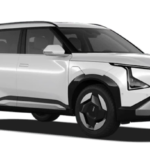 Kia EV5 Competitors in Australia: 12 Best Electric SUV Alternatives in 2026
Kia EV3 vs EV5 Interior and Technology
Both SUVs use Kia's modern interior design philosophy, combining digital displays with spacious and minimalist cabins.
The technology is remarkably similar, although individual features depend on the chosen variant.
Infotainment and Displays
Both vehicles feature a panoramic display arrangement incorporating:
- A 12.3-inch digital instrument cluster.
- A 5-inch climate control display.
- A 12.3-inch infotainment touchscreen.
The displays provide access to navigation, driving information, vehicle settings and entertainment.
Both models also offer wireless Apple CarPlay and Android Auto functionality.
Additional equipment, including premium audio systems, head-up displays and wireless phone charging, varies by grade.
Kia EV3 Interior
The EV3 focuses on intelligent space utilisation.
Its cabin feels modern and relatively airy for a compact SUV.
The flat floor helps maximise usable space, while the minimalist dashboard contributes to a clean appearance.
Depending on the variant, equipment can include heated and ventilated front seats, a sunroof, a powered tailgate and premium upholstery.
The EV3 also offers useful storage spaces designed for everyday convenience.
Kia EV5 Interior
The larger EV5 adopts a more substantial cabin layout.
Its taller roof and additional length provide a roomier environment, particularly for passengers travelling in the rear.
Higher specifications can include premium comfort features such as relaxation seating, massage functionality and upgraded interior materials.
The EV5 is particularly attractive for drivers who prioritise long-distance passenger comfort.
Is the EV5 Interior Worth the Extra Money?
That depends on how often the extra space will be used.
For a couple or a small household, the EV3 offers an excellent combination of technology and practicality.
For a family regularly transporting multiple passengers, the EV5's additional cabin space may be worth paying for.
Interior winner: Kia EV5 for space and comfort; a close contest for technology.
Kia EV5 vs EV3 Safety Features
Safety is a major consideration for Australian families, and both vehicles perform strongly.
The Kia EV3 and EV5 have achieved five-star ANCAP safety ratings.
Both offer a comprehensive selection of active and passive safety technologies.
Standard Safety Technology
Depending on model specification, the safety equipment includes:
- Autonomous emergency braking.
- Forward collision avoidance assistance.
- Lane keeping assistance.
- Lane following assistance.
- Blind-spot collision avoidance.
- Rear cross-traffic collision avoidance.
- Adaptive cruise control.
- Driver attention monitoring.
- Speed limit assistance.
- Multiple airbags.
The exact equipment and functionality should be confirmed for the chosen variant.
ANCAP Safety Results
| ANCAP Assessment | Kia EV3 | Kia EV5 |
|---|---|---|
| Adult occupant protection | 83% | 88% |
| Child occupant protection | 86% | 86% |
| Vulnerable road user protection | 78% | 74% |
| Safety assist | 81% | 82% |
| Overall rating | 5 stars | 5 stars |
The EV5 scores slightly higher for adult occupant protection, while the EV3 achieves a better vulnerable road user protection score.
Both deliver strong safety performance.
Importantly, a larger vehicle is not automatically safer in every situation. Crash-test performance, safety systems and driver behaviour all matter.
Safety winner: Tie.
Kia EV3 vs EV5 Running Costs in Australia
Electric vehicles typically have lower routine energy costs than equivalent petrol SUVs when charged at economical electricity rates.
However, running costs vary depending on efficiency, electricity prices, servicing and insurance.
Electricity Consumption Comparison
| Model | Claimed Electricity Consumption |
|---|---|
| EV3 Air Long Range | 14.9 kWh/100 km |
| EV5 Air Long Range | 18.0 kWh/100 km |
| EV5 Earth AWD | 20.1 kWh/100 km |
| EV5 GT-Line AWD | 21.0 kWh/100 km |
The EV3 is noticeably more efficient.
Annual Charging Cost Example
Let's assume an Australian driver covers 15,000 km annually and pays $0.30 per kWh for home electricity.
For the EV3 Air Long Range:
15,000 km × 14.9 kWh/100 km = 2,235 kWh annually.
Estimated annual electricity cost: $670.50.
For the EV5 Air Long Range:
15,000 km × 18.0 kWh/100 km = 2,700 kWh annually.
Estimated annual electricity cost: $810.00.
The EV3 could therefore save approximately $140 annually in this example.
These calculations exclude charging losses, public charging premiums and variations in real-world energy consumption.
Actual household electricity rates may also differ substantially.
Servicing and Maintenance
Both electric SUVs require routine servicing, although they have fewer traditional engine-related maintenance items than petrol vehicles.
There are no conventional engine oil changes, spark plug replacements or exhaust system maintenance requirements.
Nevertheless, owners still need to monitor:
- Tyres and wheel alignment.
- Brake system condition.
- Cabin air filters.
- Cooling systems.
- Suspension components.
- Brake fluid and other scheduled maintenance items.
Kia offers prepaid servicing arrangements for eligible Australian electric vehicles.
The EV3 generally benefits from lower servicing costs than the larger EV5, although exact costs depend on the service package and variant.
Insurance Costs
Insurance premiums depend on factors such as:
- Driver age and experience.
- Residential postcode.
- Vehicle purchase value.
- Annual driving distance.
- Insurance excess.
- Cover type.
- Insurer repair-cost assessments.
Because the EV5 generally has a higher purchase price, it may also cost more to insure.
However, buyers should obtain individual quotes rather than assuming the difference will be substantial.
Running costs winner: Kia EV3.
Kia EV5 vs EV3 Warranty and Reliability
Kia's warranty coverage is an important advantage for Australian buyers.
Both models are covered by Kia's seven-year, unlimited-kilometre new vehicle warranty for eligible private-use vehicles, subject to the manufacturer's conditions.
However, high-voltage battery capacity warranty terms vary by model year.
Battery Warranty Differences
Kia Australia specifies the following battery capacity warranty periods:
- Pre-MY27 vehicles: 7 years or 150,000 km.
- MY27 and later vehicles: 8 years or 160,000 km.
These periods apply to battery capacity falling below the manufacturer's specified 70% threshold, subject to warranty conditions.
Consequently, a MY27 Kia EV3 may have a longer battery capacity warranty than a MY26 Kia EV5.
Buyers should verify the actual model year and warranty documentation before purchasing.
Is the Kia EV3 More Reliable Than the EV5?
It is still relatively early to make a definitive long-term reliability comparison.
Both vehicles feature modern electric powertrains and sophisticated electronic systems.
The EV3's smaller size does not necessarily make it more reliable, and the EV5's larger battery does not automatically mean it will last longer.
Potential ownership considerations include software performance, charging electronics, battery management, infotainment reliability and the condition of suspension components.
Regular servicing, correct charging practices and software updates remain important.
We would avoid declaring either vehicle the reliability winner until more long-term Australian ownership data becomes available.
Kia EV3 vs EV5 Towing Capacity
Some Australian drivers need an electric SUV capable of towing a small trailer.
Both models offer towing capability, but the limits depend on the variant.
The EV3 Standard Range is rated to tow up to 500 kg braked, while the front-wheel-drive Long Range variants offer up to 1,000 kg braked.
The EV5 Standard Range has a lower 300 kg braked towing rating, while Long Range variants offer up to 1,250 kg.
These ratings make the longer-range EV5 more suitable for drivers who occasionally tow heavier loads.
However, towing can significantly reduce electric driving range because of increased weight and aerodynamic drag.
Before towing, owners should confirm the exact rating for their vehicle, maximum towball download and applicable trailer requirements.
Neither model should be treated as a replacement for a dedicated heavy-duty towing vehicle.
Towing winner: Kia EV5 Long Range.
Kia EV5 vs EV3 for Australian City Driving
For city driving, we would generally choose the EV3.
Its compact dimensions, lighter construction and efficient electric powertrain make it well suited to everyday commuting.
Drivers regularly navigating Melbourne traffic, Sydney shopping centres or Brisbane residential streets may appreciate its manoeuvrability.
The EV3 also requires less parking space and offers more than enough cabin room for most urban lifestyles.
The EV5 remains manageable around town, but its additional length and height are more noticeable when parking in restricted spaces.
If most journeys involve one or two passengers and relatively small amounts of luggage, the EV5's extra size may offer limited practical benefit.
City driving winner: Kia EV3.
Kia EV5 vs EV3 for Australian Families
Families have different requirements.
A household with two children, child seats, sports equipment and holiday luggage may find the EV5 more practical.
The larger rear seating area and 513-litre boot provide additional flexibility.
Its taller cabin may also make entering and exiting the vehicle more convenient for some passengers.
However, the EV3 is not simply a city-only electric SUV.
Its 460-litre boot, generous wheelbase and five-seat configuration make it a realistic family vehicle.
For smaller households, the EV3 could meet everyday needs without the higher purchase price or energy consumption of the EV5.
We would recommend physically testing child seats, prams and luggage before deciding.
Family practicality winner: Kia EV5.
Kia EV3 vs EV5 for Highway Driving and Road Trips
Australian road trips introduce a different set of priorities.
Driving range, cabin comfort, charging speed and luggage capacity all become important.
The EV3's excellent efficiency gives it a significant advantage on longer journeys.
An EV3 Air Long Range with a claimed 604 km WLTP range has considerable flexibility between charging stops.
Its comparatively short DC charging times can also help reduce travel interruptions.
However, the EV5 provides additional passenger space and comfort.
Families covering long distances with multiple passengers may prefer its more spacious cabin and larger boot.
Which Would We Choose for a Road Trip?
For two adults travelling with moderate luggage, we would lean towards the EV3 Long Range.
For a family of four carrying substantial luggage, the EV5 Air Long Range may be the more comfortable option.
The best vehicle depends on whether charging efficiency or passenger space matters more.
Kia EV5 vs EV3: Advantages and Disadvantages
Kia EV3 Pros
- Lower starting purchase price.
- Better maximum WLTP driving range.
- Lower claimed electricity consumption.
- Faster percentage-based DC charging times.
- Easier manoeuvrability in urban environments.
- Generous interior space for a compact SUV.
- Modern technology and five-star ANCAP rating.
- Available AWD performance variant.
Kia EV3 Cons
- Smaller rear boot.
- Less front luggage storage.
- Lower maximum power output.
- Less overall passenger space than the EV5.
- Lower maximum braked towing capacity.
Kia EV5 Pros
- Larger and more practical interior.
- More rear luggage capacity.
- Spacious family-friendly cabin.
- More powerful AWD variants.
- Strong towing capability in Long Range versions.
- Premium comfort features available.
- Five-star ANCAP safety rating.
- Substantial SUV styling and road presence.
Kia EV5 Cons
- Higher starting price.
- Lower maximum driving range.
- Greater electricity consumption.
- Longer published DC charging times.
- Larger dimensions can make parking less convenient.
- Potentially higher ownership expenses.
Kia EV5 vs EV3: Which Model Should You Buy?
There are several ways to approach this decision.
Choose the Kia EV3 If You Want Better Value
The EV3 makes the most sense for buyers who prioritise purchase price, efficiency and driving range.
It offers impressive technology, practical interior space and excellent performance without requiring the additional investment of a larger SUV.
We particularly like the EV3 Air Long Range because of its 604 km claimed range.
For many Australian buyers, it strikes an excellent balance between affordability and long-distance usability.
Choose the Kia EV5 If You Need More Space
The EV5 is the more appropriate choice for families who regularly carry passengers and bulky luggage.
Its larger body, more substantial boot and available premium comfort features are genuine advantages.
The EV5 Air Long Range is an especially interesting option because it combines the larger SUV body with the model's highest claimed driving range.
Choose the Kia EV5 AWD If Performance Matters
The EV5 Earth and GT-Line AWD deliver impressive power and traction.
Their 230 kW dual-motor system produces stronger acceleration than the EV3 GT-Line AWD.
Nevertheless, the smaller EV3 AWD remains a compelling option, especially for drivers who want lively performance without giving up much claimed driving range.
Kia EV5 vs EV3 Australia: Final Verdict
After comparing the Kia EV5 and EV3 across pricing, dimensions, driving range, charging, performance, practicality and ownership costs, our overall preference is the Kia EV3 for most Australian buyers.
The EV3 offers several meaningful advantages.
It costs less, consumes less electricity and can travel further on a single charge. It is also easier to manoeuvre around crowded urban environments.
Most importantly, the EV3 provides enough cabin space and technology to satisfy many Australian households without the expense of a larger electric SUV.
However, the EV5 remains an excellent alternative.
Its larger cabin, greater luggage capacity and stronger AWD performance make it particularly appealing to families.
If we were purchasing an electric SUV primarily for commuting, everyday use and occasional long-distance travel, we would choose the Kia EV3 Air Long Range.
If we regularly transported children, multiple passengers and substantial luggage, we would consider the Kia EV5 Air Long Range instead.
Ultimately, the best choice is not necessarily the larger or more expensive vehicle. It is the electric SUV that most closely matches your driving habits, passenger requirements and budget.
Frequently Asked Questions About Kia EV5 vs EV3 Australia
1. Is the Kia EV5 bigger than the EV3?
Yes. The Kia EV5 is approximately 315 mm longer, 25 mm wider and 155 mm taller than the standard Kia EV3. It also has a longer wheelbase and a larger luggage compartment. This makes the EV5 more spacious and potentially more suitable for families, while the EV3 is easier to manoeuvre in urban environments.
2. Which has better driving range, the Kia EV3 or EV5?
The Kia EV3 offers the longer maximum claimed range. The EV3 Air Long Range can travel up to 604 km under WLTP testing, compared with 555 km for the EV5 Air Long Range. Actual driving range depends on speed, weather, traffic, terrain and driving conditions.
3. Is the Kia EV5 worth the extra money in Australia?
The Kia EV5 can be worth the additional cost for buyers who need more passenger room, a larger boot or stronger AWD performance. However, for drivers primarily interested in efficiency, affordability and long-distance range, the Kia EV3 generally offers better value.
4. Which charges faster, the Kia EV3 or EV5?
The Kia EV3 has shorter published DC fast-charging times. Under favourable conditions, the EV3 can charge from 10% to 80% in approximately 29–31 minutes, while the EV5 takes approximately 36–38 minutes. Both support home AC charging and Australia's CCS2 public fast-charging infrastructure.
This content may interest you!Kia EV5 vs BYD Atto 3 Australia: Which Electric SUV Is Better in 2026?5. Which is better for Australian families, the Kia EV3 or EV5?
The Kia EV5 is generally better suited to families who need maximum passenger and luggage space. Its larger cabin and 513-litre boot are useful for carrying children, prams and holiday equipment. However, the EV3 remains a practical family vehicle, particularly for smaller households wanting lower ownership costs and longer claimed driving range.
Leave a Reply