
Nissan Patrol vs Toyota Prado: Which 4WD Is Better?

Choosing between the Nissan Patrol vs Toyota Prado looks simple until we start digging beneath the badges. Both are serious four-wheel drives, both have decades of Australian credibility behind them, and both can swallow family holidays, tow heavy trailers and leave sealed roads behind without breaking into a sweat.
Yet they approach the job from surprisingly different directions.
The Patrol is the big bruiser. It is wider, longer, more powerful and traditionally powered by a thirsty but charismatic petrol V8. The Prado is the more measured traveller: smaller, diesel-powered, significantly more economical and easier to live with when our "off-road adventure" on Tuesday morning is actually the school run.
There is another wrinkle in 2026. Australia's outgoing Y62 Patrol still uses Nissan's 5.6-litre naturally aspirated V8, but Nissan has now confirmed the new Y63 Patrol with a 317kW/700Nm 3.5-litre twin-turbo V6, nine-speed automatic transmission and 3,700kg braked towing capacity. Australian customer deliveries are scheduled to begin in early 2027.
So which one deserves a spot in our driveway? Let's break it down properly.
- Nissan Patrol vs Toyota Prado at a Glance
- Engine Performance: Patrol Has the Muscle
- Fuel Economy: Prado Wins by a Huge Margin
- Towing: Which Is Better for Caravans?
- Off-Road Ability: Prado vs Patrol in the Dirt
- Size and Practicality: Patrol Is the Bigger Beast
- Interior Space and Family Use
- City Driving: Prado Is Easier to Live With
- Highway Comfort: Patrol Fights Back
- Payload and Weight: Don't Ignore the Numbers
- Reliability and Mechanical Simplicity
- Running Costs: Prado Is the Sensible Choice
- Prado vs Patrol for Long-Distance Touring
- Technology and Equipment
- The 2027 Y63 Patrol Changes This Comparison
- Nissan Patrol vs Prado for Families
- Which Is Better for Serious Off-Road Modification?
- Nissan Patrol vs Toyota Prado: Pros and Cons
- Nissan Patrol vs Toyota Prado: Which Is Better Value?
- Who Should Buy the Nissan Patrol?
- Who Should Buy the Toyota Prado?
- Final Verdict: Nissan Patrol or Toyota Prado?
- Frequently Asked Questions
Nissan Patrol vs Toyota Prado at a Glance
The easiest way to understand these two SUVs is to forget the marketing brochures for a moment.
Think of the Patrol as a large interstate locomotive. It feels happiest with kilometres disappearing beneath it, a caravan behind it and plenty of open space around it.
The Prado feels more like a Swiss Army knife. It can tour, tow and tackle difficult tracks, but its dimensions and diesel economy also make it easier to justify as an everyday vehicle.
For the Australian-spec vehicles currently on sale, the broad picture looks like this:
| Category | Nissan Patrol Y62 | Toyota LandCruiser Prado |
|---|---|---|
| Engine | 5.6L petrol V8 | 2.8L turbo-diesel |
| Maximum power | 298kW | 150kW |
| Maximum torque | 560Nm | 500Nm |
| Transmission | 7-speed automatic | 8-speed automatic |
| Drivetrain | 4WD | 4WD |
| Braked towing | 3,500kg | 3,500kg |
| Official combined economy | 14.4L/100km | 7.6L/100km |
| Length | 5,175mm | 4,990mm |
| Width | 1,995mm | 1,980mm |
| Fuel capacity | 140L | 110L |
Current Patrol specifications come directly from Nissan Australia, while Toyota lists 7.6L/100km for the current 2.8-litre turbo-diesel Prado and a 3,500kg braked towing capacity across the range.
Those numbers already reveal the personalities. The Patrol prioritises muscle. The Prado prioritises efficiency and versatility.
Engine Performance: Patrol Has the Muscle
If acceleration, effortless overtaking and raw engine performance matter to us, the current Patrol wins rather emphatically.
Its 5.6-litre naturally aspirated petrol V8 produces 298kW and 560Nm. There is no tiny engine working overtime here. Press the accelerator and the Patrol gathers speed with the sort of authority we expect from something this enormous.
There is something wonderfully old-school about it too. The V8 responds progressively, sounds substantial and rarely feels stressed.
The Prado takes a very different route.
Its 2.8-litre four-cylinder turbo-diesel produces 150kW and 500Nm, with maximum torque arriving between 1,600 and 2,800rpm.
On paper, 150kW beside the Patrol's 298kW looks like bringing a pocketknife to a chainsaw competition. In everyday driving, however, the Prado's diesel torque makes it perfectly capable.
Does the Prado Feel Underpowered?
Not necessarily.
Around town and at ordinary highway speeds, the Prado's low-rpm torque does most of the heavy lifting. The eight-speed automatic also provides a broader spread of ratios than older Prado generations enjoyed.
What it cannot replicate is the effortless surge of the V8 Patrol.
Load both vehicles heavily, point them uphill and ask for a quick overtake and the difference becomes obvious. The Patrol tends to respond as though someone simply turned the volume knob clockwise. The Prado has to work harder.
What Changes With the New Y63 Patrol?
A lot.
Nissan's incoming Y63 abandons the V8 for a 3.5-litre twin-turbo V6 producing 317kW and 700Nm, paired with a nine-speed automatic. That means more power and substantially more torque than the outgoing Y62 despite losing two cylinders.
For buyers comparing these vehicles in late 2026, that creates an unusual decision: buy the proven V8 Patrol now or wait for the much newer and stronger Y63.
Fuel Economy: Prado Wins by a Huge Margin
Here the Prado turns the tables dramatically.
Nissan lists the outgoing Patrol at 14.4L/100km combined, while Toyota quotes 7.6L/100km combined for the current Prado diesel.
Laboratory numbers never perfectly represent real-world driving, of course. Add roof racks, all-terrain tyres, traffic, hills or a caravan and consumption rises.
But the relative difference matters more than the exact number.
The Prado simply requires far less fuel.
Over thousands of kilometres each year, that difference can become substantial. Touring remote Australia also becomes easier when every litre carries us farther.
Patrol's Giant Fuel Tank Helps — But Doesn't Perform Magic
The Patrol fights its thirst with a sizeable 140-litre fuel capacity, while the Prado carries 110 litres.
That gives the Nissan respectable theoretical touring range despite the thirsty petrol V8.
Still, tank size and efficiency aren't the same thing. Carrying more fuel is rather like bringing a larger water bottle because we're twice as thirsty.
For buyers covering huge annual distances, the Prado's diesel economy is one of its strongest advantages.
Towing: Which Is Better for Caravans?
This contest is closer than many expect.
The outgoing Patrol and current Prado are both rated to tow 3,500kg braked when appropriately equipped and operated within their relevant limits.
Yet matching maximum ratings do not mean they feel identical with a trailer attached.
The Patrol's petrol V8 has considerably more power, and its sheer physical mass can create a reassuring sense of stability when towing a large caravan or boat.
This content may interest you!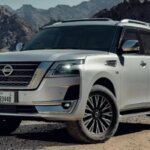 Nissan Patrol vs Armada: Which Full-Size Nissan SUV Is Better?
The Prado counters with excellent low-speed diesel torque and much lower solo fuel consumption.
Heavy Towing Favours the Patrol's Power
If we're regularly hauling something approaching 3.5 tonnes, the Patrol's performance advantage becomes meaningful.
Long climbs, highway merging and overtaking are simply easier when almost 300kW is available.
The new Y63 pushes the gap even further. Nissan has confirmed a 3,700kg braked towing capacity together with 700Nm of torque for the Australian model.
That will move the next-generation Patrol beyond the Prado's current 3,500kg headline figure.
But Always Check Payload and Combined Limits
A towing rating isn't a permission slip to load everything until the suspension groans.
Passengers, luggage, accessories, tow-ball download, bullbars and camping equipment all affect actual vehicle mass and legal load limits.
For serious caravan buyers, we would calculate the complete loaded setup rather than simply comparing the 3,500kg printed in a brochure.
Off-Road Ability: Prado vs Patrol in the Dirt
Neither vehicle is pretending to be an off-roader.
Both come from genuine 4WD bloodlines and use architectures designed for demanding terrain rather than merely looking adventurous outside a café.
The Patrol uses independent suspension at both ends, while the Prado combines double-wishbone front suspension with a four-link rigid rear axle. Toyota also offers Adaptive Variable Suspension on VX and Kakadu models.
The resulting character is different.
Patrol Off-Road Strengths
The Patrol brings excellent ground clearance, strong wheel control and heaps of usable power. Nissan quotes 273mm of minimum ground clearance for the Ti and Ti-L, plus a 34.4-degree approach angle for the Ti.
Its 4WD hardware and rear differential lock make it far more than a luxury SUV wearing muddy boots.
The biggest obstacle is sometimes the Patrol itself.
At 5,175mm long and 1,995mm wide, it is a substantial machine.
On broad desert tracks, that hardly matters. On a narrow forest trail bordered by trees and rocks, those dimensions suddenly feel as subtle as carrying a dining-room table through a hallway.
Prado Off-Road Strengths
The Prado is shorter at 4,990mm, although at 1,980mm wide the latest generation is hardly tiny. Toyota quotes a 12.0m kerb-to-kerb turning circle compared with the Patrol's 12.5m figure.
That smaller footprint can make positioning the Prado easier on technical trails.
Toyota's off-road heritage also runs deep. Depending on grade, buyers can access increasingly sophisticated suspension, traction and terrain-control systems.
Which Would We Take Into the Bush?
For narrow, technical exploration, we'd lean toward the Prado.
For broad tracks, sand, remote touring or adventures where effortless power and cabin space matter just as much as manoeuvrability, the Patrol becomes extremely tempting.
There isn't a weak vehicle here. There are simply different tools for different terrain.
Size and Practicality: Patrol Is the Bigger Beast
Nobody climbs into a Patrol and wonders whether Nissan made it big enough.
The outgoing Australian Ti measures 5,175mm long, 1,995mm wide and 1,940mm high, riding on a 3,075mm wheelbase. The Ti-L is slightly taller at 1,955mm.
The current Prado is 4,990mm long and 1,980mm wide, with a 2,850mm wheelbase. Depending on grade, height is around 1,925–1,935mm.
That means the Patrol is roughly 185mm longer and has a wheelbase 225mm longer.
For passengers, that scale is welcome.
For city parking spaces, perhaps less so.
Interior Space and Family Use
Families are likely to appreciate the Patrol's broader cabin and overall sense of space.
It feels like a genuine full-size SUV rather than a medium SUV expanded by clever packaging. Adults sitting across multiple rows have more physical vehicle surrounding them, and the Patrol's width is particularly noticeable when shoulders start competing for territory.
The Prado remains highly practical, but buyers should pay attention to grade.
Toyota's Australian range includes five- and seven-seat configurations depending on version. The GX and Altitude are five-seaters, while the VX and Kakadu seat seven; the GXL is available in five- or seven-seat form according to Toyota's published specification information.
For large families using the third row constantly, our decision should therefore be based on more than badge preference.
City Driving: Prado Is Easier to Live With
This may be where the Prado quietly wins more buyers than any spectacular off-road specification does.
The Patrol is comfortable in town, but physics remains physics.
At nearly 5.2 metres long and almost two metres wide before mirrors, underground car parks can become an exercise in spatial mathematics. Tight supermarket parking spaces are not impossible, but we're rarely going to describe them as fun.
The Prado's 12.0m turning circle also shades the Patrol's 12.5m figure.
This content may interest you!Nissan Patrol vs Ford Everest Australia: Which SUV Wins?If our 4WD spends Monday to Friday negotiating suburbs and only occasionally disappears into the bush, the Toyota is easier to justify.
Highway Comfort: Patrol Fights Back
Give the Patrol some open road and suddenly its size stops feeling inconvenient.
The long wheelbase, generous cabin, substantial kerb mass and independent suspension create an easygoing touring personality. It settles into highway speeds with the composure of a lounge room travelling at 100km/h.
The V8's power reserve makes overtaking effortless too.
The Prado is also a very capable long-distance vehicle. Its strongest advantage is that the fuel gauge moves far more slowly.
So our preference depends on what "touring comfort" means. If it means effortless performance and room, Patrol. If it means travelling farther on less fuel in a still-comfortable 4WD, Prado.
Payload and Weight: Don't Ignore the Numbers
Big vehicles are not automatically payload champions.
The Patrol Ti has a published kerb mass of 2,786kg and GVM of 3,500kg; Nissan lists a carrying capacity of 719kg on its current specifications page. The Ti-L is heavier at 2,847kg.
Current Prado kerb weights range from roughly 2,495kg to 2,595kg, depending on grade, with GVM figures between 3,100kg and 3,200kg.
For touring builds, every accessory matters.
A bullbar, winch, second spare, drawers, fridge, passengers and tow-ball load can consume payload astonishingly quickly. We'd check the precise variant rather than assuming either model can carry unlimited camping gear.
Reliability and Mechanical Simplicity
This part deserves nuance.
The outgoing Patrol's 5.6-litre V8 has been around for years, which gives owners and independent mechanics a substantial body of experience with the platform. A naturally aspirated petrol engine also avoids some of the complexity associated with highly boosted modern powertrains.
The Prado's 2.8-litre turbo-diesel is similarly familiar within Toyota's broader 4WD family, though current vehicles combine it with increasingly sophisticated electronics and a 48V system.
Neither should be described as indestructible. No modern 4WD is.
Maintenance history, operating conditions, modifications and previous towing use matter enormously, particularly when buying second-hand.
Prado's Reputation Is a Real Ownership Advantage
Toyota's reputation for durability is not merely an advertising slogan; it influences buyer confidence, parts familiarity and the used market.
For remote travellers, the popularity of Toyota 4WDs can also be reassuring because workshops across regional Australia are likely to have significant experience with them.
The Patrol likewise enjoys a devoted Australian following, particularly among enthusiasts who appreciate its drivetrain strength and modification potential.
Running Costs: Prado Is the Sensible Choice
Fuel alone tilts this comparison heavily toward the Prado.
Compare the official figures of 7.6L/100km versus 14.4L/100km, and the scale becomes obvious.
Even allowing for the gap between laboratory testing and real driving, somebody travelling 20,000 or 30,000km annually could see a meaningful difference in fuel expenditure.
Tyres, insurance, servicing and consumables will depend on model, grade and usage, but the Patrol's greater appetite for premium unleaded is impossible to ignore.
Anyone buying a V8 Patrol should go in with eyes open. The exhaust note may make us smile; the petrol receipt occasionally won't.
Prado vs Patrol for Long-Distance Touring
Here the answer becomes beautifully frustrating: both make excellent touring vehicles.
The Prado gives us outstanding efficiency, 110 litres of fuel capacity, strong diesel torque and slightly more manageable dimensions.
The Patrol gives us immense interior space, a 140-litre tank, superior power and the relaxed highway manner associated with a much larger SUV.
For a couple travelling enormous distances with relatively light equipment, we'd probably choose the Prado.
For a family towing a substantial caravan across Australia with mountains of luggage, the Patrol's size and performance become much harder to resist.
Technology and Equipment
The newest Prado represents a major leap from the older generation in cabin technology. Higher grades include a 12.3-inch touchscreen with wireless Apple CarPlay and Android Auto, while Toyota Safety Sense bundles driver-assistance features including pre-collision safety technology, radar cruise control, lane departure alert and road-sign assistance.
The outgoing Patrol has also evolved considerably during its long life. Current Ti equipment includes a 12.3-inch multimedia system, wireless smartphone integration and an Around View Monitor. Ti-L adds equipment including Bose premium audio, heated and cooled front seats, a power tailgate and sunroof.
But the Y63 changes the game again.
The 2027 Y63 Patrol Changes This Comparison
Anybody shopping in late 2026 should understand that the Patrol is between generations in Australia.
Nissan announced Australian Y63 pricing and key specifications on 27 August 2026, with orders already opening and customer deliveries planned for early 2027. The range will start at $98,990 MSRP before on-road costs.
More importantly, it is not a mild facelift.
The new Patrol introduces the 317kW/700Nm twin-turbo V6, nine-speed transmission, 3,700kg braked towing capacity, updated ladder frame, extensive new cabin technology and a six-grade Australian range including a PRO-4X model.
Nissan says every Australian Y63 will feature full-time 4WD, low range, an electronic rear differential lock and eight drive and terrain modes.
That makes the decision fascinating.
This content may interest you!Nissan Patrol vs Land Cruiser Australia: Which 4WD Is Better?Buyers who love the character of a naturally aspirated V8 may actively prefer the outgoing Y62. Buyers wanting maximum performance, technology and towing capacity have a compelling reason to wait for the Y63.
Nissan Patrol vs Prado for Families
For a big family, we'd generally give the Patrol the advantage for pure cabin generosity.
It simply starts with a larger canvas.
But size isn't automatically convenience. If one parent spends most weekdays navigating multi-storey car parks, school zones and tight suburban streets, the Prado can make everyday life considerably easier.
This is the question we'd ask ourselves:
Do we need the biggest vehicle during 95% of our driving, or only during the 5% when we're on holiday?
The answer often determines the winner.
Which Is Better for Serious Off-Road Modification?
Both platforms have healthy Australian aftermarket ecosystems.
We can find suspension kits, protection equipment, roof systems, snorkels, long-range solutions, towing accessories and camping equipment for either vehicle.
The Patrol is especially attractive to enthusiasts chasing power and large touring builds. The Prado appeals to people trying to balance touring capability with manageable dimensions and fuel consumption.
Before modifying either one aggressively, however, we'd plan the finished vehicle's weight first. Building the dream expedition rig and then discovering it has almost no remaining legal payload is a rather expensive punchline.
Nissan Patrol vs Toyota Prado: Pros and Cons
If we reduce the entire comparison to its core strengths, the decision becomes clearer:
- Choose the Nissan Patrol if we prioritise power, interior space, effortless heavy touring, V8 character in the outgoing Y62 or the massive 317kW/700Nm performance promised by the incoming Y63.
- Choose the Toyota Prado if we prioritise fuel economy, everyday manoeuvrability, diesel touring range and a more balanced city-to-bush ownership experience.
- Choose the Patrol for heavy towing when effortless performance matters more than fuel consumption.
- Choose the Prado for frequent long-distance driving when operating costs matter.
- Choose the Prado for tighter trails and urban parking, particularly if the vehicle must serve as a daily driver.
- Choose the Patrol for space-hungry families and owners who simply enjoy driving something that feels unapologetically substantial.
- Wait for the Y63 Patrol if the newest drivetrain, 3,700kg towing rating and cabin technology are priorities and an early-2027 delivery works for us.
Nissan Patrol vs Toyota Prado: Which Is Better Value?
Value is more complicated than price.
A cheaper vehicle that burns substantially more fuel may become more expensive across several years. Likewise, paying more for additional capability we regularly use can be smarter than buying a cheaper vehicle and discovering it cannot comfortably perform the required job.
The Prado's efficiency gives it a major total-cost advantage for high-kilometre owners.
The Patrol makes its case differently. We get more engine, more physical vehicle and, particularly in the Y62, an increasingly rare large naturally aspirated V8.
The right value equation therefore depends on use rather than merely the amount printed on the windscreen.
Who Should Buy the Nissan Patrol?
The Patrol suits buyers who need genuine full-size SUV space and don't want their engine to feel remotely intimidated by the size of the vehicle.
It makes particular sense for large families, regular caravan towers, remote-tourer builds and drivers who value performance more highly than fuel efficiency.
The outgoing Y62 also occupies an interesting place in automotive history. Large naturally aspirated V8 family 4WDs are disappearing rapidly. Anyone specifically wanting that experience may see the final Y62s as especially appealing.
For everybody else, the incoming Y63 looks like the more advanced proposition.
Who Should Buy the Toyota Prado?
The Prado makes sense for an exceptionally broad audience.
It is serious enough for remote touring, rated to tow 3,500kg, economical enough to cover huge distances without horrifying fuel bills and manageable enough to function as a normal family vehicle.
That versatility is its superpower.
The Prado rarely wins this comparison by shouting louder than the Patrol. It wins by asking fewer compromises from its owner.
And sometimes that's exactly what makes a great 4WD great.
Final Verdict: Nissan Patrol or Toyota Prado?
So where do we land in the Nissan Patrol vs Toyota Prado debate?
For most buyers looking for one 4WD to handle commuting, family duties, touring and occasional towing, we'd lean toward the Toyota Prado. Its 2.8-litre diesel, substantially lower official fuel consumption and slightly smaller dimensions make it the easier all-rounder.
But "most practical" doesn't mean "best for everyone."
The Nissan Patrol is the more exciting choice when power, towing performance, cabin size and long-distance comfort dominate our priorities. The outgoing Y62's V8 gives it a character the Prado simply cannot imitate.
And the incoming Y63 raises the stakes dramatically. With 317kW, 700Nm and a 3,700kg braked towing capacity, Nissan's next Patrol will turn what was already the stronger performer into an even more formidable towing and touring machine.
Our simplest verdict is therefore this:
Prado for efficiency and everyday versatility. Patrol for power, space and heavy-duty touring.
Neither choice is wrong.
One feels like an exceptionally capable tool that fits neatly into everyday life. The other feels like bringing a sledgehammer to the job — gloriously excessive until the moment we actually need a sledgehammer.
Frequently Asked Questions
1. Is a Nissan Patrol better than a Toyota Prado?
The Patrol is better if we prioritise engine performance, interior space and effortless towing. The Prado is generally better for fuel economy, urban manoeuvrability and owners covering large annual distances. The better vehicle depends heavily on how it will be used.
2. Which is better for towing, Patrol or Prado?
Current Australian Y62 Patrol and Prado models both offer up to 3,500kg braked towing capacity. The Patrol's stronger petrol V8 can make heavy towing feel more effortless. The incoming Y63 Patrol increases the maximum braked towing capacity to 3,700kg.
3. Which uses less fuel, Toyota Prado or Nissan Patrol?
The Prado wins comfortably. Toyota quotes 7.6L/100km combined for the current 2.8-litre turbo-diesel Prado, while Nissan quotes 14.4L/100km for the outgoing 5.6-litre V8 Patrol. Actual consumption varies with driving conditions, load, modifications and towing.
This content may interest you!Nissan Patrol vs Mitsubishi Pajero Australia: Which 4WD Wins?4. Is the Prado easier to drive around town than the Patrol?
Generally, yes. The Prado is shorter and has a smaller published turning circle. The current Prado measures 4,990mm long with a 12.0m turning circle, compared with 5,175mm and 12.5m for the outgoing Patrol.
5. Should I buy a Y62 Patrol now or wait for the Y63?
Buy the Y62 if you specifically want the character and proven familiarity of the 5.6-litre naturally aspirated V8. Waiting for the Y63 makes more sense if you want Nissan's newest technology, 317kW/700Nm twin-turbo V6, nine-speed transmission and 3,700kg towing capacity. Nissan says first Australian customer deliveries will begin in early 2027.
Leave a Reply