
Toyota HiLux vs LandCruiser Australia: Which One Should You Buy?

Choosing between the Toyota HiLux and Toyota LandCruiser in Australia sounds simple until we look closely at what each vehicle is actually designed to do.
Both are legendary Toyota 4WDs. Both can tow serious loads, travel long distances, tackle difficult Australian tracks and handle conditions that would quickly expose the weaknesses of a normal SUV.
But they serve noticeably different buyers.
The Toyota HiLux is fundamentally a ute. It makes sense for tradies, farmers, campers, fleet operators and anyone who wants a separate tray or tub for equipment, tools and dirty gear.
The Toyota LandCruiser, particularly the LandCruiser 300, is primarily a large 4WD wagon. It offers considerably more passenger comfort, stronger performance and greater refinement while retaining serious towing and off-road capability.
Then we have the LandCruiser 70 Series, which complicates the comparison because it is much closer to the HiLux in its work-oriented philosophy.
So, instead of simply asking whether the HiLux or LandCruiser is better, we need to ask something more useful: which Toyota makes more sense for the way we actually drive in Australia?
- Toyota HiLux vs LandCruiser Australia: Quick Comparison
- Toyota HiLux vs LandCruiser Price in Australia
- Engine and Performance
- Toyota HiLux vs LandCruiser Fuel Economy
- HiLux vs LandCruiser Towing Capacity
- Payload and Carrying Equipment
- Toyota HiLux vs LandCruiser Off-Road
- What About the LandCruiser 70 Series?
- Interior and Comfort
- HiLux vs LandCruiser for City Driving
- HiLux vs LandCruiser for Australian Road Trips
- Reliability and Durability
- HiLux vs LandCruiser Running Costs
- HiLux vs LandCruiser for Camping
- Which Is Better for Beach Driving?
- Toyota HiLux vs LandCruiser for Families
- Toyota HiLux vs LandCruiser for Work
- HiLux or LandCruiser for Remote Australia?
- Major Advantages of Each Toyota
- Is the LandCruiser Better Than the HiLux?
- Toyota HiLux vs LandCruiser: Which One Makes the Most Sense?
- Frequently Asked Questions
- Conclusion: Toyota HiLux vs LandCruiser Australia
Toyota HiLux vs LandCruiser Australia: Quick Comparison
For most buyers, the key differences look like this:
| Feature | Toyota HiLux 4x4 | LandCruiser 300 | LandCruiser 70 |
|---|---|---|---|
| Vehicle type | Ute | Large 4WD SUV | Heavy-duty 4WD |
| Main diesel engine | 2.8L turbo-diesel | 3.3L twin-turbo V6 diesel | 2.8L turbo-diesel |
| Diesel power | 150kW | 227kW | Around 150kW |
| Diesel torque | Up to 500Nm | 700Nm | Up to 500Nm |
| Braked towing | Up to 3,500kg | 3,500kg | 3,500kg |
| Drivetrain | Part-time 4WD on 4x4 models | Permanent 4WD | Heavy-duty 4WD |
| Main advantage | Practicality and value | Comfort and performance | Ruggedness |
| Best suited to | Work and recreation | Touring and family use | Heavy-duty work and remote travel |
Toyota's current-generation HiLux uses a 2.8-litre turbo-diesel four-cylinder producing 150kW and up to 500Nm with the automatic transmission. Toyota also offers V-Active 48V technology on selected automatic versions.
The LandCruiser 300's 3.3-litre twin-turbo diesel produces substantially more output at 227kW and 700Nm and is paired with a 10-speed automatic transmission and permanent four-wheel drive.
Which LandCruiser Are We Comparing With the HiLux?
This is important.
Someone searching Toyota HiLux vs Land Cruiser Australia could realistically be considering three different Toyota vehicles: the HiLux, LandCruiser 300 and LandCruiser 70.
The LandCruiser 300 is the natural comparison if we want an SUV for towing, family touring and long-distance driving.
The LandCruiser 70 Series is the more relevant comparison if our priorities are work, durability, remote-area driving and carrying heavy equipment.
We will therefore concentrate on the LC300 but include the LC70 whenever its characteristics make it the more relevant alternative.
Toyota HiLux vs LandCruiser Price in Australia
Price is one of the biggest differences.
The new-generation HiLux range starts at $33,990 before on-road costs for the 4x2 WorkMate single-cab chassis manual. Moving into the 4x4 range increases prices, while the Rogue and Rugged X double-cab 4x4 variants are listed at $71,990 before on-roads.
That makes the HiLux accessible at a much lower level than the LandCruiser 300.
The LandCruiser also extends much further into premium territory. Toyota added its performance-hybrid powertrain to the flagship 300 Series Sahara ZX and GR Sport, with 2026 pricing starting at $156,060 for the GR Sport hybrid and $156,810 for the Sahara ZX hybrid before on-road costs.
The LC70 sits somewhere between the HiLux and LC300 in philosophy and pricing. Toyota has listed its 2.8-litre 70 Series from around the mid-$70,000 range before on-road costs depending on body and specification.
Is a LandCruiser Worth the Extra Money Over a HiLux?
That depends heavily on what we expect from the vehicle.
We are not simply paying extra for a LandCruiser badge.
A LandCruiser 300 gives us a more powerful engine, permanent four-wheel drive, a more sophisticated suspension setup, superior rear-seat accommodation, better sound insulation and considerably more SUV-style comfort.
But none of those advantages necessarily matter to someone who needs a tray for tools every morning.
For a tradie carrying compressors, building materials, muddy boots and equipment, spending substantially more on an LC300 could actually make the vehicle less useful.
Engine and Performance
Here the differences become obvious.
Toyota HiLux 2.8 Turbo-Diesel
The Australian 2026 HiLux range standardises Toyota's 2.8-litre 1GD-FTV turbo-diesel four-cylinder engine.
It produces 150kW.
Automatic versions develop 500Nm, while manual versions produce 420Nm. Selected automatic double-cab versions also feature Toyota's 48V V-Active system.
Those figures are more than adequate for normal Australian ute duties.
A HiLux does not feel like a performance vehicle, but the 500Nm automatic offers strong low-speed response and enough torque for towing, overtaking and off-road driving.
LandCruiser 300 3.3 Twin-Turbo Diesel
The LandCruiser 300 takes a substantial step upward.
Its 3.3-litre twin-turbo V6 diesel generates 227kW and 700Nm, feeding a 10-speed automatic transmission.
The difference is especially noticeable when we load the vehicle or attach a caravan.
The LandCruiser does not have to work as hard to maintain speed, climb hills or accelerate while towing.
LandCruiser 300 Performance Hybrid
Australia now also receives the LC300 i-FORCE MAX performance hybrid in Sahara ZX and GR Sport specifications.
The 3.5-litre twin-turbo petrol V6 hybrid system produces a combined 341kW and 790Nm, making it the most powerful production LandCruiser powertrain Toyota has offered in Australia.
This hybrid is designed primarily around performance rather than simply maximising fuel economy.
Toyota HiLux vs LandCruiser Fuel Economy
The smaller HiLux generally has the advantage when we're trying to minimise fuel consumption.
Depending on configuration, official combined consumption for current 4x4 HiLux diesel variants sits roughly in the low-to-mid 7L/100km range under laboratory testing, although real-world fuel consumption will depend heavily on load, tyres, accessories, terrain and driving style.
By comparison, Toyota has previously published an official combined figure of 8.9L/100km for the LC300 diesel.
Real-world touring consumption can be considerably higher for either vehicle once we add a bullbar, roof rack, larger tyres, camping equipment or a caravan.
Which Is Better for Long-Distance Fuel Costs?
For drivers covering huge distances without needing the LC300's additional performance or cabin space, the HiLux can make considerable sense.
Its smaller engine, lower mass and lower purchase price all work in its favour.
This content may interest you!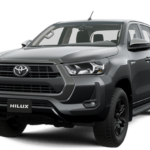 Toyota HiLux vs Ford Ranger Raptor Australia: Which Ute Is Better in 2026?
The LandCruiser counters with a larger fuel capacity and the ability to carry passengers and luggage inside a secure wagon body.
For remote touring, those differences can matter almost as much as the litres-per-100km number.
HiLux vs LandCruiser Towing Capacity
Here we have an interesting result.
Both can tow up to 3,500kg braked in appropriate configurations. Toyota specifies a 3,500kg braked towing capacity for HiLux 4x4 variants as well as the LandCruiser 300 and LandCruiser 70.
So does that mean they're equally good tow vehicles?
Not necessarily.
Which Is Better for Towing a Caravan?
If we are towing a large caravan regularly, the LandCruiser 300 has several inherent advantages.
Its 700Nm diesel engine provides considerably more torque than the 500Nm automatic HiLux. The LandCruiser is also heavier, uses permanent four-wheel drive and has a longer-distance touring focus.
That can make it feel more composed with a substantial trailer behind it.
A HiLux can still be an excellent tow vehicle, particularly when we also need a ute tub. However, once we start approaching maximum towing weights, calculations involving GVM, GCM, axle loads, payload and tow-ball mass become extremely important.
A nominal 3,500kg towing rating does not mean we can load the vehicle to its maximum payload and simultaneously tow 3,500kg.
Payload and Carrying Equipment
This is where the HiLux starts fighting back.
Its entire layout is built around carrying cargo.
A cab-chassis HiLux can be configured with different tray arrangements, while a pick-up gives us a separate tub where we can throw tools, camping equipment, firewood, muddy recovery gear or even wet equipment without making the passenger compartment filthy.
That separation is difficult to replicate in an SUV.
HiLux for Tradies
For many Australian trades, the choice becomes fairly straightforward.
A HiLux can function as both a work vehicle during the week and a family adventure ute on weekends.
We can add a canopy, drawers, roof rack, fridge, second battery, toolboxes or service body and essentially build the vehicle around a particular profession.
LandCruiser for Touring Families
A LandCruiser 300 takes the opposite approach.
Its enclosed interior is much better suited to passengers, luggage and family touring.
There is no exposed ute tub, and second-row occupants receive a much more SUV-like environment.
So while the HiLux wins for dirty or bulky cargo, the LC300 is usually more convenient when our "payload" consists primarily of people, suitcases and camping equipment.
Toyota HiLux vs LandCruiser Off-Road
Both vehicles have genuine off-road ability, but they behave differently.
The HiLux combines a ladder-frame construction with proper 4WD hardware and is particularly well suited to buyers who want a vehicle capable of moving between job sites, trails and remote camping areas.
Toyota's 2026 generation also introduced improvements including electric power steering and upgraded technology while maintaining its utility-focused design.
The LC300 takes a more sophisticated approach.
Every LandCruiser 300 includes low-range gearing and a locking centre differential, while Toyota offers additional terrain-management hardware depending on specification.
HiLux Off-Road Advantages
The HiLux's biggest advantage is not necessarily a specification on paper.
It is its combination of capability, size, practicality and lower purchase cost.
If we scratch a HiLux on a narrow bush track, it can hurt a little less emotionally than scraping the side of a six-figure luxury LandCruiser.
The ute configuration also gives us enormous freedom to install off-road and touring accessories.
LandCruiser Off-Road Advantages
The LC300's strength lies in combining serious off-road capability with refinement.
It can cross difficult terrain and then settle immediately into a comfortable highway cruise.
Toyota equips the platform with permanent 4WD, low range and various electronic off-road systems, while the GR Sport is particularly focused on difficult terrain.
For buyers who travel deep into the Australian outback but still want a comfortable everyday family vehicle, that combination is difficult to ignore.
What About the LandCruiser 70 Series?
If our idea of a LandCruiser is a rugged workhorse rather than a luxury wagon, the 70 Series deserves separate consideration.
Current LC70 models use Toyota's 2.8-litre turbo-diesel four-cylinder and offer automatic or manual transmission configurations depending on variant and availability. Toyota rates the range for up to 3,500kg braked towing and offers wagon, Troop Carrier and cab-chassis body styles.
The LC70 is therefore the LandCruiser that competes most directly with heavy-duty HiLux variants.
HiLux vs LandCruiser 70
We would choose between them mainly according to workload.
The HiLux is more modern, easier to live with around town and available across a huge variety of configurations at lower price points.
The LC70 prioritises heavy-duty engineering, remote-area use and traditional 4WD toughness.
Interestingly, both now share a version of Toyota's 2.8-litre turbo-diesel.
But similar engine outputs do not make them identical vehicles. Their chassis, dimensions, suspension layouts and intended applications remain different.
Interior and Comfort
If comfort is a priority, the LC300 has a clear advantage.
This content may interest you!Toyota HiLux vs Prado Australia: Which Toyota 4WD Makes More Sense?It is designed from the beginning as a large passenger 4WD.
Road noise is better controlled, seating is more substantial, rear passenger accommodation is more appropriate for long journeys and higher grades offer luxury equipment that simply isn't the purpose of a HiLux.
The new HiLux has improved considerably, though.
Toyota redesigned the interior for the latest generation and upgraded its multimedia, active-safety and comfort technology.
A HiLux SR5 or Rogue can therefore work perfectly well as an everyday family vehicle.
It simply doesn't hide its commercial-vehicle roots as effectively as the LC300.
HiLux vs LandCruiser for City Driving
Neither vehicle is exactly a small urban runabout.
However, there are different disadvantages.
The HiLux is long. A double-cab ute can become awkward in tight underground car parks, especially when accessories such as tow bars and bullbars are installed.
The LandCruiser 300 is shorter than some HiLux configurations but substantially wider and still physically imposing.
We would generally find the modern HiLux relatively easy to manoeuvre thanks to its lighter steering, but the LC300 provides the more refined driving experience.
If most journeys involve inner-city traffic and shopping-centre car parks, though, we should probably ask whether we need either vehicle's full capability.
HiLux vs LandCruiser for Australian Road Trips
This is one area where the LandCruiser 300 really justifies its existence.
Imagine travelling from Melbourne to Darwin, crossing Western Australia or spending several weeks touring Queensland with the family.
Passenger comfort becomes increasingly important with every hour behind the wheel.
The LC300 gives us stronger overtaking performance, a comfortable wagon cabin and a drivetrain designed around long-distance touring.
The HiLux is still an excellent road-trip vehicle, especially when fitted with a canopy or touring setup.
However, passengers sitting in the second row are likely to appreciate the LandCruiser more after several thousand kilometres.
Reliability and Durability
Toyota has built both nameplates around reputations for durability, but reliability is never guaranteed simply because a vehicle carries a HiLux or LandCruiser badge.
Maintenance remains essential.
Diesel emissions equipment, modern electronics, turbochargers, transmissions, cooling systems and 4WD components all need proper servicing.
The latest vehicles also contain considerably more technology than old HiLux and LandCruiser models.
For remote Australian travel, we would put just as much emphasis on preventative maintenance, tyre condition, spare parts, fuel planning and vehicle preparation as we would on the badge attached to the grille.
HiLux vs LandCruiser Running Costs
The HiLux will normally be the less expensive vehicle to own.
The purchase price is considerably lower, there are many fleet-focused configurations, and its 2.8-litre diesel generally uses less fuel than the larger LC300.
The LandCruiser will typically cost more in areas such as insurance, tyres, purchase finance and potentially registration depending on location and specification.
Accessories can dramatically change the equation for both vehicles.
A relatively affordable HiLux can quickly become expensive after adding a premium canopy, suspension, bullbar, winch, roof rack, auxiliary battery system and touring equipment.
HiLux vs LandCruiser for Camping
For camping, there is no universal winner because the two vehicles encourage different setups.
A HiLux with a canopy is arguably one of the most flexible camping platforms available. We can build drawers, a fridge slide, kitchen, electrical system and rooftop tent around the rear tray.
The equipment also stays separate from passengers.
A LandCruiser offers the convenience and security of an enclosed wagon and is especially attractive for families.
For towing a caravan and travelling long highway distances between campsites, the LC300 becomes particularly compelling.
For carrying messy gear and building a customised touring setup, the HiLux has the advantage.
Which Is Better for Beach Driving?
Both can perform extremely well on Australian beaches when driven appropriately.
Tyre pressures, vehicle weight, sand conditions, tides and driver technique matter enormously.
The HiLux's lower overall mass in many configurations can be beneficial on soft sand, while the LC300's permanent 4WD, strong torque and sophisticated traction systems provide excellent capability.
Neither vehicle makes us immune to getting bogged.
Carrying suitable recovery equipment and knowing how to use it matters far more than simply having "LandCruiser" or "HiLux" written on the tailgate.
Toyota HiLux vs LandCruiser for Families
For a family that does not specifically need a ute tray, we would generally find the LandCruiser 300 easier to live with.
It gives passengers a proper SUV cabin and provides more refinement on long trips.
Certain LC300 grades also provide seven-seat configurations, broadening their usefulness for larger families.
A HiLux double cab still makes sense for families who regularly carry bicycles, camping gear, surfboards, tools or equipment that would be inconvenient inside an SUV.
The key question is whether we need passenger space or cargo separation more often.
This content may interest you! Toyota LandCruiser vs Prado Australia: Which 4WD Is Better?
Toyota HiLux vs LandCruiser for Work
For everyday commercial use, the HiLux is difficult to beat.
Toyota offers single-cab, extra-cab and double-cab configurations together with cab-chassis and pick-up bodies.
That variety makes it possible to configure the vehicle around the job instead of adapting the job to the vehicle.
The LandCruiser 300 is far less suitable for traditional ute work.
If we need LandCruiser toughness with a tray, the 79 Series LandCruiser 70 cab-chassis becomes the relevant alternative instead.
HiLux or LandCruiser for Remote Australia?
Remote travel changes the equation.
We need to think beyond horsepower and infotainment screens.
Fuel range, payload, tyres, spare parts availability, recovery equipment and how much weight we're carrying become extremely important.
The LandCruiser has an extraordinary reputation in remote Australian conditions, particularly the 70 Series.
But the HiLux is hardly unusual in remote areas either.
For many buyers, a properly prepared HiLux provides more than enough capability at a much lower initial cost.
For extremely demanding workloads or long-term outback touring, a LandCruiser may offer characteristics that justify the additional investment.
Major Advantages of Each Toyota
The decision becomes easier if we reduce each vehicle to its strongest qualities:
- Choose the HiLux when we need a tray or tub, lower purchase cost, better work flexibility, strong towing capability and easier justification as a commercial vehicle. Choose the LandCruiser 300 when passenger comfort, long-distance touring, stronger performance and SUV practicality matter most. Choose the LandCruiser 70 when ruggedness, heavy-duty work and remote-area capability take priority over luxury.
Is the LandCruiser Better Than the HiLux?
Not automatically.
A LandCruiser 300 is undeniably more powerful and more luxurious than a HiLux.
But "better" depends on the job.
Imagine a carpenter choosing between an LC300 Sahara and a HiLux SR5 with a custom canopy.
The HiLux is probably much more useful despite costing far less.
Now imagine a family towing a large caravan from Sydney to Broome.
The LC300's 700Nm diesel engine, permanent 4WD and more comfortable passenger compartment become considerably more appealing.
This is why comparing these vehicles purely by specifications misses the point.
Toyota HiLux vs LandCruiser: Which One Makes the Most Sense?
For the majority of buyers who need an actual ute, the Toyota HiLux makes more sense.
It delivers serious 4WD ability, a 3,500kg maximum braked towing capacity in relevant 4x4 configurations, strong 2.8-litre diesel performance and enormous flexibility without pushing us into LandCruiser 300 pricing.
The LandCruiser 300 makes more sense when we want an SUV first and a work vehicle second.
Its 227kW/700Nm diesel powertrain offers substantially greater performance, particularly while overtaking or towing, and its cabin is much more appropriate for long-distance family travel.
Meanwhile, the LandCruiser 70 remains the specialist choice for people whose interpretation of "LandCruiser" means a rugged workhorse capable of being configured for serious work or remote touring.
Best for a Tradie
HiLux.
The tub and cab-chassis options give it a practical advantage that an LC300 simply cannot match.
Best for Towing
Both are rated up to 3,500kg braked in relevant configurations, but the LC300's much stronger diesel output makes it particularly attractive for frequent heavy towing. Actual legal towing capability still depends on vehicle loading, GVM, GCM, axle limits and tow-ball mass.
Best for Family Touring
LandCruiser 300.
More passenger comfort and stronger performance make a difference during long Australian road trips.
Best for Serious Work
HiLux for most jobs; LandCruiser 70 for particularly demanding heavy-duty or remote applications.
Best Value
For buyers who actually need a ute, the HiLux offers significantly lower entry pricing while retaining genuine 4WD and towing capability.
Frequently Asked Questions
Is a Toyota HiLux Better Than a LandCruiser?
The HiLux is better suited to buyers who need ute practicality, while the LandCruiser 300 focuses more heavily on passenger comfort, touring and performance. Neither is universally better because their intended roles are different.
Can a Toyota HiLux Tow as Much as a LandCruiser?
Relevant Toyota HiLux 4x4 models, the LandCruiser 300 and LandCruiser 70 are rated for up to 3,500kg braked towing. However, payload, GVM, GCM, axle loads and tow-ball mass must also be considered rather than relying solely on the headline towing number.
Which Is Better for Off-Road Driving, HiLux or LandCruiser?
Both are highly capable. The HiLux provides excellent capability for its price and can be extensively modified, while the LC300 combines sophisticated 4WD technology with greater comfort. The LC70 remains particularly attractive for heavy-duty remote-area applications.
Is a LandCruiser More Powerful Than a HiLux?
Yes. The HiLux's current 2.8-litre turbo-diesel produces 150kW and up to 500Nm, compared with 227kW and 700Nm from the LC300's 3.3-litre twin-turbo diesel. The flagship LC300 performance hybrid increases output to 341kW and 790Nm.
Should I Buy a HiLux or LandCruiser for Touring Australia?
A LandCruiser 300 is particularly well suited to long-distance family touring because of its comfort, power and wagon layout. A HiLux may make more sense when we need to carry camping equipment in a separate tub or canopy, especially if we want to build a customised touring setup.
Conclusion: Toyota HiLux vs LandCruiser Australia
The Toyota HiLux vs LandCruiser Australia comparison ultimately comes down to something far more important than power figures or badge prestige: what do we actually need the vehicle to do?
The HiLux is the more versatile working vehicle. It is substantially cheaper to enter, available in numerous body configurations and capable of functioning as a tradie's vehicle from Monday to Friday before becoming a camping, towing or off-road vehicle on the weekend.
The LandCruiser 300 is the more complete long-distance SUV. Its stronger 3.3-litre twin-turbo diesel, permanent four-wheel-drive system, more comfortable cabin and excellent towing credentials make it extremely attractive for Australian families travelling long distances or towing large caravans.
And if maximum ruggedness matters more than refinement, the LandCruiser 70 remains the bridge between those two worlds.
For work, carrying equipment and value, the HiLux is extremely difficult to overlook.
For family touring, comfort, performance and frequent heavy towing, the LandCruiser 300 has major advantages.
This content may interest you! Ford Everest vs Land Cruiser 300 Australia: Which Big 4WD Should We Buy?
For hardcore work and remote-area durability, we should also put the LandCruiser 70 firmly on the shortlist.
The best Toyota is therefore not necessarily the biggest or most expensive one. It is the one whose design matches what we actually plan to do with it across Australia's roads, worksites and tracks.
Leave a Reply