
Toyota LandCruiser 200 Series Towing Capacity Australia: Complete Guide

The Toyota LandCruiser 200 Series has earned a near-mythical reputation across Australia. We see it hauling caravans through the Nullarbor, towing boats towards remote boat ramps, and dragging camper trailers along corrugated outback tracks. It is big, powerful, comfortable, and seemingly built from the same ingredients as a railway locomotive.
But how much can a Toyota LandCruiser 200 Series actually tow?
For Australian-delivered models, the headline figure is generally 3,500 kg of maximum braked towing capacity. That sounds straightforward, but towing weights rarely behave like a single number printed on a brochure. Vehicle payload, tow-ball download, Gross Vehicle Mass, Gross Combination Mass, axle loads, passengers, fuel and accessories all affect how much we can legally and safely tow.
In other words, the LandCruiser 200 may be a heavyweight towing machine, but even heavyweights must step onto the scales.
This guide explains the Toyota LandCruiser 200 Series towing capacity in Australia, including its practical limits, important weight definitions, petrol-versus-diesel considerations, caravan suitability and the common mistakes that can leave an apparently legal setup overloaded.
- What Is the Toyota LandCruiser 200 Series Towing Capacity?
- LandCruiser 200 Series Towing Specifications at a Glance
- Understanding the Important Towing Weight Terms
- How Tow-Ball Weight Reduces LandCruiser Payload
- Can the LandCruiser 200 Tow a 3,500 kg Caravan?
- Diesel LandCruiser 200 Towing Capacity
- Petrol LandCruiser 200 Towing Capacity
- Does the LandCruiser 200 Need Electric Brakes?
- Is a Weight-Distribution Hitch Required?
- LandCruiser 200 GVM and Payload Problems
- Can We Upgrade the LandCruiser 200 Towing Capacity?
- How to Calculate a Safe Towing Setup
- Towing a Caravan Safely with a 200 Series
- Common LandCruiser 200 Towing Mistakes
- Is the LandCruiser 200 a Good Tow Vehicle?
- What Caravan Weight Suits a LandCruiser 200?
- Pre-Towing Checklist for Australian Owners
- Final Thoughts
- Frequently Asked Questions
- 1. What is the Toyota LandCruiser 200 Series towing capacity in Australia?
- 2. What is the maximum tow-ball weight for a LandCruiser 200?
- 3. Can a LandCruiser 200 legally tow a 3.5-tonne caravan?
- 4. Does a GVM upgrade increase the 200 Series towing capacity?
- 5. Is the diesel or petrol LandCruiser 200 better for towing?
What Is the Toyota LandCruiser 200 Series Towing Capacity?
Most Australian Toyota LandCruiser 200 Series models have the following factory towing limits:
- Maximum braked towing capacity: 3,500 kg
- Maximum unbraked towing capacity: typically 750 kg
- Maximum tow-ball download: generally up to 350 kg
- Gross Vehicle Mass: commonly 3,350 kg
- Gross Combination Mass: approximately 6,800–6,850 kg, depending on the applicable model documentation
Toyota advises owners to confirm the exact limits through the vehicle’s owner’s manual, towbar plate and vehicle documentation, because specifications can differ by model year, engine, equipment and towing hardware.
The factory braked towing figure of 3,500 kg applies when the trailer has a compliant braking system. A heavy caravan without functioning brakes does not magically become legal because the LandCruiser is powerful enough to move it.
That distinction matters. Engine strength determines whether the vehicle can pull a load; certified weight limits determine whether it is allowed to.
LandCruiser 200 Series Towing Specifications at a Glance
The following figures provide a useful general reference for many Australian 200 Series variants.
| Specification | Typical Factory Figure |
|---|---|
| Maximum braked towing capacity | 3,500 kg |
| Maximum unbraked towing capacity | 750 kg |
| Maximum tow-ball download | Up to 350 kg |
| Gross Vehicle Mass | Around 3,350 kg |
| Gross Combination Mass | Around 6,800–6,850 kg |
| Typical kerb weight | Approximately 2,600–2,740 kg |
| Approximate factory payload | Roughly 610–750 kg, depending on variant |
A commonly quoted late-model example uses a kerb weight of about 2,740 kg and a GVM of 3,350 kg, leaving approximately 610 kg of payload before passengers, accessories, luggage or tow-ball weight are added.
These are not universal figures for every LandCruiser 200. A petrol GX, diesel GXL and highly equipped Sahara can have different kerb weights. The more factory equipment a vehicle carries, the less remaining payload it may have.
Why the 3,500 kg Figure Is Only the Beginning
A 3,500 kg towing rating does not automatically mean we can attach a 3,500 kg caravan, fill the LandCruiser with seven adults, add a bull bar, mount two spare wheels and head for Cape York.
The 3,500 kg figure is only one ceiling. A towing combination must remain under several limits simultaneously:
- The trailer’s Aggregate Trailer Mass.
- The vehicle’s maximum braked towing capacity.
- The towbar’s rated capacity.
- The maximum permitted tow-ball download.
- The LandCruiser’s Gross Vehicle Mass.
- The Gross Combination Mass.
- The front- and rear-axle load limits.
- The tyres’ load ratings.
Whichever limit we reach first becomes the real limit.
Think of the ratings as doors in a hallway. Passing through the first door does not matter if the next one is locked.
Understanding the Important Towing Weight Terms
Weight terminology can sound like alphabet soup served with a side of engineering jargon. Once we separate the terms, however, the calculation becomes much easier.
Braked Towing Capacity
Braked towing capacity is the maximum permissible weight of a trailer fitted with an appropriate braking system.
For most Australian LandCruiser 200 Series vehicles, this is 3,500 kg in factory form.
A trailer approaching that weight normally requires electric, hydraulic or air-operated brakes that comply with Australian regulations. Requirements can vary according to trailer mass and jurisdiction, so the trailer itself must be correctly engineered and registered.
Unbraked Towing Capacity
Unbraked towing capacity applies to trailers without their own braking system.
For many passenger vehicles and four-wheel drives in Australia, including the 200 Series, the commonly stated ceiling is 750 kg. Owners should still verify the rating listed for their particular vehicle and towbar.
Even when a light trailer is below 750 kg, poor loading can cause instability. A tiny box trailer loaded like a badly balanced seesaw can be more troublesome than a well-designed braked caravan.
Aggregate Trailer Mass
Aggregate Trailer Mass, or ATM, is the maximum permitted total weight of the fully loaded trailer when it is not coupled to the tow vehicle.
ATM includes:
- The trailer itself
- Water
- Gas bottles
- Batteries
- Food
- Clothing
- Camping equipment
- Generator
- Tools
- Accessories
- Everything else carried in or on the trailer
If a caravan has a 3,500 kg ATM, that does not mean it weighs 3,500 kg when empty. It means 3,500 kg is its maximum legal loaded mass.
Gross Trailer Mass
Gross Trailer Mass, or GTM, is the load carried by the trailer’s wheels while the trailer is coupled to the tow vehicle.
The tow-ball download is being carried by the LandCruiser, so it is not included in the weight supported by the trailer axles.
A simplified relationship is:
ATM – tow-ball download = GTM
For example:
- Caravan ATM: 3,200 kg
- Tow-ball download: 300 kg
- Approximate GTM: 2,900 kg
Gross Vehicle Mass
Gross Vehicle Mass, or GVM, is the maximum legal operating weight of the LandCruiser itself.
It includes:
- The vehicle
- Driver and passengers
- Fuel
- Bull bar
- Winch
- Roof rack
- Drawers
- Fridge
- Recovery equipment
- Luggage
- Tow-ball download
- Other accessories and cargo
Many 200 Series examples have a factory GVM of approximately 3,350 kg.
The key point is easy to miss: tow-ball weight counts against the LandCruiser’s payload.
Gross Combination Mass
Gross Combination Mass, or GCM, is the maximum permitted combined operating mass of the tow vehicle and trailer.
Late-model 200 Series figures are often quoted at approximately 6,800 or 6,850 kg, depending on the source and applicable vehicle specification.
We must use the certified figure attached to the individual vehicle rather than assuming every 200 Series is identical.
Why GCM Can Be Misleading
Suppose a LandCruiser has:
- GVM: 3,350 kg
- Maximum towing capacity: 3,500 kg
- GCM: 6,850 kg
At first glance, the numbers appear perfectly matched:
This content may interest you! Ford Everest Towing Capacity Australia: Complete Guide
3,350 kg + 3,500 kg = 6,850 kg
However, tow-ball download is part of the loaded vehicle’s weight and forms part of the trailer’s ATM. This creates an important overlap in ordinary GCM calculations.
As a result, the practical loading arrangement can be constrained by GVM well before the theoretical GCM number appears troublesome. Australian towing analyses frequently identify vehicle payload as the 200 Series’ main limitation when towing a caravan near 3,500 kg.
How Tow-Ball Weight Reduces LandCruiser Payload
Tow-ball weight is the downward force the trailer places on the towbar.
Australian caravans commonly produce ball loads somewhere around 8–12 percent of their loaded mass, although the correct figure depends on the trailer’s design, loading and manufacturer specifications.
Consider a late-model diesel 200 Series with:
- Kerb weight: 2,740 kg
- GVM: 3,350 kg
- Starting payload: 610 kg
- Caravan ball weight: 300 kg
Once the caravan is connected, only around 310 kg of payload remains.
That 310 kg must cover:
- Driver
- Passengers
- Bull bar
- Towbar, where not included in kerb weight
- Fridge
- Drawers
- Recovery equipment
- Luggage
- Roof rack
- Additional fuel
- Other accessories
Two adults, a bull bar and basic touring equipment could consume it rapidly. The vehicle may still pull the caravan without complaint, yet be over its legal GVM.
Example of a Heavily Loaded Touring Setup
Let us build a hypothetical setup.
| Item | Added Weight |
| Two adults | 170 kg |
| Two children | 90 kg |
| Bull bar | 70 kg |
| Winch | 30 kg |
| Drawer system | 60 kg |
| Fridge and slide | 45 kg |
| Recovery gear and tools | 40 kg |
| Roof rack and awning | 45 kg |
| Luggage and food | 70 kg |
| Tow-ball download | 320 kg |
| Total added load | 900 kg |
If the vehicle started with only 610 kg of payload, it would be approximately 290 kg over GVM.
That is the trap. The 200 Series looks enormous, and its twin-turbo diesel feels strong enough to tow a house, but physical size does not create legal payload.
Can the LandCruiser 200 Tow a 3,500 kg Caravan?
Yes, a factory-standard Australian LandCruiser 200 Series can generally be rated to tow a braked trailer with an ATM of up to 3,500 kg.
However, towing at the maximum rating requires careful weight management.
A 3,500 kg caravan with a 350 kg tow-ball download can dramatically reduce the vehicle’s available payload. In one commonly discussed late-model configuration, a nominal 610 kg payload drops to about 260 kg after a 350 kg ball load is applied.
That remaining capacity may not accommodate several passengers and heavy touring accessories.
Therefore, the more useful question is not simply, “Can it tow 3,500 kg?”
We should ask:
Can our specific LandCruiser carry its passengers, equipment and ball load while towing that caravan without exceeding GVM, GCM or axle limits?
Sometimes the answer is yes. Sometimes it is no. The weighbridge decides.
Diesel LandCruiser 200 Towing Capacity
The 4.5-litre twin-turbo diesel V8 is the engine most Australians associate with heavy towing.
Depending on model year, the diesel produced strong torque at relatively low engine speeds, which made it well suited to moving large caravans, boats and trailers. The engine’s broad torque delivery allows the LandCruiser to climb hills without constantly chasing high revs.
The diesel’s main towing advantages include:
- Strong low-speed torque
- Relaxed highway performance
- Good engine braking when the correct gear is selected
- Long-distance touring range
- Wide availability of diesel in regional Australia
- Proven popularity among caravan owners
Its disadvantages include substantial vehicle weight, servicing costs, fuel consumption under load and the need to maintain cooling, fuel and intake systems properly.
The diesel does not receive a higher factory towing rating simply because it feels stronger. Its maximum braked towing capacity remains generally capped at 3,500 kg in standard form.
Real-World Diesel Towing Behaviour
When towing a large caravan, the diesel V8 tends to feel settled rather than frantic. It is less like a sprinter pulling a sled and more like a draught horse leaning into a harness.
Nevertheless, towing performance depends on:
- Caravan frontal area
- Wind direction
- Road gradient
- Ambient temperature
- Tyre pressure
- Vehicle and trailer loading
- Transmission condition
- Driving speed
- Accessory weight
A tall 3,000 kg caravan pushing through a headwind can demand more effort than a streamlined 3,300 kg boat trailer.
Weight tells only half the story; aerodynamic drag writes the other half.
Petrol LandCruiser 200 Towing Capacity
Petrol V8 versions of the LandCruiser 200 also generally carry a maximum braked towing rating of 3,500 kg, subject to the model’s documentation and equipment.
The petrol engine can tow confidently, but it produces its power differently from the diesel. Drivers may notice:
- Higher engine speeds on climbs
- More frequent transmission downshifts
- Higher fuel consumption under heavy load
- Smoother and quieter operation
- Strong performance when allowed to rev
A petrol 200 Series can be an excellent tow vehicle for owners who travel fewer kilometres, find a well-maintained used example or prefer petrol-engine refinement.
Fuel range becomes more important in remote Australia. A heavily loaded petrol V8 towing into a headwind can drink fuel like a thirsty camel arriving at an outback roadhouse.
Petrol Versus Diesel for Towing
| Category | Petrol V8 | Twin-Turbo Diesel V8 |
| Factory towing capacity | Generally 3,500 kg | Generally 3,500 kg |
| Low-rpm torque | Good | Excellent |
| Fuel use while towing | Usually higher | Usually lower |
| Purchase price used | Often lower | Often higher |
| Engine refinement | Smooth and quiet | Strong and relaxed |
| Remote fuel availability | Generally good | Usually excellent |
| Heavy towing popularity | Moderate | Very high |
The diesel is usually the preferred choice for regular long-distance caravan towing. The petrol remains capable, especially when purchase cost, annual kilometres and maintenance history favour it.
Does the LandCruiser 200 Need Electric Brakes?
For a large caravan or trailer, yes, a suitable trailer-brake system is essential.
Australian towing rules generally require heavier trailers to have their own braking system. Trailers above certain weight thresholds may require brakes operating on all wheels and an emergency breakaway system.
A correctly installed electric brake controller allows the driver to manage trailer braking from inside the LandCruiser. It can help the trailer remain controlled during:
- Sudden stops
- Long descents
- Wet weather
- Crosswinds
- Emergency manoeuvres
- Low-speed reversing or adjustment
The controller should be calibrated to the loaded trailer, not merely fitted and forgotten.
Too little trailer braking makes the LandCruiser do excessive work. Too much can cause the trailer wheels to lock. The ideal adjustment feels coordinated, as though the vehicle and trailer are braking as one long machine.
Is a Weight-Distribution Hitch Required?
A weight-distribution hitch uses spring bars to redistribute some load through the tow vehicle and trailer chassis.
This content may interest you!Ford Everest Boot Space: Capacity, Seats and PracticalityIt may improve:
- Vehicle stance
- Steering feel
- Headlight aim
- Front-axle loading
- Stability
However, a weight-distribution hitch does not make excess weight disappear. It cannot legally increase:
- GVM
- GCM
- Towbar rating
- Towing capacity
- Caravan ATM
- Axle ratings
It redistributes forces; it does not erase kilograms.
Owners should also confirm that the tow vehicle, towbar and trailer manufacturer permit the use of a weight-distribution system. Certain off-road couplings, chassis designs and driving conditions may require specific procedures.
LandCruiser 200 GVM and Payload Problems
The LandCruiser 200’s towing ability is impressive, but its standard payload can become tight once touring accessories are fitted.
Popular accessories include:
- Steel bull bar
- Winch
- Underbody protection
- Dual-battery system
- Long-range fuel tank
- Roof platform
- Awning
- Rear drawers
- Fridge
- Rear bar
- Extra spare wheel
- Auxiliary water tank
- Communications equipment
Individually, each item appears manageable. Together, they can consume hundreds of kilograms.
A touring build grows like luggage before a family holiday: one harmless item at a time until the suitcase will no longer close.
Accessories Can Affect Axle Loads
Even when total vehicle weight remains below GVM, one axle may be overloaded.
Heavy rear accessories and caravan ball load place substantial pressure on the rear axle. A rear bar, spare wheel, drawer system, fridge and 300 kg ball load can create a rear-axle problem before the overall GVM is reached.
Likewise, a steel bull bar and winch can significantly load the front axle.
That is why a proper weighing process should record:
- Front-axle weight
- Rear-axle weight
- Total vehicle weight
- Trailer axle weight
- Tow-ball download
- Total combination weight
A single total from a public weighbridge may not reveal where the overload sits.
Can We Upgrade the LandCruiser 200 Towing Capacity?
Certified aftermarket upgrades are available in Australia for some 200 Series vehicles.
Depending on the supplier, state, registration status and engineering approval, packages may increase:
- Gross Vehicle Mass
- Axle ratings
- Gross Combination Mass
- Braked towing capacity
Some certified packages advertise towing upgrades from the original 3,500 kg rating to 4,000 kg, along with revised GCM figures. These are not automatic factory capabilities; they require approved components, certification and compliance with applicable regulations.
A standard GVM upgrade does not necessarily increase towing capacity or GCM. Some packages raise GVM while leaving the original 3,500 kg towing limit and original GCM unchanged.
GVM Upgrade Versus Towing Upgrade
These terms are not interchangeable.
GVM Upgrade
A GVM upgrade increases the maximum legal loaded weight of the LandCruiser itself.
It may help accommodate:
- Accessories
- Passengers
- Cargo
- Tow-ball download
However, it may not increase GCM or towing capacity.
Towing-Capacity Upgrade
A towing upgrade increases the certified maximum trailer weight, potentially from 3,500 kg to 4,000 kg.
It may involve:
- Upgraded suspension
- Revised towbar or coupling components
- Engineering approval
- Revised compliance documentation
- Changes to GCM
- Specific tyre or axle requirements
GCM Upgrade
A GCM upgrade raises the permitted combined mass of the loaded vehicle and trailer.
Without an appropriate GCM revision, increasing GVM can reduce the theoretical trailer mass available when the vehicle is fully loaded.
Before purchasing any upgrade, we should ask the supplier for written confirmation of:
- New GVM
- New GCM
- New towing capacity
- Front-axle rating
- Rear-axle rating
- Tow-ball limit
- Registration requirements
- State and territory recognition
- Pre-registration or post-registration approval status
“Upgraded suspension” is not the same as “legally upgraded vehicle.”
How to Calculate a Safe Towing Setup
We can use the following process before a long trip.
Step 1: Confirm the Vehicle Ratings
Check:
- Owner’s manual
- Towbar plate
- Compliance documents
- Registration modifications
- Engineering certificates
- Tyre load ratings
Do not rely solely on an online advertisement or another owner’s vehicle.
Step 2: Find the Vehicle’s Actual Loaded Weight
Load the LandCruiser exactly as it will travel:
- Full fuel
- Passengers
- Fridge
- Luggage
- Tools
- Recovery gear
- Pets
- Accessories
Then weigh it.
Step 3: Measure the Caravan’s Loaded ATM
The caravan should contain its normal travelling load:
- Water
- Food
- Gas
- Batteries
- Clothing
- Generator
- Outdoor furniture
- Bikes
- Accessories
Many caravans leave the dealer comfortably below ATM and gradually gain weight over time. Modifications accumulate like barnacles on a boat.
Step 4: Measure Tow-Ball Download
Use a suitable ball-weight scale or professional weighing service.
Do not estimate ball weight from the caravan’s brochure. Water tanks, batteries, toolboxes and storage location can change it dramatically.
Step 5: Check Every Limit
Confirm that:
- Actual trailer ATM is below the trailer’s rated ATM.
- Actual trailer mass is below the LandCruiser’s towing capacity.
- Tow-ball download is below the towbar and vehicle limits.
- Loaded LandCruiser mass is below GVM.
- Front and rear axles remain below their limits.
- Combined vehicle and trailer weight remains below GCM.
- Tyres are suitable for their actual loads.
Towing a Caravan Safely with a 200 Series
Legal weight is only the starting point. A stable setup also depends on loading, maintenance and driving technique.
Load Heavy Items Low and Near the Axles
Heavy caravan items should generally sit low and reasonably close to the trailer axles.
Loading heavy equipment at the extreme rear can reduce ball weight and encourage sway. Loading everything at the front can create excessive ball weight and overload the LandCruiser’s rear axle.
This content may interest you!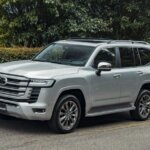 Toyota LandCruiser Weight: Kerb Weight, GVM, Payload and Towing Explained
We want balance, not a pendulum.
Use Correct Tyre Pressures
Vehicle and trailer tyre pressures should suit the load, tyre construction and manufacturer recommendations.
Before departure, check:
- Cold tyre pressures
- Tread condition
- Sidewall damage
- Valve condition
- Wheel-nut torque
- Spare tyres
- Tyre age
- Load and speed ratings
Toyota’s general towing guidance also emphasises checking vehicle tyres, trailer tyres and trailer lights before travel.
Allow More Braking Distance
A heavy caravan transforms braking distances.
Even with good trailer brakes, we should:
- Increase following distance
- Look farther ahead
- Avoid abrupt lane changes
- Reduce speed before descents
- Brake early and progressively
- Use appropriate lower gears
The LandCruiser may feel secure enough to disguise speed. Physics is less easily impressed.
Control Heat on Long Climbs
Heavy towing increases heat in:
- Engine coolant
- Transmission fluid
- Engine oil
- Differentials
- Tyres
- Brakes
On steep climbs, avoid forcing the transmission to hunt repeatedly between gears. Select an appropriate gear when necessary and monitor warning lights or temperature information.
A healthy cooling system is essential. Radiators, hoses, coolant, fans and transmission servicing deserve attention before remote touring.
Manage Long Descents Carefully
Use engine braking and an appropriate transmission gear rather than riding the brakes continuously.
Constant braking can overheat:
- Vehicle brake pads
- Rotors
- Trailer brakes
- Wheel bearings
- Brake fluid
Slow down before the descent begins. Gravity becomes much harder to negotiate once several tonnes have gathered momentum.
Common LandCruiser 200 Towing Mistakes
Assuming 3,500 kg Means Unlimited Vehicle Loading
It does not. Payload, GVM, GCM and axle ratings still apply.
Ignoring Tow-Ball Download
Ball weight is part of the vehicle load and can consume half or more of the available payload.
Using Caravan Tare Weight
Tare is an empty reference figure. We tow the caravan at its actual loaded weight, not the weight it had before water, batteries and luggage were added.
Forgetting Accessories
Bull bars, winches, drawers, roof racks and long-range tanks are not weightless simply because they are bolted to the vehicle.
Assuming Airbags Increase GVM
Airbag helper springs may improve ride height or suspension control, but they do not legally increase GVM, GCM or axle ratings unless included within a certified upgrade.
Relying on Engine Power Alone
A powerful engine can move an illegal load. It cannot make the load legal.
Checking Only the Total Combination Weight
A rig can remain below GCM while exceeding vehicle GVM or rear-axle capacity.
Is the LandCruiser 200 a Good Tow Vehicle?
Yes. When correctly maintained and loaded, the Toyota LandCruiser 200 Series remains one of Australia’s most respected tow vehicles.
Its strengths include:
- 3,500 kg factory braked towing capacity
- Strong V8 engine options
- Full-time four-wheel drive
- Stable size and wheelbase
- Comfortable long-distance cabin
- Strong regional service familiarity
- Excellent aftermarket support
- Proven remote-touring credentials
Its principal weakness is not pulling power. It is payload management.
A lightly accessorised LandCruiser towing a sensibly loaded 2,500–3,000 kg caravan can be a relaxed, capable combination. A fully accessorised vehicle towing a 3,500 kg caravan requires far more careful calculation.
The closer we operate to any maximum limit, the less margin remains for measurement error, extra luggage, changing water loads and real-world conditions.
What Caravan Weight Suits a LandCruiser 200?
There is no perfect caravan weight for every owner, but staying below the absolute 3,500 kg ceiling creates useful flexibility.
A caravan with a loaded ATM around 2,500–3,000 kg may leave more room for:
- Family passengers
- Touring accessories
- Variable ball weight
- Additional supplies
- Fuel and water
- Measurement uncertainty
That does not mean a 3,500 kg caravan is automatically unsafe. It means the combination demands disciplined loading and accurate weighing.
We should choose a caravan based on the LandCruiser’s real configured weight—not its empty showroom specification.
Pre-Towing Checklist for Australian Owners
Before hitching up, confirm the following:
- The trailer’s loaded ATM is within its limit.
- The trailer mass is below the LandCruiser’s certified towing capacity.
- The towbar and coupling ratings are sufficient.
- Safety chains are correctly attached.
- Trailer brakes and breakaway system operate correctly.
- Tow-ball download is within limits.
- The LandCruiser is below GVM.
- Both axles are within their certified limits.
- The combination is below GCM.
- Tyres have suitable load ratings and pressures.
- Wheel nuts are secure.
- Lights and indicators work.
- Mirrors provide a legal field of view.
- Cargo is restrained.
- Caravan cupboards, windows and hatches are secured.
- The jockey wheel and stabilisers are fully raised.
- The number plate is visible.
- The route suits the height and mass of the combination.
Final Thoughts
The Toyota LandCruiser 200 Series towing capacity in Australia is generally 3,500 kg for a braked trailer, making it a serious option for large caravans, boats, horse floats and equipment trailers.
Yet the towing rating is only the headline.
The real story lives in the relationship between tow-ball weight, payload, GVM, GCM and axle loads. A vehicle can remain below its 3,500 kg towing ceiling while still being illegally overloaded. That is why scales are more valuable than assumptions.
The LandCruiser 200 is a formidable tow vehicle, but it performs best when we treat its ratings as boundaries rather than targets. Load it thoughtfully, weigh the complete rig, maintain it properly and leave a sensible safety margin.
Do that, and the 200 Series feels exactly as its reputation suggests: less like an ordinary SUV and more like a dependable travelling companion built for the long Australian road.
Frequently Asked Questions
1. What is the Toyota LandCruiser 200 Series towing capacity in Australia?
Most Australian-delivered Toyota LandCruiser 200 Series models have a maximum braked towing capacity of 3,500 kg. The exact figure should be confirmed through the vehicle’s owner’s manual, towbar plate and compliance documentation.
2. What is the maximum tow-ball weight for a LandCruiser 200?
The commonly stated maximum tow-ball download is 350 kg, although the towbar, coupling and vehicle documentation must all support that figure. Tow-ball weight also counts as part of the LandCruiser’s payload.
3. Can a LandCruiser 200 legally tow a 3.5-tonne caravan?
Yes, provided the caravan’s actual loaded weight does not exceed 3,500 kg and the complete setup remains within the LandCruiser’s GVM, GCM, axle ratings, tow-ball limit and towbar rating.
4. Does a GVM upgrade increase the 200 Series towing capacity?
Not necessarily. Some upgrades increase only GVM and axle ratings while leaving the original towing capacity and GCM unchanged. A certified towing-capacity upgrade is a separate modification and must be legally approved.
5. Is the diesel or petrol LandCruiser 200 better for towing?
Both generally have a 3,500 kg maximum braked towing capacity, but the twin-turbo diesel V8 is usually preferred for frequent heavy towing because of its strong low-rpm torque and comparatively better fuel efficiency under load. The petrol V8 remains smooth and capable but generally uses more fuel.
This content may interest you! Isuzu D-Max Load Capacity: Payload, Limits, and Safe Loading
Leave a Reply