
Audi Q7 vs Q8 Australia: Which Luxury SUV Makes More Sense?

Choosing between the Audi Q7 vs Q8 in Australia looks simple until we spend a little time with the specifications. They share plenty of Audi DNA, use related platforms, offer quattro all-wheel drive and deliver the sort of polished long-distance comfort we expect from a large German luxury SUV. Yet they approach the job from very different directions.
The Audi Q7 is the sensible one. It gives us seven seats, flexible second- and third-row seating, plenty of luggage capacity and serious towing ability. Audi Australia quotes up to 1,908 litres of maximum storage and a 3,500kg braked towing capacity when correctly equipped.
The Q8 is the more dramatic sibling. It sacrifices the Q7's third row for a sleeker coupé-like roofline, a wider-looking stance and a five-seat cabin that feels deliberately more indulgent. Audi lists 605 litres of luggage space for the regular Q8 and the same maximum 3,500kg towing capacity.
So is the Q8 really better because it costs more? Or is the Q7 quietly the smarter luxury SUV for Australian buyers?
Let's dig into it.
- Audi Q7 vs Q8 Australia at a Glance
- What Is the Main Difference Between the Audi Q7 and Q8?
- Audi Q7 vs Q8 Price in Australia
- Exterior Design: Conservative Q7 or Bold Q8?
- Audi Q7 vs Q8 Dimensions
- Interior Design and Cabin Quality
- Audi Q7 vs Q8 Seating Capacity
- Audi Q7 vs Q8 Boot Space
- Engines and Performance in Australia
- Diesel vs Petrol for Australian Buyers
- Audi Q8 Plug-In Hybrid: A Difference the Q7 Doesn't Match
- Ride Comfort and Handling
- Quattro All-Wheel Drive
- Audi Q7 vs Q8 Towing Capacity
- Australian Family Life: Where the Q7 Pulls Ahead
- Where the Audi Q8 Makes More Sense
- Technology and Infotainment
- Safety
- Running Costs and Servicing
- Q7 vs Q8 for Long Australian Road Trips
- Audi Q7 vs Q8 for City Driving
- Should We Buy the Q7 or Q8?
- Audi Q7 vs Q8 Australia: Our Closing Thoughts
- Frequently Asked Questions
Audi Q7 vs Q8 Australia at a Glance
Before getting buried in details, here is the basic difference between these two SUVs.
| Feature | Audi Q7 | Audi Q8 |
|---|---|---|
| Seating | 7 seats | 5 seats |
| Character | Practical luxury SUV | Sporty coupé-style luxury SUV |
| Maximum cargo space | Up to 1,908L | Up to 1,755L on regular MY26 variants |
| Standard boot focus | Family flexibility | Large five-seat luggage area |
| Maximum braked towing | 3,500kg* | 3,500kg* |
| Available MY26 power | Up to 250kW before SQ7 | Up to 360kW with Q8 TFSI e before S/RS models |
| Best suited to | Families, touring, versatility | Style, luxury, five-seat use |
*Subject to vehicle configuration, load and appropriate Audi towing equipment. Audi Australia quotes a maximum of 3,500kg for both vehicles.
That's the comparison in miniature. The Q7 is like a beautifully tailored hiking jacket: expensive and stylish, but still built to do a job. The Q8 is closer to a designer leather jacket. It does many of the same things, but image is a much bigger part of the equation.
What Is the Main Difference Between the Audi Q7 and Q8?
The biggest difference is not performance. It is philosophy.
The Audi Q7 is a seven-seat SUV designed around practicality. We get a third row, adjustable rear seating and a square-backed body that makes better use of its footprint. Audi specifically positions the Q7 as accommodating up to seven passengers and gives it electrically folding third-row seats.
The Audi Q8 is a five-seat luxury SUV with a coupé-inspired silhouette. It sits lower visually, looks wider and carries more presence from the kerb.
If our household regularly carries six or seven people, the decision almost makes itself: Q7.
If we rarely need more than five seats and we'd happily exchange unused passenger capacity for a more dramatic design, the Q8 suddenly makes much more sense.
Audi Q7 vs Q8 Price in Australia
Price is where things become particularly interesting.
For MY26, published Australian pricing places the entry-level Q7 TFSI 185kW quattro at around A$108,800 before on-road costs, while stronger Q7 variants move into the mid-A$130,000 range before stepping up to the SQ7.
The MY26 Q8 occupies a noticeably higher part of the market. The Q8 TDI 210kW S line has been listed at A$144,400 when new, while the plug-in hybrid Q8 TFSI e 360kW S line has been listed at A$154,284 before the usual on-road considerations.
That means we're potentially looking at a gap of more than A$35,000 between the cheapest Q7 and the starting point of the mainstream Q8 range.
Are We Paying for More Car With the Q8?
Not necessarily.
We're largely paying for:
- more powerful standard engines,
- S line positioning,
- more dramatic exterior styling,
- a more exclusive model position,
- and the Q8's coupé-SUV image.
Ironically, the cheaper Q7 gives us more seats and potentially greater day-to-day versatility.
This is why simply assuming "Q8 is above Q7, therefore Q8 is better" misses the point.
They're solving different problems.
Exterior Design: Conservative Q7 or Bold Q8?
Park both vehicles together and their family relationship is obvious, but so are their personalities.
Audi Q7 Design
The Q7 wears the traditional large-SUV shape.
Its roof remains high well into the rear section, the tailgate is fairly upright and the overall proportions communicate practicality. It looks expensive without desperately trying to announce the fact.
That's appealing.
In an Australian suburban driveway, the Q7 can blend in surprisingly well for something this large. It has presence, but it doesn't feel like it arrived with its own red carpet.
Audi Q8 Design
The Q8 turns the volume up.
Its roofline slopes towards the rear, the body looks wider and the overall proportions seem lower and more planted. Audi itself describes the model as a large, coupé-like SUV, and that description captures its purpose nicely.
It is the one we're more likely to glance back at after parking.
Which One Looks More Expensive?
For many of us, probably the Q8.
Its proportions simply look more exotic.
But design is personal. Some buyers may actually prefer the Q7 because its restrained appearance will probably age more gracefully than an aggressively styled coupé-SUV.
Audi Q7 vs Q8 Dimensions
Despite their different shapes, the two vehicles are more closely related in size than they initially appear.
Published MY26 specification data lists the Q7 at roughly 5.05 metres long, depending on variant, while the regular Q8 sits at approximately 5.0 metres. Their wheelbases are around three metres, meaning both are genuinely large vehicles by Australian standards.
Interestingly, the Q8 can be slightly wider while sitting lower than the Q7.
That contributes to the Q8's broad, sporty stance.
Which Is Easier Around Australian Cities?
Neither is a small car.
In tight inner-Melbourne streets, compact Sydney car parks or older shopping centres where the parking bays seem to have been designed when cars were the width of kitchen appliances, both require attention.
The Q7's boxier shape can make its extremities easier to judge, while the Q8's width remains something to remember.
Parking cameras and driver-assistance technology help enormously, but physics still wins.
A two-metre-wide luxury SUV remains a two-metre-wide luxury SUV.
Interior Design and Cabin Quality
Step inside either model and we find a similar philosophy: restrained luxury rather than excessive decoration.
Audi tends to favour sharp lines, clean surfaces and technology integrated into the dashboard instead of making the cabin look like someone glued a tablet onto it as an afterthought.
The Q7 feels sophisticated and functional.
The Q8 feels sophisticated and slightly more theatrical.
Front-Seat Experience
From the driver's seat, the difference isn't enormous.
Both give us the elevated driving position luxury-SUV buyers expect, premium materials and a technology-heavy interface. Depending on specification, equipment can vary, so Australian buyers should always compare the actual vehicles rather than assuming every Q7 or Q8 has an identical feature list.
Where the Q8 earns its reputation is atmosphere.
The lower roofline, wider cabin sensation and exterior styling make the car feel sportier even before we've moved.
Audi Q7 vs Q8 Seating Capacity
This may be the most important section in the entire comparison.
The Q7 carries seven people.
The Q8 carries five.
Simple, right?
Mostly.
Q7 Third-Row Seats
Audi gives the Q7 an electrically folding third row, and the second-row bench can slide and recline. This allows us to redistribute space depending on whether we're prioritising second-row passengers, third-row passengers or luggage.
For families with young children, that flexibility is enormously useful.
A seven-seat SUV also gives us options even when we don't have five children. Think grandparents, visiting relatives, children's friends or the occasional airport run.
Is the Audi Q7 a True Seven-Seater?
Yes, although we shouldn't expect the third row to feel like business class.
Independent Australian testing has found the third row most appropriate for children or shorter adults on shorter trips rather than full-size adults undertaking long journeys.
That's normal for this type of SUV.
This content may interest you!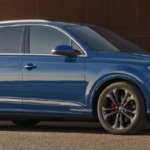 Audi Q7 vs BMW X7 Australia: Which Luxury SUV Makes More Sense?
The important thing is that the seats exist when we need them.
With the Q8, they simply don't.
Audi Q7 vs Q8 Boot Space
Here's where specifications can become misleading if we compare numbers without context.
The Q8 has an impressive 605L luggage capacity in regular versions, and published MY26 data quotes as much as 1,755L with the rear seats folded.
The Q7 works differently because of its third row.
With all seven seats required, cargo capacity is naturally much smaller. Fold the third row, however, and the Q7 becomes extremely useful. Audi quotes up to 1,908L of maximum storage space with the relevant rear seats folded.
Which Boot Is Better in Real Life?
For a five-person household with lots of luggage, the Q8's broad five-seat cargo area works beautifully.
For families constantly changing between school runs, sports equipment, shopping, pets and extra passengers, we'd take the Q7's flexibility.
It's the difference between having one big room and having movable walls.
Engines and Performance in Australia
MY26 Australian Q7 buyers have a broad choice.
Published Q7 pricing and specifications include:
- TFSI 185kW quattro – 2.0-litre turbo petrol
- TDI 170kW quattro – 3.0-litre diesel
- TDI 210kW quattro S line – 3.0-litre diesel
- TFSI 250kW quattro S line – 3.0-litre petrol
There's also the much faster SQ7 sitting above the regular range.
The Q8 range starts from a more performance-oriented level. MY26 versions include the TDI 210kW S line, TFSI 250kW S line, and the TFSI e 360kW plug-in hybrid, with SQ8 and RS Q8 models occupying more extreme territory.
Q7 250kW vs Q8 250kW
This is arguably the fairest comparison.
Both offer a 250kW petrol powertrain, so once comparable drivetrains enter the discussion, the performance distinction becomes smaller than the styling suggests.
The Q8 may look dramatically faster standing still, but the equivalent Q7 is hardly a slow family wagon.
That is one of the most compelling aspects of the Q7: we don't necessarily have to sacrifice serious performance to get seven seats.
Diesel vs Petrol for Australian Buyers
Australia remains a market where diesel can make plenty of sense in a large SUV, particularly for buyers covering long distances or towing regularly.
The 210kW Q8 TDI produces 600Nm, according to Australian MY26 specifications, while the equivalent petrol produces 250kW and 500Nm.
That creates two distinct personalities.
The diesel suits relaxed highway cruising and heavy-load use. The petrol feels more eager when we ask for performance.
Which Engine Would Suit Touring?
For frequent interstate trips, long highway drives and towing, we'd look closely at the six-cylinder diesel options.
For mostly urban driving with occasional country trips, the petrol versions can be appealing.
And for buyers who can regularly charge at home and whose driving pattern suits electrification, the Q8 TFSI e introduces another alternative entirely.
Audi Q8 Plug-In Hybrid: A Difference the Q7 Doesn't Match
The regular Australian Q8 range includes a TFSI e plug-in hybrid producing 360kW and 700Nm, with Audi claiming 0–100km/h in 5.0 seconds.
That makes the Q8 TFSI e an interesting proposition.
It combines genuine performance with the ability to conduct shorter journeys using electric energy when charged appropriately.
Audi says it can also be charged from a standard Australian 240V outlet, while a dedicated wallbox provides greater convenience and charging speed.
The catch?
Plug-in hybrids deliver their biggest advantages when we actually plug them in.
Buying one and rarely charging it is a little like buying noise-cancelling headphones and never switching the noise cancelling on.
Ride Comfort and Handling
These are large luxury SUVs, not lightweight sports cars, and that should shape our expectations.
The Q7 prioritises stability, refinement and easy long-distance progress. Optional adaptive air suspension is available on relevant Australian configurations, potentially adding another layer of comfort and body control.
The Q8's lower appearance and sportier positioning give it a more performance-oriented character, although it remains fundamentally a large luxury SUV.
Which Feels Sportier?
The Q8.
That's hardly surprising.
Its whole design brief leans in that direction.
But here's the question worth asking: how often are we actually going to exploit that difference?
For many Australian owners, the vehicle will spend more time travelling between home, work, school, shopping centres and holiday destinations than chasing corners through the Adelaide Hills.
That puts comfort and ease of use back near the top of the priority list.
Quattro All-Wheel Drive
Both models prominently use Audi's quattro all-wheel-drive system across the Australian range.
For us, the practical benefit isn't that either suddenly becomes a hardcore bush-basher.
It's about traction and stability.
Wet roads, loose surfaces, country highways and steep driveways are environments where a sophisticated AWD system can add confidence.
Neither vehicle should be confused with a dedicated off-road machine built around low-range gearing and maximum articulation, but both are far more versatile than their polished appearance might imply.
Audi Q7 vs Q8 Towing Capacity
This one ends in a draw.
Audi Australia quotes up to 3,500kg braked towing capacity for both the Q7 and Q8 when fitted with the appropriate Audi Genuine towing equipment. Actual allowable towing loads still depend on vehicle configuration, laden weight, accessories and operating conditions.
That's substantial capacity.
For Australian buyers towing:
- larger caravans,
- boats,
- horse floats,
- or substantial trailers,
both deserve consideration.
Which Would We Prefer for Towing?
For frequent towing, the Q7's practical body shape and available diesel powertrains make an especially strong case.
The Q8 can tow the same headline maximum, but its greatest appeal lies elsewhere.
Australian Family Life: Where the Q7 Pulls Ahead
This is the environment where the Q7 begins collecting points almost effortlessly.
Seven seats?
Yes.
Large maximum cargo capacity?
Yes.
Sliding and reclining second row?
Yes.
Strong towing capacity?
Yes.
This content may interest you!Audi Q7 or VW Touareg Australia: Which Luxury SUV Makes More Sense?Luxury cabin?
Yes.
Performance options?
Absolutely.
The Q7 doesn't force us to choose between family practicality and premium-car ownership nearly as much as some alternatives.
Schoolbags can go in the back. Grandparents can come along. The third row can disappear when we need luggage space. A caravan can be attached for a road trip.
It is difficult to ignore that versatility.
Where the Audi Q8 Makes More Sense
The Q8 becomes much easier to justify if our situation looks different.
Imagine we rarely carry more than four people.
We don't need third-row seats.
We care deeply about design.
We want something that feels special every time the garage door opens.
Suddenly the Q8's compromises aren't compromises anymore.
We aren't "losing" two seats we never needed.
Instead, we're buying the body style we actually wanted.
The Emotional Factor Matters
Cars at this price level aren't purely rational purchases.
If rationality were the only thing that mattered, we'd all drive something cheaper.
The Q8 understands that.
Its value lies partly in how it makes us feel, not simply how many litres fit behind the rear seats.
And there's nothing inherently wrong with paying for that.
Technology and Infotainment
Both models belong to Audi's technology-heavy luxury SUV generation, with digital instrumentation, touchscreen-based vehicle controls and extensive driver-assistance technology available across the range.
Exact equipment varies by model and package, so this is one category where comparing actual Australian dealer stock is more useful than making blanket assumptions based on overseas specifications.
The same applies to wheel designs, seat upholstery, sound systems, lighting packages and suspension.
A highly optioned Q7 can feel more luxurious than a particular Q8 sitting beside it.
Badges don't tell the whole story.
Safety
For a vehicle carrying family members, safety technology understandably matters.
Both Q7 and Q8 variants are equipped with modern driver-assistance systems, but specification can change with model year and variant.
Instead of simply asking which model has "more safety", we would check whether the specific example we're considering includes the equipment important to us: surround-view cameras, blind-spot monitoring, adaptive cruise assistance, lane assistance and related systems.
This becomes even more important when comparing used Q7 and Q8 vehicles from different model years.
Running Costs and Servicing
Neither vehicle should be mistaken for a budget SUV to own.
Large wheels mean expensive tyres.
Premium engines bring premium servicing expectations.
Insurance can vary substantially according to driver, postcode, model and insurer.
Fuel consumption also depends strongly on which engine we choose.
MY26 Australian Q8 data, for example, lists official combined fuel figures around 7.1L/100km for the diesel and 9.2L/100km for the conventional petrol version, while the plug-in hybrid produces a much lower laboratory figure that depends heavily on battery charging and journey type.
The correct comparison, therefore, isn't simply "Q7 versus Q8".
It is specific Q7 engine versus specific Q8 engine.
Q7 vs Q8 for Long Australian Road Trips
Australia has a way of turning "a little drive" into 700 kilometres.
That makes comfort, luggage capacity and cruising ability particularly important.
For long family journeys, we'd lean toward the Q7.
Its more versatile interior becomes valuable when everyone brings a suitcase, backpack, snacks, pillows and enough charging cables to wire a small office.
For two to four adults heading away for a weekend, however, the Q8 feels wonderfully suited to the task. Its 605L boot in regular versions is generous, its cabin is luxurious and its road presence suits the grand-tourer role beautifully.
Audi Q7 vs Q8 for City Driving
If neither vehicle regularly leaves metropolitan areas, the decision changes again.
The third row becomes less important if we never use it.
Towing ability becomes irrelevant if we don't own anything with a tow ball.
At that point, design, parking practicality, performance and cabin atmosphere carry more weight.
The Q8 can therefore make surprising sense as a luxury urban vehicle for buyers who simply want a large, comfortable five-seater.
The Q7 still offers better flexibility, but unused flexibility has limited value.
Should We Buy the Q7 or Q8?
Here's the easiest way to decide.
Consider the Audi Q7 if we:
- genuinely need seven seats;
- have children or regularly transport extra passengers;
- value maximum cargo flexibility;
- tow regularly;
- want a lower entry price into Audi's large-SUV range;
- prefer traditional SUV styling;
- want practicality without giving up luxury.
Consider the Audi Q8 if we:
- only need five seats;
- care strongly about exterior design;
- prefer a sportier, coupé-like shape;
- want stronger standard performance specifications;
- are interested in the Q8 plug-in hybrid;
- don't mind paying extra for exclusivity and styling;
- want Audi's large SUV to feel more like a luxury statement.
Audi Q7 vs Q8 Australia: Our Closing Thoughts
The Audi Q7 vs Q8 Australia debate isn't really about which SUV is universally superior.
It's about whether we value space or style more.
The Q7 is the rational powerhouse of the pair. It can seat seven, swallow an enormous amount of luggage when configured appropriately and tow up to 3,500kg. Yet it can still be ordered with serious six-cylinder performance.
The Q8 takes much of that engineering and wraps it in a more dramatic package. We lose the third row and some ultimate cargo flexibility, but gain a sportier silhouette and access to a model range designed to feel more exclusive. Regular Q8 models still provide a substantial 605L boot and up to 3,500kg towing capacity, so this isn't merely a fashion accessory pretending to be an SUV.
For a growing family, the Q7's flexibility is difficult to ignore.
For a couple or smaller household that doesn't need seven seats, the Q8 gives us an appealing reason to choose with our eyes as well as our spreadsheet.
Ultimately, that's the beauty of these two Audis. Underneath, they're close relatives. In personality, however, they might as well be wearing completely different clothes.
Frequently Asked Questions
1. Is the Audi Q8 bigger than the Q7?
Not in every dimension. The Q7 is generally longer and taller, while the Q8's body can be slightly wider depending on the specification measured. Both have wheelbases around three metres, so they occupy a broadly similar footprint.
2. Does the Audi Q8 have seven seats in Australia?
No. The Australian Audi Q8 is a five-seat SUV. Buyers needing a third row should look at the Q7, which accommodates up to seven passengers.
3. Does the Audi Q7 or Q8 have more boot space?
It depends on seat configuration. The regular Q8 provides a generous 605L luggage area with its five-seat layout, while the Q7 offers far greater configuration flexibility and up to 1,908L with the rear seats folded.
4. Can the Audi Q7 and Q8 tow a caravan?
Yes. Audi Australia quotes a maximum 3,500kg braked towing capacity for both models when appropriately equipped, although actual permitted capacity depends on vehicle load, specification and towing equipment.
5. Why is the Audi Q8 more expensive than the Q7?
The Q8 occupies a more style- and performance-oriented position in Audi's SUV range. Its Australian lineup starts with stronger powertrains and S line specifications, while the Q7 offers more entry-level engine choices. Consequently, the Q8's extra price buys positioning, styling and specification rather than extra passenger capacity.
This content may interest you!Audi Q7 vs BMW X5 Australia: Which Luxury SUV Makes More Sense?
Leave a Reply