
Ford Everest vs Land Cruiser 300 Australia: Which Big 4WD Should We Buy?

Choosing between the Ford Everest and Toyota LandCruiser 300 in Australia sounds simple until we start looking at what these vehicles actually offer. Both are large, diesel-friendly Australian adventure machines. Both can tow a serious caravan. Both can take a family far beyond the bitumen. And both have the sort of road presence that makes small crossovers look like shopping trolleys.
But they are not really direct twins.
The Ford Everest is the smarter-value option: a sophisticated seven-seat 4WD that combines towing capability, modern technology, strong diesel performance and surprisingly polished road manners without climbing into luxury-car pricing territory.
The Toyota LandCruiser 300 is bigger, stronger and more expensive. It is designed around serious long-distance touring and hard use, with a formidable 3.3-litre twin-turbo V6 diesel, permanent four-wheel drive and the kind of Australian reputation that has been built over decades rather than marketing campaigns.
So, Ford Everest vs Land Cruiser 300 Australia — which one should we actually buy?
For many families, we'd choose the Everest.
For remote touring, heavy-duty off-road travel and buyers who simply want the more substantial machine, the LC300 remains difficult to ignore.
Let's dig deeper.
- Ford Everest vs Land Cruiser 300 Australia at a Glance
- Ford Everest Engine and Performance
- LandCruiser 300 Engine and Performance
- Ford Everest vs Land Cruiser 300 Towing Capacity
- Ford Everest vs LC300 Off-Road Capability
- Size and Road Presence
- Everest vs LandCruiser 300 Interior
- Seven-Seat Family Practicality
- On-Road Comfort and Handling
- Fuel Economy and Touring Range
- Safety: Everest vs LandCruiser 300
- Price and Value for Money
- Ford Everest Advantages
- Toyota LandCruiser 300 Advantages
- Which Is Better for Australian Families?
- Which Is Better for Towing?
- Which Is Better Off Road?
- Everest Platinum vs LandCruiser 300
- Everest Tremor vs LC300 GR Sport
- Which One Would We Buy?
- Final Verdict: Ford Everest vs Land Cruiser 300 Australia
- Frequently Asked Questions
Ford Everest vs Land Cruiser 300 Australia at a Glance
The numbers immediately reveal that these SUVs occupy slightly different territory.
| Category | Ford Everest V6 | Toyota LandCruiser 300 Diesel |
|---|---|---|
| Engine | 3.0L turbo-diesel V6 | 3.3L twin-turbo diesel V6 |
| Power | 184kW | 227kW |
| Torque | 600Nm | 700Nm |
| Transmission | 10-speed automatic | 10-speed automatic |
| Drive | Full-time 4WD on V6 models | Permanent 4WD |
| Maximum braked towing | 3,500kg | 3,500kg |
| Seats | Up to 7 | Grade dependent, up to 7 |
| LC300 fuel tank | — | 110L diesel capacity |
| Main strength | Value and versatility | Heavy-duty touring |
Ford Australia's current V6 Everest produces 184kW and 600Nm, while Toyota's 3.3-litre twin-turbo-diesel LC300 produces 227kW and 700Nm. Both use 10-speed automatic transmissions, and both can tow up to 3,500kg when appropriately equipped.
That 43kW and 100Nm advantage matters. Yet numbers don't tell the entire story.
These Two SUVs Have Different Personalities
Think of the Everest as an athletic hiking boot.
It is tough, capable and ready for dirt, but still comfortable enough to wear every day.
The LandCruiser 300 is closer to a full expedition boot. Bigger, heavier-duty and designed with difficult terrain and long journeys deeply embedded in its DNA.
That's why simply declaring the Toyota the winner because it makes more power misses the point.
The real question is whether we need everything the LC300 gives us enough to justify paying for it.
Ford Everest Engine and Performance
Current Everest buyers have more flexibility than they once did.
The 2026.5 Australian Everest line-up offers a 2.0-litre turbo-diesel on selected grades, while the 3.0-litre V6 turbo-diesel is available across the range. Ford rates the V6 at 184kW and 600Nm, paired with a 10-speed automatic.
For this comparison, the V6 is the engine we want.
Why?
Because if we're cross-shopping an Everest against a LandCruiser 300, the smaller Everest diesel isn't really playing the same game.
The Everest V6 Is the Sweet Spot
The Everest's 600Nm arrives low in the rev range, between 1,750 and 2,250rpm according to Ford. That gives it exactly the sort of relaxed shove we want when overtaking, climbing a hill or hauling a trailer.
It doesn't feel like a sports SUV, nor should it.
Instead, acceleration has a muscular, effortless character. Press the accelerator and the big Ford gathers speed without sounding like the engine is trying to escape through the bonnet.
The 10-speed transmission keeps the V6 in its useful torque zone, although ten ratios can occasionally feel like a lot of gears for one gearbox to juggle.
Still, as an everyday drivetrain, the V6 Everest is excellent.
LandCruiser 300 Engine and Performance
Toyota answers with considerably more muscle.
The LC300 diesel uses a 3.3-litre twin-turbocharged V6 producing 227kW and 700Nm, with maximum torque available from 1,600 to 2,600rpm. It drives through a 10-speed torque-converter automatic to a permanent four-wheel-drive system, complete with low range and a locking centre differential.
That's serious hardware.
The Toyota Feels Like the Bigger Machine
The LC300 doesn't merely have more torque on paper.
It feels built around effortless load carrying.
With passengers, luggage and a caravan attached, that extra 100Nm becomes much more meaningful than it appears while cruising empty through suburbia.
Toyota has tuned the drivetrain for low-effort progress rather than excitement. There's a deep reserve of torque sitting beneath our right foot, ready when we need it.
And Now There's an LC300 Performance Hybrid
The comparison has become even more interesting in 2026.
Toyota has introduced a performance-hybrid LandCruiser 300 in Australia for the GR Sport and Sahara ZX grades. The system produces a combined 341kW and 790Nm, making it the most powerful LandCruiser Toyota has offered. Toyota says its 3,500kg towing capability remains unchanged from the diesel range.
That puts the flagship LC300 in an entirely different performance league from the Everest.
It also pushes it into a dramatically different price bracket, so we wouldn't treat the hybrid as the logical alternative for the average Everest buyer.
Ford Everest vs Land Cruiser 300 Towing Capacity
Here's where things get interesting.
Despite the Toyota's extra power and torque, both the Ford Everest and LandCruiser 300 have a maximum braked towing capacity of 3,500kg when correctly configured.
So if we're simply searching Google for maximum towing capacity, we get a draw.
Real towing is more complicated.
Which One Is Better for Towing a Caravan?
For occasional towing of a medium-size caravan, boat or trailer, the Everest V6 makes enormous sense.
It has plenty of torque, good towing technology and enough capacity for many Australian recreational towing setups.
The LandCruiser begins to make a stronger argument when towing becomes a major part of our lifestyle.
Think:
- large caravans,
- long interstate journeys,
- remote touring,
- heavy passenger and luggage loads,
- repeated towing in hot conditions,
- or extensive travel away from major population centres.
Payload, tow-ball download, accessories, passengers and gross combination limits must also be calculated before towing. A 3,500kg headline number does not mean we can automatically load either SUV with a full family, roof rack, bullbar, drawers and camping equipment while simultaneously towing 3.5 tonnes.
That's where careful weight calculations matter far more than advertising numbers.
Ford Everest vs LC300 Off-Road Capability
Both SUVs are genuine off-road vehicles rather than crossovers dressed in hiking clothes.
That matters.
Ford Everest Off Road
V6 Everest models combine full-time four-wheel drive with selectable terrain features, while Ford offers increasingly specialised versions including the Tremor.
The current Everest Tremor has 255mm of ground clearance and an 800mm quoted wading capability, along with dedicated off-road suspension.
That's not pretend capability.
A properly equipped Everest can handle sand, mud, steep tracks, rocky terrain and many of the trails Australian recreational drivers are realistically likely to encounter.
And because it isn't as enormous as an LC300, the Ford can sometimes feel more manageable on tight bush tracks.
LandCruiser 300 Off Road
The Toyota starts from a more heavy-duty foundation.
Every diesel LC300 uses permanent four-wheel drive, low-range gearing and a locking centre differential. Toyota quotes 235mm of running ground clearance for the LC300, while equipment varies substantially by grade.
The GR Sport is especially interesting for serious off-road use because Toyota gives it front, centre and rear differential-locking capability along with its Multi-Terrain Select hardware.
Which 4WD Would We Take Into Remote Australia?
LandCruiser 300.
This isn't because the Everest is incapable.
Far from it.
But if our trip involved weeks through remote Australia, substantial loads, difficult terrain and long distances between services, we'd prefer the LC300's heavy-duty character.
Toyota's advantage here feels less like winning a specification-table competition and more like choosing the tool engineered for the bigger job.
For weekend trails and family camping?
The Everest makes far more financial sense.
Size and Road Presence
The LandCruiser 300 is a substantial vehicle.
Depending on grade, Toyota lists it at roughly 4,980mm to 5,015mm long, around 1,980–2,000mm wide and 1,950mm high, with a 2,850mm wheelbase.
You feel that size.
This content may interest you!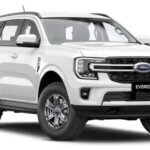 Ford Everest vs Land Cruiser Prado Australia: Which 4WD Is Better?
It gives the Toyota a commanding highway presence and contributes to its spacious, solid character.
But there's another side to the coin.
The Bigger SUV Isn't Always the Better SUV
Try squeezing an LC300 into an old shopping-centre car park.
Suddenly, heroic outback dimensions aren't quite as romantic.
For families spending Monday to Friday in Sydney, Melbourne, Brisbane, Perth or Adelaide and only heading into the bush at weekends, the Everest often feels like the more manageable compromise.
Neither is small, but the Ford behaves more like an everyday family SUV.
The Toyota reminds us constantly that we're piloting something substantial.
Everest vs LandCruiser 300 Interior
This is one area where the Ford punches well above its traditional position in the market.
Modern Everests no longer feel like basic utility-derived wagons with some carpet glued over the floor.
The cabin looks contemporary, digital and thoughtfully designed.
Ford Everest Interior and Technology
Depending on specification, the Everest can deliver large-screen infotainment, digital instrumentation, sophisticated driver-assistance technology, premium audio, leather-accented seating and plenty of convenience features.
The Platinum pushes the formula towards luxury territory.
Ford's interior has a modern visual character. Screens are prominent, controls feel contemporary and the overall design feels closer to a sophisticated new-generation SUV than an old-school 4WD.
For tech-focused buyers, that's appealing.
LandCruiser 300 Interior
The LC300 takes another approach.
Rather than feeling flashy for the sake of it, it communicates robustness and space.
Higher grades become genuinely luxurious, while lower variants remain focused more heavily on functionality.
Toyota also upgraded the LC300 range for Australia in 2025 with additional multimedia, safety and equipment improvements, keeping the model technologically relevant despite its more traditional personality.
Which Has the Better Cabin?
We'd split this one.
Everest wins for modern presentation and value.
LC300 wins for the feeling of substance, space and flagship presence.
If we're buying with our eyes, the Ford can actually look like the newer-generation product.
If we're buying for big-family touring, the Toyota's scale starts paying dividends.
Seven-Seat Family Practicality
This is where the Everest becomes extremely persuasive.
It can serve as the school-run car on Wednesday, tow a boat on Saturday and carry camping equipment on Sunday.
That's a useful talent.
The third row isn't magic — no seven-seat SUV turns its rearmost seats into a limousine — but the Everest works well as a genuine multi-purpose family vehicle.
LandCruiser 300 Seating Depends on Grade
LC300 seating configuration varies with specification, so buyers need to check the exact grade rather than assuming every LandCruiser 300 provides the same arrangement.
That matters particularly at the top of the range, where different equipment and drivetrain choices can alter the packaging.
If our number-one requirement is simply a versatile seven-seat family 4WD, the Everest is arguably easier to justify.
On-Road Comfort and Handling
Drive these vehicles back-to-back and their personalities become clearer.
The Everest feels relatively agile for a ladder-frame SUV.
Steering is approachable, body movements are well controlled for the class, and it doesn't constantly punish us for choosing a vehicle with genuine off-road ability.
That's probably one of its biggest accomplishments.
The LC300 Prioritises Effortless Progress
Toyota feels larger and more substantial.
It can settle beautifully into long-distance cruising, where its effortless diesel torque and large-vehicle composure make kilometres disappear.
On a twisting urban road, however, physics still works.
Big SUVs carry weight and height.
The LandCruiser doesn't suddenly turn into a GR86 because we select a different drive mode.
If our driving is mostly urban, suburban and highway commuting, the Everest's easier-going dimensions and road manners make a strong case.
Fuel Economy and Touring Range
Large turbo-diesel 4WDs aren't purchased because we enjoy visiting service stations, but neither is a fuel miser.
Toyota has historically quoted 8.9L/100km combined for the diesel LC300, though real consumption varies significantly with terrain, traffic, load, tyres, accessories and towing.
More importantly for touring, the diesel LC300 carries 110 litres of fuel through an 80L main and 30L sub tank.
That's a meaningful feature in Australia.
Why Tank Size Matters in the Outback
Range isn't simply about saving money.
It's freedom.
A large fuel reserve means fewer calculations between remote fuel stops and more flexibility when exploring regional Australia.
For a city buyer, that's almost irrelevant.
For someone crossing huge distances through Western Australia, South Australia, Queensland or the Northern Territory?
It becomes one of those little specification numbers that suddenly feels very big.
Safety: Everest vs LandCruiser 300
Both vehicles have performed strongly under ANCAP testing.
The current-generation Ford Everest received a five-star ANCAP rating under 2022 criteria, with scores including 86% for adult occupant protection, 93% for child occupant protection, 74% for vulnerable road-user protection and 86% for safety assist.
The LandCruiser 300 also received a five-star ANCAP rating, with its assessment carrying a 2022 datestamp.
Both therefore begin from a strong foundation.
As always, exact driver-assistance features can vary by model year and variant, so we should compare the specific vehicles sitting in the dealership rather than assuming every badge includes identical equipment.
Price and Value for Money
Here's the elephant in the dealership.
The Ford Everest costs substantially less to enter than the LandCruiser 300, and Ford's current Australian range spans Active, Sport, Tremor, Wildtrak and Platinum grades. Ford is advertising the 2026.5 Active from around the $60,000 drive-away level under its current qualifying offer, while exact pricing varies with engine, grade, location and on-road costs.
The LC300 plays in a more expensive category, and the gulf becomes enormous at the top end.
Toyota announced the new LC300 GR Sport performance hybrid at $156,060 before on-road costs for its mid-2026 Australian introduction.
That alone demonstrates why comparing these SUVs purely by specifications can be misleading.
Is a LandCruiser 300 Worth the Extra Money?
Sometimes.
Imagine we're travelling through remote Australia every year, towing a large caravan, carrying substantial gear and expecting to keep the vehicle for a very long time.
The extra capability and heavy-duty nature of the LC300 could be worth every dollar.
But imagine our life looks more like this:
school runs Monday to Friday, occasional commuting, weekend sport, two camping trips a year and perhaps towing a caravan during holidays.
Suddenly the Everest looks almost suspiciously sensible.
It gives us a huge percentage of the experience for dramatically less money.
This content may interest you!Ford Everest and Endeavour Same? The Complete ExplanationFord Everest Advantages
The Everest's biggest strength isn't that it destroys the LandCruiser in any single category.
It's that it combines so many useful characteristics without demanding LC300 money.
We particularly like:
- strong 3.0-litre V6 diesel performance,
- 3,500kg maximum braked towing capacity,
- genuine 4WD ability,
- up to seven seats,
- sophisticated cabin technology,
- manageable everyday manners,
- strong ANCAP safety performance,
- broad choice of specifications,
- and substantially easier pricing to justify.
It's a remarkably complete package.
Toyota LandCruiser 300 Advantages
The Toyota earns its premium with deeper reserves of capability.
Its key advantages include:
- 227kW and 700Nm from the standard diesel V6,
- permanent 4WD with low-range gearing,
- 3,500kg maximum braked towing,
- a 110-litre diesel fuel capacity,
- substantial dimensions and touring presence,
- strong remote-adventure credentials,
- specialised GR Sport off-road hardware,
- and the availability of a 341kW/790Nm performance-hybrid flagship in 2026.
The LC300 isn't simply an Everest with extra horsepower.
It's a bigger proposition altogether.
Which Is Better for Australian Families?
Ford Everest.
For most families, that's our answer.
The Everest strikes a sweet balance between seven-seat practicality, towing capacity, genuine off-road capability, technology and day-to-day usability.
We don't need to cross the Simpson Desert to justify owning one.
It works perfectly well as an ordinary family SUV that happens to have extraordinary capability hiding underneath.
The LandCruiser can do the same job, but we're buying far more vehicle than many suburban households actually need.
Which Is Better for Towing?
For moderate recreational towing, we'd choose the Everest V6 on value.
For frequent heavy towing and long-distance caravan touring, we'd take the LandCruiser 300.
Both are officially capable of towing up to 3,500kg braked, but the Toyota's extra 100Nm of torque gives it a useful theoretical advantage when moving substantial loads.
Don't forget that actual legal towing capability depends on the vehicle's complete weight configuration, not merely the maximum trailer figure.
Which Is Better Off Road?
For occasional trails, beaches, camping and recreational four-wheel driving, the Everest is more than enough.
For difficult terrain and serious remote touring, we'd lean towards the LandCruiser 300.
And if hardcore off-road capability matters more than luxury, the LC300 GR Sport's differential-locking hardware makes it especially appealing.
The Everest Tremor deserves attention too. With its dedicated suspension, 255mm ground clearance and quoted 800mm wading capability, Ford has clearly designed it for buyers who want more than an SUV wearing chunky tyres for decoration.
Everest Platinum vs LandCruiser 300
This might actually be the most interesting comparison.
The Everest Platinum gives us the Ford at its most luxurious while retaining the 184kW/600Nm V6 diesel, 10-speed automatic and full-time four-wheel drive.
It's an attractive choice for someone who wants luxury-SUV comfort without completely abandoning the value argument.
The LC300 still feels more substantial and has considerably more diesel performance.
Yet ask ourselves one question:
What are we actually gaining for every additional dollar?
If the answer is capability we'll genuinely use, buy the Toyota.
If the answer is mostly prestige and theoretical ability, we'd keep the difference and buy the Ford.
Everest Tremor vs LC300 GR Sport
Now we're talking to the mud enthusiasts.
The Everest Tremor represents Ford's adventurous side, combining the V6 with off-road-oriented suspension and increased clearance.
Toyota's LC300 GR Sport goes further with an explicitly heavy-duty off-road approach and available locking differentials, while the new performance-hybrid GR Sport dramatically increases power and torque.
Budget aside, we'd choose the Toyota for the expedition.
Value included?
The Tremor becomes very tempting indeed.
Which One Would We Buy?
Our choice depends almost entirely on how we're going to use it.
Buy the Ford Everest If…
We'd choose the Everest if we want a vehicle that spends most of its life carrying a family, commuting, taking road trips, towing occasionally and exploring trails on weekends.
It's also the obvious choice if value matters.
For the majority of Australian buyers, the Everest V6 is the sweet spot.
Buy the Toyota LandCruiser 300 If…
We'd choose the LC300 if remote travel, demanding towing, heavy loads and extensive off-road touring are central to our lifestyle rather than occasional hobbies.
It's also the one we'd want if money were secondary and outright capability mattered most.
Our Overall Winner: Ford Everest
Yes, the LandCruiser 300 is the more formidable vehicle.
But "better" and "better buy" aren't always the same thing.
The Everest offers an unusually convincing combination of capability, comfort, towing ability, seven-seat practicality and technology at a much more accessible position in the market.
That makes it our overall winner for the typical Australian buyer.
For the serious outback traveller?
Reverse the decision.
Final Verdict: Ford Everest vs Land Cruiser 300 Australia
The Ford Everest vs Land Cruiser 300 Australia battle isn't really David against Goliath.
It's more like choosing between a Swiss Army knife and an expedition toolbox.
The Everest does almost everything an Australian family could reasonably ask of a large SUV. The V6 is punchy, towing capacity reaches 3,500kg, genuine 4WD hardware is available, the cabin feels modern and the seven-seat configuration makes everyday family life easier. Ford has transformed the Everest into one of Australia's most rounded adventure SUVs.
The LandCruiser 300 goes further. Its diesel produces 227kW and 700Nm, its permanent 4WD system is fundamentally serious, its large fuel capacity suits remote touring and Toyota now even offers a spectacular 341kW/790Nm performance-hybrid flagship.
But capability has a price.
If we're asking which vehicle is better regardless of cost, the LandCruiser 300 has the edge.
If we're asking which one most Australians should actually buy, the Everest is our pick.
And perhaps that's the biggest lesson here.
We shouldn't buy the 4WD that survives our imaginary expedition.
We should buy the one that best handles the journeys we actually take.
Frequently Asked Questions
1. Is the Ford Everest better than the LandCruiser 300?
For value, everyday driving and family practicality, we'd argue the Ford Everest is the better buy. The LandCruiser 300 is the more powerful and heavy-duty vehicle, making it better suited to serious towing and remote touring. The right choice therefore depends heavily on how much of the Toyota's additional capability we'll actually use.
2. Which has more power, the Ford Everest or LandCruiser 300?
The diesel LandCruiser 300 is considerably more powerful. Toyota's 3.3-litre twin-turbo diesel produces 227kW and 700Nm, compared with 184kW and 600Nm from Ford's 3.0-litre V6 turbo-diesel Everest.
Toyota's 2026 LC300 performance hybrid raises the stakes further, producing a combined 341kW and 790Nm in the relevant flagship grades.
3. Can a Ford Everest tow as much as a LandCruiser 300?
Yes, in terms of the headline maximum figure. Ford and Toyota both quote maximum braked towing capacities of up to 3,500kg when the vehicles are appropriately equipped.
However, owners must calculate payload, tow-ball download, vehicle mass and applicable combination limits for their specific vehicle and trailer.
4. Is the Everest good enough for Australian off-roading?
Absolutely. The Everest is a genuine 4WD and can tackle considerably more challenging terrain than typical road-focused SUVs. The Everest Tremor is particularly capable, offering dedicated off-road suspension, 255mm quoted ground clearance and up to 800mm wading capability.
For extreme remote touring, however, we'd still favour the LC300.
5. Should I buy an Everest or LandCruiser 300 for a caravan?
For an occasional or moderate-size caravan, the V6 Everest offers excellent value and enough towing ability for many Australian setups. For frequent long-distance touring with a large caravan, we'd lean towards the LC300 because of its 700Nm diesel output, substantial touring character and 110-litre diesel fuel capacity.
Either way, calculate the complete loaded weight of the vehicle and caravan before buying rather than relying only on the advertised 3,500kg towing maximum.
This content may interest you!Ford Everest vs Toyota Land Cruiser Australia: Which 4WD Should We Buy?
Leave a Reply