
Ford Everest vs Toyota Land Cruiser Australia: Which 4WD Should We Buy?

Few Australian 4WD comparisons stir up quite as much debate as Ford Everest vs Toyota Land Cruiser Australia. Both are large, diesel-powered, body-on-frame SUVs built for families who want more than school-run credentials. They tow, tour, tackle dirt roads and look perfectly at home with a caravan hanging off the back.
Yet they're not really twins.
The Ford Everest approaches the adventure-SUV formula with modern technology, relatively approachable pricing and surprisingly polished road manners. The Toyota LandCruiser 300 Series plays a different game. It is bigger, stronger on paper, more powerful and deeply embedded in Australian 4WD culture.
So, should we save money and choose the Everest, or spend considerably more for the LandCruiser?
That's where things get interesting.
For the current Australian market, Ford offers Everest variants including Active, Sport, Tremor, Wildtrak and Platinum, with 2.0-litre and 3.0-litre turbo-diesel choices depending on grade. Toyota's LandCruiser 300 remains centred around its 3.3-litre twin-turbo diesel V6, while Toyota has also expanded the LC300 story with a petrol-electric i-FORCE MAX Performance Hybrid option on selected variants.
Let's put these two Aussie adventure favourites under the microscope.
- Ford Everest vs Toyota Land Cruiser Australia at a Glance
- What Is the Biggest Difference Between the Everest and LandCruiser?
- Ford Everest vs Toyota Land Cruiser Engine Performance
- What About the New LandCruiser Performance Hybrid?
- Ford Everest vs Land Cruiser Towing Capacity
- Which Is Better Off Road?
- On-Road Comfort: The Everest Fights Back
- Fuel Economy: Does the Everest Save Money?
- Interior and Technology
- Seven-Seat Practicality
- Ford Everest vs Toyota Land Cruiser Safety
- Reliability and Long-Term Ownership
- Which Is Better for Australian Families?
- Which Is Better for Touring Australia?
- Everest Tremor vs LandCruiser GR Sport
- Ford Everest Platinum vs LandCruiser Sahara
- The Size Factor We Shouldn't Ignore
- Value for Money: Everest Wins
- Reasons to Buy the Ford Everest
- Reasons to Buy the Toyota LandCruiser
- Ford Everest vs Toyota Land Cruiser: Which Is Better?
- Conclusion: Everest or LandCruiser for Australia?
- Frequently Asked Questions
Ford Everest vs Toyota Land Cruiser Australia at a Glance
Before disappearing down the rabbit hole of engines, lockers and low-range gearing, here's the basic personality difference.
| Category | Ford Everest | Toyota LandCruiser 300 |
|---|---|---|
| Vehicle type | Large body-on-frame SUV | Large body-on-frame 4WD |
| Main diesel engines | 2.0L turbo / 3.0L V6 turbo | 3.3L twin-turbo V6 |
| Diesel V6 output | 184kW / 600Nm | 227kW / 700Nm |
| Transmission | 10-speed automatic | 10-speed automatic |
| Maximum braked towing | Up to 3,500kg | 3,500kg |
| Seating | Five or seven depending on model | Five or seven depending on grade |
| Main strength | Value and everyday usability | Heavy-duty touring capability |
| Best suited to | Families, towing and mixed driving | Remote touring and serious 4WD use |
Ford's current V6 diesel produces 184kW and 600Nm, while Toyota's LC300 diesel develops 227kW and 700Nm. Both can tow up to 3,500kg when configured within their applicable weight limits.
Already, we can see the split.
The Everest tries to give us most of what adventure-loving families actually need without asking LandCruiser money.
The LC300 says: why stop at "most"?
What Is the Biggest Difference Between the Everest and LandCruiser?
Price and positioning.
The Everest competes in the ute-based seven-seat SUV segment, even though its increasingly sophisticated cabin and technology have pushed it well beyond the bare-bones truck feel associated with older vehicles of this type.
The LandCruiser 300 sits higher.
It's Toyota's flagship heavy-duty 4WD, designed around demanding towing, touring and off-road requirements. Toyota's Australian range stretches from practical versions through to luxurious Sahara models and the particularly off-road-oriented GR Sport.
Ford currently advertises the MY26.5 Everest Active 2.0L from around $60,000 drive-away under its applicable offer, while final Everest pricing varies by model, options and location. That provides some perspective on just how accessible the Everest can be relative to a LandCruiser 300.
Everest Is the Rational Choice
For many families, the Everest makes sense before we've even driven the cars.
It provides four-wheel-drive ability, diesel torque, seven-seat availability and 3.5-tonne maximum towing without automatically entering six-figure territory.
That's a compelling recipe.
LandCruiser Is the Heavyweight Choice
The LandCruiser starts from a different philosophy.
It's less about squeezing maximum equipment from every dollar and more about supplying a serious long-distance 4WD platform with substantial engine output, fuel capacity and off-road hardware.
It's like comparing a very good hiking boot with an expedition boot. Most people can happily cross the same muddy paddock wearing either, but one was conceived with significantly bigger journeys in mind.
Ford Everest vs Toyota Land Cruiser Engine Performance
Here's where the Toyota begins flexing its muscles.
Ford Everest 3.0 V6 Diesel
The 3.0-litre V6 turbo-diesel associated with the Everest and Ranger family develops 184kW and 600Nm, paired with Ford's 10-speed automatic.
Those aren't small numbers.
In everyday use, 600Nm is plenty for overtaking, towing and climbing steep terrain. The V6 also gives higher Everest grades the effortless feeling buyers often expect from an expensive large SUV.
Ford has additionally broadened its current Everest strategy with a 2.0-litre turbo-diesel option on selected grades, while retaining the V6 for buyers wanting more pulling power.
Who Needs the Everest V6?
We'd favour it if we're regularly towing a caravan, travelling with a heavily loaded vehicle or simply want the smoother, stronger engine.
For suburban commuting alone, it could be overkill.
But enjoyable overkill.
Toyota LandCruiser 300 3.3 V6 Diesel
The Toyota answers with a larger 3.3-litre twin-turbo V6 diesel producing 227kW and 700Nm. It also uses a 10-speed automatic transmission.
The difference is substantial: 43kW and 100Nm over Ford's V6.
Do we desperately need that extra grunt while driving to Woolies?
Probably not.
Hook up a large caravan, load camping equipment into every spare corner and point the nose towards a long highway climb, though, and the Toyota's additional reserves become much easier to appreciate.
What About the New LandCruiser Performance Hybrid?
There's now another ingredient in the Toyota story.
This content may interest you!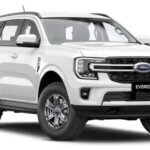 Ford Everest vs Land Cruiser 300 Australia: Which Big 4WD Should We Buy?
Toyota Australia lists a 3.5-litre V6 twin-turbo petrol engine combined with its i-FORCE MAX Performance Hybrid system on selected LandCruiser 300 variants. Toyota quotes combined output of 341kW and 790Nm.
This isn't primarily the sort of hybrid conceived to sip fuel around suburban streets like a small Toyota hatchback.
Toyota describes the system as performance-focused, using electrification to improve power delivery, responsiveness and capability for towing and off-road work.
For buyers comparing diesel Everest and LC300 models, however, the 3.3-litre diesel remains the more direct apples-to-apples comparison.
Ford Everest vs Land Cruiser Towing Capacity
Here's a surprising result.
It's effectively a draw on headline numbers.
The Ford Everest can tow up to 3,500kg braked, while the Toyota LandCruiser 300 diesel is also rated to 3,500kg braked. Ford quotes a maximum 350kg towball limit for the Everest in its towing guidance.
That doesn't mean they'll behave identically with 3.5 tonnes attached.
Why the LandCruiser Still Appeals to Heavy Towers
Toyota gives us 700Nm, a substantial chassis and a vehicle designed around demanding touring.
The LC300 also carries a large 110-litre total fuel capacity in the published diesel specifications, comprising an 80-litre main and 30-litre sub tank.
That's valuable when we're pulling a caravan through enormous stretches of Australia where the next fuel pump can feel like it's somewhere near the moon.
Everest Is Still an Excellent Tow Vehicle
Don't dismiss the Ford.
Its V6's 600Nm, 10-speed gearbox and maximum 3,500kg towing rating make it a genuinely serious towing SUV.
And because purchase price matters, plenty of buyers may prefer putting the money saved over an LC300 towards the caravan itself.
There's an important caveat with either vehicle: a maximum towing figure is not permission to simply attach 3,500kg and forget about mathematics. Payload, GVM, towball download, axle limits and combined vehicle-and-trailer mass all need to be checked for the particular configuration.
Which Is Better Off Road?
Both are considerably more capable than the average SUV, but this category leans towards the LandCruiser 300, particularly in its more off-road-focused configurations.
The LC300 uses permanent four-wheel drive with low range. Toyota's GR Sport adds front, centre and rear differential locking as well as E-KDSS suspension technology intended to combine on-road stability with improved wheel articulation off road.
Toyota also quotes 235mm running ground clearance for the diesel LC300 specifications published for its original Australian range, with some variants offering a 32-degree approach angle.
Ford Everest Off-Road Ability
The Everest is no soft crossover wearing muddy boots for Instagram.
V6 variants use full-time 4WD, while Ford's range includes purpose-built adventure versions such as the Tremor. Ford explicitly positions the current Tremor around tougher off-road use while retaining the V6 and up-to-3,500kg towing ability.
For beaches, forestry trails, muddy campsites, rocky tracks and ordinary recreational four-wheel driving, an appropriately equipped Everest should give most owners more capability than they'll routinely exploit.
When Does the LandCruiser Advantage Matter?
The difference becomes more meaningful when our version of "off road" means remote Australia.
If we're crossing deeply rutted tracks, touring for weeks, travelling far from major towns or deliberately seeking difficult terrain, the LC300's heavy-duty positioning starts earning its premium.
For the occasional campsite?
An Everest can be more than enough.
On-Road Comfort: The Everest Fights Back
Here's where Toyota's bigger-is-better philosophy doesn't automatically win.
The current Everest is remarkably civilised for a vehicle built on tough ladder-frame foundations.
Ford has paid considerable attention to steering, suspension refinement, cabin design and driver assistance. The result is a vehicle that feels less agricultural than buyers might expect.
That's important because, realistically, where do most Australian 4WDs spend Monday to Friday?
On bitumen.
Everest in Urban Australia
The Ford's proportions remain substantial, but it generally fits into normal family life surprisingly well.
School drop-offs, shopping centres and long motorway commutes don't feel like chores merely because we chose a vehicle capable of heading bush on Saturday morning.
The Everest's road manners are one of its strongest arguments.
LandCruiser 300 on the Highway
The LandCruiser also made a substantial leap forward when the 300 Series replaced the LC200.
Toyota adopted its TNGA-based body-on-frame architecture and redesigned the suspension while reducing weight in numerous areas. Toyota specifically targeted better stability, comfort and road dynamics.
At highway speeds, the LC300 can therefore feel surprisingly sophisticated for such a huge machine.
Yet its size never completely disappears.
This content may interest you!Ford Everest vs Land Cruiser Prado Australia: Which 4WD Is Better?Fuel Economy: Does the Everest Save Money?
Running costs matter when diesel isn't exactly handed out for free.
Toyota's published combined fuel-consumption figure for the LC300 3.3-litre diesel is 8.9L/100km under the applicable test cycle.
Current Everest efficiency varies according to engine and variant. CarsGuide lists the 2026 Everest 2.0-litre diesel at 7.1L/100km combined, illustrating the efficiency advantage available when choosing Ford's smaller engine.
But brochure numbers become only part of the story once we add roof racks, bullbars, camping equipment, passengers and a caravan.
A heavily loaded touring 4WD rarely consumes fuel like one cruising gently through a laboratory test cycle.
Interior and Technology
The Ford Everest deserves serious credit here.
Older ute-derived SUVs sometimes made occupants feel as though practicality had won an argument against interior designers.
The Everest doesn't.
Large digital displays, connected features, a modern dashboard and sophisticated driver assistance help the Ford feel thoroughly contemporary. Ford's current model range also provides wireless smartphone integration and extensive connectivity depending on grade.
The LandCruiser Cabin
Toyota's LC300 is considerably more modern inside than the old LC200, while higher specifications pile on equipment.
The Sahara, for example, was introduced with features including premium JBL audio, a head-up display, heated steering wheel, heated second-row seating and power-folding third-row seats.
The Toyota feels substantial and expensive.
The Ford can feel more digitally adventurous.
Which one is better depends partly on whether we value traditional luxury or contemporary interface design.
Seven-Seat Practicality
Both vehicles can accommodate seven occupants in appropriate variants, but neither makes the third row magically limousine-like.
Toyota's published LC300 configuration varies by grade: GXL, VX and Sahara have historically offered seven seats, while GX, Sahara ZX and GR Sport are five-seaters.
Ford likewise offers five- and seven-seat configurations depending on the current Everest version.
For families regularly carrying young passengers, either can work.
If we're transporting seven adults across Australia, however, we'd test the third row personally before signing anything.
Legs don't care what the brochure says.
Ford Everest vs Toyota Land Cruiser Safety
Both vehicles bring substantial safety credentials.
The current-generation Ford Everest received a five-star ANCAP rating with an August 2022 datestamp.
The LandCruiser 300 received a five-star ANCAP rating in 2022, although ANCAP notes that its rating applies to the assessed variants and excludes the GR Sport.
Both offer sophisticated crash-avoidance technology, although exact systems depend on variant.
When buying, we should compare the particular grades we're actually considering rather than assuming every badge brings identical equipment.
Reliability and Long-Term Ownership
Toyota walks into this section carrying decades of LandCruiser reputation on its shoulders.
That's powerful.
Across Australia, LandCruisers have spent generations working on farms, mines, construction sites and remote touring routes. That history creates buyer confidence that cannot be manufactured overnight.
But we shouldn't automatically conclude that a current LC300 will therefore be perfect or that an Everest will be troublesome.
They're modern vehicles packed with turbochargers, sensors, electronic control modules, emissions equipment and complex transmissions.
Neither is a 1980s tractor with air-conditioning.
Toyota's Ownership Argument
Toyota supports the LandCruiser 300 with a five-year/unlimited-kilometre warranty under its Warranty Advantage program, while qualifying scheduled servicing can extend engine and driveline coverage under Toyota's applicable conditions.
For people travelling far into regional Australia, Toyota's long-standing presence across the country also remains a practical attraction.
Everest Ownership Argument
Ford benefits from sharing significant engineering DNA with the Ranger family.
That means the Everest isn't an obscure specialist 4WD. It belongs to one of Ford Australia's key vehicle architectures, with engines and drivetrain concepts familiar across a very popular product family.
For many buyers, that's reassuring.
Which Is Better for Australian Families?
We'd give the Ford Everest the advantage for the average family.
This content may interest you!Ford Everest vs Toyota Fortuner Australia: Which 4WD SUV Is Better?Why?
Because family ownership involves more than crossing the Simpson Desert.
It involves:
- commuting Monday morning;
- navigating underground car parks;
- carrying children and sports equipment;
- doing supermarket runs;
- taking annual road trips;
- occasionally towing;
- heading camping several weekends a year;
- and paying the household bills afterwards.
The Everest balances those competing jobs beautifully.
A LandCruiser can do them too, naturally, but we're paying for a deeper level of capability that many households may rarely need.
Which Is Better for Touring Australia?
Now the needle swings towards Toyota.
The LandCruiser 300 feels like the natural choice for serious cross-country touring, particularly when we're travelling heavily loaded or heading well beyond major population centres.
That 700Nm diesel engine, full-time four-wheel drive, large fuel capacity and serious off-road hardware create an enormously persuasive package.
Think Cape York.
Think the Kimberley.
Think remote Outback tracks where the nearest dealership isn't conveniently around the corner.
The further we move away from suburban Australia, the easier the Toyota premium becomes to justify.
Everest Tremor vs LandCruiser GR Sport
Want the mud-loving versions?
This is the fun comparison.
The Everest Tremor brings Ford's V6 turbo-diesel and is specifically engineered as a more off-road-focused Everest while retaining up to 3,500kg braked towing capacity.
Toyota's GR Sport takes the LandCruiser formula further with front and rear locking differentials plus E-KDSS, while the diesel version provides 227kW and 700Nm. Toyota now also offers its dramatically more powerful 341kW/790Nm i-FORCE MAX Performance Hybrid powertrain in the GR Sport family.
For difficult terrain, the Toyota is the bigger hammer.
But it's an expensive hammer.
If an Everest Tremor gets us to every destination we're realistically planning to visit, the Ford can represent the smarter use of money.
Ford Everest Platinum vs LandCruiser Sahara
At the luxurious end, the argument changes again.
An Everest Platinum combines rugged SUV architecture with the sort of comfort, technology and styling once reserved for premium road-biased SUVs.
The LandCruiser Sahara similarly transforms its heavy-duty underpinnings into something genuinely luxurious.
Which would we choose?
If value, technology and normal family driving dominate the equation, Everest Platinum.
If the luxury cabin needs to accompany a seriously capable heavy touring platform, LandCruiser Sahara.
The Size Factor We Shouldn't Ignore
The LC300 is a genuinely large machine.
Toyota has published dimensions around 4,980mm long, 1,980mm wide and 1,950mm tall for many core LC300 variants, with a 2,850mm wheelbase. Exact dimensions vary slightly by grade.
That's fantastic when size works in our favour.
It becomes less amusing while spiralling through a narrow multi-storey car park.
One of the smartest things prospective buyers can do is borrow or test-drive both vehicles through their actual daily environment.
Don't spend an hour exclusively driving beautiful country roads.
Park it.
Reverse it.
Take it through your garage.
Drive past the school at 8:20 a.m.
Reality is the best vehicle reviewer.
Value for Money: Everest Wins
If we're evaluating what we receive for what we spend, the Ford has an enormously strong argument.
This content may interest you!Ford Everest vs Toyota Prado Australia: Which 4WD Is Better?The Everest gives us access to:
- genuine four-wheel-drive hardware;
- strong turbo-diesel engines;
- a 10-speed automatic;
- up to 3,500kg towing capacity;
- family-friendly seating;
- modern infotainment;
- sophisticated driver assistance;
- and substantial off-road capability.
Ford's advertised entry point for the MY26.5 Active 2.0L has been around $60,000 drive-away under its stated Australian offer conditions.
LandCruiser money buys more vehicle in several respects, but the relationship isn't linear.
Spend dramatically more and we don't suddenly get dramatically more seats or another tonne of towing capacity.
That's why the Everest is such a difficult rival.
Reasons to Buy the Ford Everest
The Ford makes most sense if we want one vehicle to comfortably handle virtually everything family life throws at us.
Its strongest arguments are value, modern technology, comfortable road manners and serious towing/off-road capability without automatically paying flagship-4WD money.
We'd choose the Everest if our priorities are roughly 70% everyday driving and 30% adventure.
It's the Swiss Army knife of this comparison.
Reasons to Buy the Toyota LandCruiser
The Toyota becomes easier to justify when capability takes priority over price.
Its 3.3-litre diesel has considerably more power and torque than Ford's V6, while its full-time 4WD hardware, substantial fuel capacity and available off-road technology create an extremely strong foundation for remote touring.
We'd lean LandCruiser if we're frequently towing heavy loads, travelling remotely or building a long-term expedition vehicle.
It's less Swiss Army knife and more Leatherman bolted to a toolbox.
Ford Everest vs Toyota Land Cruiser: Which Is Better?
There's no universal winner because these SUVs solve slightly different problems.
For most Australian buyers, we'd choose the Ford Everest.
That's not because it's categorically a better 4WD.
It's because it delivers such a strong combination of comfort, practicality, towing performance, off-road capability and technology while leaving considerably more money in our pocket.
The Toyota LandCruiser 300 wins when capability becomes the priority.
If we're towing a big caravan across Australia, regularly venturing into difficult remote terrain or simply want Toyota's flagship touring 4WD and can comfortably afford it, the LC300 makes tremendous sense.
Our Verdict by Category
| Category | Winner |
| Purchase value | Ford Everest |
| Diesel performance | Toyota LandCruiser |
| Maximum towing rating | Tie |
| Serious off-roading | Toyota LandCruiser |
| Remote touring | Toyota LandCruiser |
| Everyday family driving | Ford Everest |
| Technology/value balance | Ford Everest |
| Fuel-saving potential | Ford Everest 2.0 |
| Heavy touring platform | Toyota LandCruiser |
| Best all-round buy | Ford Everest |
The Simple Buying Rule
Here's the easiest way to decide.
Buy the Everest because it does almost everything exceptionally well. Buy the LandCruiser because your adventures genuinely demand more.
That's the heart of this comparison.
Conclusion: Everest or LandCruiser for Australia?
The battle between the Ford Everest vs Toyota Land Cruiser Australia isn't really about finding one objectively superior SUV.
It's about working out how much capability we'll actually use.
The Ford Everest has matured into one of Australia's most convincing family adventure vehicles. It's comfortable enough for everyday life, capable enough for demanding holidays, powerful enough for serious towing and sophisticated enough that we no longer need to accept agricultural road manners simply because we want a proper 4WD.
The LandCruiser 300 operates one level higher.
Its muscular 3.3-litre twin-turbo diesel, 700Nm torque output, sophisticated four-wheel-drive system and deep touring focus make it the machine we'd rather have underneath us when civilisation disappears from the rear-view mirror.
But capability we never use is expensive decoration.
If we're camping occasionally, towing moderately and spending most weeks driving around Australian suburbs and highways, we'd pocket the savings and buy the Everest.
If we're hauling a big caravan from Melbourne to Darwin, exploring remote tracks or building a vehicle for years of hard touring, we'd start looking very seriously at the LandCruiser.
Both can take us far beyond where normal SUVs turn around.
The question is simply: how far are we actually planning to go?
Frequently Asked Questions
1. Is a Ford Everest better than a Toyota LandCruiser?
For value, everyday driving and family use, the Ford Everest may be the better choice. The LandCruiser 300 is stronger when heavy-duty touring, demanding off-road driving and additional diesel power are priorities. Toyota's 3.3-litre twin-turbo diesel produces 227kW and 700Nm, compared with 184kW and 600Nm from Ford's 3.0-litre V6 diesel.
2. Can a Ford Everest tow as much as a LandCruiser?
On the headline figure, yes. Properly configured Ford Everest models offer up to 3,500kg braked towing capacity, matching the 3,500kg rating of the diesel LandCruiser 300. Actual legal towing capacity can be restricted by vehicle loading and other weight limits, so buyers should calculate their complete towing setup.
3. Which is better for off-roading, Everest or LandCruiser?
For serious and remote off-road use, we'd favour the LandCruiser 300, particularly the GR Sport. Toyota equips that model with front and rear differential locks and E-KDSS, while retaining low-range four-wheel-drive capability. The Everest remains a highly capable recreational 4WD, particularly in off-road-oriented versions such as the Tremor.
4. Is the Ford Everest cheaper to run than the LandCruiser?
Potentially, particularly with Ford's smaller 2.0-litre diesel. Current published figures vary by Everest variant, while Toyota quotes 8.9L/100km combined for its 3.3-litre diesel LC300. Real-world costs depend heavily on load, towing, driving style, tyres, accessories, servicing and insurance.
5. Which should we buy for travelling around Australia?
For regular remote touring with a large caravan or substantial load, we'd choose the Toyota LandCruiser 300 if the budget allows. For a combination of family use, holidays, camping and occasional towing, the Ford Everest offers stronger value and enough capability for most Australian adventures.
This content may interest you!Ford Everest or Isuzu MU-X Australia: Which 4WD SUV Should We Buy?
Leave a Reply