
Hyundai i30 Weight: Complete Guide by Model and Year

How much does a Hyundai i30 weigh? It sounds like a straightforward question, but the answer depends on the model, engine, transmission, body style, and year of manufacture.
The Hyundai i30 weight generally ranges from approximately 1,200 kg to more than 1,500 kg, depending on the version. Standard hatchbacks tend to be lighter, while performance-focused i30 N models carry additional mechanical components that increase their overall weight.
For example, the Australian Hyundai i30 N Line hatchback with a 1.5-litre turbocharged engine has a published kerb weight between 1,312 and 1,439 kg. Meanwhile, the i30 Sedan Hybrid weighs between 1,360 and 1,405 kg in the MY25 Australian specifications.
Understanding these differences can help us compare performance, fuel efficiency, towing capacity, and everyday practicality.
In this guide, we'll explore the Hyundai i30's weight across different models, explain the difference between kerb weight and gross vehicle mass, and examine how vehicle weight affects driving characteristics.
- How Much Does a Hyundai i30 Weigh?
- Hyundai i30 Hatchback Weight
- Hyundai i30 N Line Weight
- Hyundai i30 N Weight
- Hyundai i30 Sedan Weight
- Hyundai i30 Hybrid Weight
- Hyundai i30 Tourer Weight
- Hyundai i30 Weight by Model Year
- What Does Hyundai i30 Kerb Weight Mean?
- Hyundai i30 Gross Vehicle Weight
- Hyundai i30 Payload Capacity
- Hyundai i30 Towing Weight
- Hyundai i30 Roof Load Limit
- Does Hyundai i30 Weight Affect Fuel Economy?
- How Weight Affects Hyundai i30 Performance
- Hyundai i30 Manual vs Automatic Weight
- Hyundai i30 Weight in Pounds
- Is the Hyundai i30 a Heavy Car?
- How to Find the Exact Weight of Your Hyundai i30
- Why Hyundai i30 Weight Matters When Buying Used
- Frequently Asked Questions About Hyundai i30 Weight
- Conclusion: Understanding Hyundai i30 Weight
How Much Does a Hyundai i30 Weigh?
The Hyundai i30 is a compact passenger car offered in several configurations across international markets.
Its weight varies according to factors such as engine size, transmission type, equipment level, and body design.
Here are some published manufacturer weight figures.
| Hyundai i30 model | Kerb weight |
|---|---|
| i30 Hatchback 1.5T manual, UK specification | 1,280–1,407 kg |
| i30 Hatchback 1.5T DCT, UK specification | 1,312–1,439 kg |
| i30 N Line Hatch 1.5T DCT, Australia | 1,312–1,439 kg |
| i30 Sedan 2.0 petrol, MY25 Australia | 1,260–1,334 kg |
| i30 Sedan N Line 1.6T, MY25 Australia | 1,340–1,385 kg |
| i30 Sedan Hybrid, MY25 Australia | 1,360–1,405 kg |
| i30 N Hatch manual, Australian 2023 specification | 1,447–1,508 kg |
| i30 N Hatch DCT, Australian 2023 specification | 1,480–1,541 kg |
These figures represent manufacturer-published ranges for the specified versions rather than a single weight applicable to every Hyundai i30.
The exact figure for an individual vehicle may differ because of its trim level, optional equipment, and market specification.
Hyundai i30 Hatchback Weight
The Hyundai i30 hatchback is one of the most recognisable versions of the model.
Its compact exterior dimensions and practical five-door layout make it suitable for urban driving, commuting, and longer highway journeys.
Despite its relatively small footprint, the hatchback offers a combination of structural strength, passenger comfort, and modern equipment.
Hyundai i30 1.5 Turbo Weight
The updated Australian i30 N Line hatchback uses a 1.5-litre turbocharged petrol engine paired with a seven-speed dual-clutch transmission.
According to Hyundai's Australian specifications:
- Minimum kerb weight: 1,312 kg
- Maximum kerb weight: 1,439 kg
- Gross Vehicle Mass: 1,870 kg
- Engine displacement: 1,482 cc
- Maximum power: 117 kW
- Fuel tank capacity: 50 litres
The published weight range reflects differences in vehicle specification and equipment.
For everyday driving, this places the i30 among conventional compact hatchbacks rather than particularly lightweight city cars.
Hyundai i30 2.0 Petrol Weight
Earlier Australian i30 hatchbacks were available with a naturally aspirated 2.0-litre GDi petrol engine.
Published figures for these versions included:
| Transmission | Kerb weight |
|---|---|
| Six-speed manual | 1,251–1,357 kg |
| Six-speed automatic | 1,276–1,382 kg |
The automatic version has a slightly higher published minimum weight.
This is a useful example of how two vehicles with similar engines and identical body designs can have different weights because of their transmissions.
These figures relate to earlier Australian hatchback specifications and should not be confused with the current 1.5-litre turbocharged N Line model.
Hyundai i30 N Line Weight
The Hyundai i30 N Line combines sporty styling with a more everyday-focused driving experience.
Although its appearance resembles the high-performance i30 N, the two versions use different powertrains and performance equipment.
The Australian 1.5T N Line hatchback has a kerb weight of 1,312–1,439 kg.
Equipment contributing to its weight can include:
- Turbocharged petrol engine
- Dual-clutch automatic transmission
- Larger alloy wheels
- Multi-link rear suspension
- Sports seats and interior trim
- Driver assistance technology
- Infotainment and comfort equipment
Is the i30 N Line Heavier Than the Standard i30?
Not necessarily.
Weight depends on the exact models being compared.
A higher-specification N Line may weigh more than a basic hatchback because it carries additional equipment. However, different engines, transmissions, and construction specifications can change the comparison.
For instance, some older 2.0-litre hatchback variants had published minimum weights below the 1.5T N Line.
When comparing vehicles, it's important to use the same market, model year, and weight measurement standard.
Hyundai i30 N Weight
The Hyundai i30 N is the high-performance version of the hatchback.
Unlike the N Line, which primarily combines sport-inspired features with daily usability, the i30 N incorporates hardware specifically designed for more demanding performance driving.
Its mechanical specification includes a powerful turbocharged engine, upgraded brakes, performance suspension components, and an electronically controlled limited-slip differential.
These additions influence the vehicle's total mass.
Hyundai i30 N Manual Weight
In Hyundai Australia's February 2023 specification sheet, the six-speed manual i30 N has:
- Minimum kerb weight: 1,447 kg
- Maximum kerb weight: 1,508 kg
- Gross Vehicle Mass: 1,980 kg
The actual weight depends on the version and fitted equipment.
Hyundai i30 N Automatic Weight
The eight-speed N DCT version has a higher published weight.
| Specification | Manual | N DCT |
|---|---|---|
| Minimum kerb weight | 1,447 kg | 1,480 kg |
| Maximum kerb weight | 1,508 kg | 1,541 kg |
| Gross Vehicle Mass | 1,980 kg | 2,010 kg |
Based on these published figures, the DCT version is approximately 33 kg heavier when comparing the corresponding lightest or heaviest configurations.
That difference does not automatically make the automatic slower or less enjoyable to drive.
Transmission gearing, shift speed, launch control, and engine performance also influence acceleration.
Important: These figures come from a specific Australian i30 N specification. Other production years and regional versions may have different published weights.
Hyundai i30 Sedan Weight
The Hyundai i30 Sedan is sold in Australia and shares its basic model identity with the Hyundai Elantra in other markets.
Although the sedan has a longer body than the hatchback, that does not automatically mean it is heavier.
Body construction, powertrain selection, and interior equipment all affect the final result.
Hyundai i30 Sedan 2.0 Weight
According to Hyundai's Australian MY25 specifications, the 2.0-litre petrol sedan has:
- Minimum kerb weight: 1,260 kg
- Maximum kerb weight: 1,334 kg
- Gross Vehicle Mass: 1,750 kg
This makes some 2.0-litre petrol sedan configurations lighter than the Australian 1.5T N Line hatchback.
However, these are different vehicle specifications, so the figures should not be interpreted as a direct body-style-only comparison.
Hyundai i30 Sedan N Line Weight
The MY25 i30 Sedan N Line uses a 1.6-litre turbocharged petrol engine.
Its published specifications include:
- Minimum kerb weight: 1,340 kg
- Maximum kerb weight: 1,385 kg
- Gross Vehicle Mass: 1,850 kg
Compared with the naturally aspirated 2.0-litre sedan, the N Line typically carries a heavier performance-oriented powertrain and associated equipment.
Hyundai i30 Hybrid Weight
The Hyundai i30 Sedan Hybrid combines a petrol engine with an electric motor and hybrid battery system.
Hybrid vehicles often weigh more than comparable conventional petrol vehicles because of their additional electrical components.
For the Australian MY25 i30 Sedan Hybrid, Hyundai publishes:
| Specification | Weight |
|---|---|
| Minimum kerb weight | 1,360 kg |
| Maximum kerb weight | 1,405 kg |
| Gross Vehicle Mass | 1,830 kg |
The hybrid's additional weight is not necessarily a disadvantage.
Its electric motor can assist the petrol engine, and regenerative braking recovers some energy during deceleration.
Consequently, a heavier hybrid can still consume less fuel than a lighter conventional petrol version.
Does Hybrid Battery Weight Affect Performance?
Yes, but vehicle weight is only one part of the equation.
The hybrid battery, electric motor, and associated hardware add mass. At the same time, electric assistance changes how the car delivers power.
When comparing hybrid and petrol vehicles, we should consider:
- Combined powertrain output
- Acceleration and responsiveness
- Fuel consumption
- Battery and motor performance
- Kerb weight
- Vehicle load
Looking at weight alone cannot tell us which model will perform better.
Hyundai i30 Tourer Weight
In selected European markets, Hyundai offers the i30 Tourer, an estate or wagon version designed to provide additional luggage capacity.
Because the Tourer has a longer body and larger cargo area, it generally weighs more than an equivalent hatchback.
This content may interest you!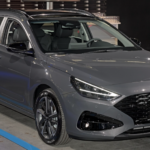 Hyundai i30 Towing Capacity Australia: Complete Guide
Hyundai's UK specifications for the 1.5T mild-hybrid models list:
| Transmission | Hatchback | Tourer |
|---|---|---|
| Six-speed intelligent manual | 1,280–1,407 kg | 1,307–1,444 kg |
| Seven-speed DCT | 1,312–1,439 kg | 1,337–1,474 kg |
These figures demonstrate that the Tourer carries some extra mass compared with the hatchback.
However, its larger luggage compartment can make it a more practical choice for families, road trips, or drivers who regularly transport equipment.
Hyundai i30 Weight by Model Year
One of the most common mistakes when researching Hyundai i30 specifications is assuming that every model year weighs the same.
The i30 has been available across multiple generations and updates, with changes to engines, gearboxes, safety equipment, and body construction.
Hyundai i30 2017–2020 Weight
Many third-generation i30 models introduced during this period used naturally aspirated petrol, turbocharged petrol, or diesel engines.
For example, earlier Australian specifications included 2.0-litre petrol hatchbacks with minimum kerb weights of 1,251 kg for the manual and 1,276 kg for the automatic.
Diesel and turbocharged versions had different weight ranges.
Hyundai i30 2021–2023 Weight
During this period, equipment and powertrain configurations continued to evolve.
Performance models such as the i30 N became important options for buyers seeking stronger acceleration and more engaging handling.
Hyundai's February 2023 Australian i30 N specifications show kerb weights starting at 1,447 kg for the manual and 1,480 kg for the DCT.
Hyundai i30 2024–2026 Weight
Updated versions of the i30 introduced revised engines, technology, and equipment in various markets.
For example, Hyundai Australia published a 1.5-litre turbocharged N Line hatchback with a kerb weight range of 1,312–1,439 kg.
UK specifications also identify mild-hybrid hatchback and Tourer models with different manual and DCT weight ranges.
There is no universal weight figure for all 2024, 2025, or 2026 i30 vehicles. We need to identify the exact regional specification and model variant.
What Does Hyundai i30 Kerb Weight Mean?
Kerb weight refers to the mass of a vehicle in its normal road-ready condition, without passengers or luggage.
It generally includes:
- Vehicle body and chassis
- Engine and transmission
- Standard mechanical components
- Operating fluids
- Standard equipment
- Fuel, according to the applicable measurement standard
However, definitions can vary between countries and manufacturers.
Some European specifications use a measurement convention that includes a standard driver allowance, while other published kerb weights exclude occupants.
For this reason, figures from different markets may not always be directly comparable.
Kerb Weight vs Dry Weight
Dry weight generally excludes some operating fluids, making it less representative of a vehicle ready for everyday driving.
Kerb weight is usually more useful when comparing passenger cars.
Before relying on a published figure, check how the manufacturer defines it.
Hyundai i30 Gross Vehicle Weight
Gross Vehicle Mass, often abbreviated GVM in Australia, represents the maximum permitted operating mass of the fully loaded vehicle.
This includes the vehicle itself, passengers, luggage, and additional equipment.
The GVM is substantially higher than kerb weight because it must account for the weight the vehicle is designed to carry.
Some published examples include:
| Hyundai i30 version | Gross Vehicle Mass |
|---|---|
| 1.5T N Line Hatch DCT, Australia | 1,870 kg |
| MY25 Sedan 2.0 petrol, Australia | 1,750 kg |
| MY25 Sedan N Line 1.6T, Australia | 1,850 kg |
| MY25 Sedan Hybrid, Australia | 1,830 kg |
| i30 N Hatch manual, 2023 specification | 1,980 kg |
| i30 N Hatch DCT, 2023 specification | 2,010 kg |
These figures are manufacturer limits, not the weight of a normally loaded vehicle.
Exceeding the authorised gross mass can affect braking performance, tyre loading, suspension operation, and road safety.
Hyundai i30 Payload Capacity
Payload is the amount of additional mass a vehicle can carry within its permitted gross weight.
In simplified terms:
Payload = Gross Vehicle Mass − Actual Kerb Weight
However, the exact calculation depends on the weight definition and the vehicle's fitted equipment.
For example, consider an i30 N Line hatchback with a gross vehicle mass of 1,870 kg.
If its actual kerb weight is 1,439 kg:
1,870 − 1,439 = 431 kg
That leaves approximately 431 kg of theoretical carrying capacity under those assumptions.
Passengers, luggage, accessories, and other added equipment must all be considered.
A lighter configuration may have more available carrying capacity, but we should verify its actual weight before calculating a usable payload.
Why Payload Matters
Imagine preparing the i30 for a weekend trip.
The vehicle might carry:
- A driver and several passengers
- Suitcases
- Sports equipment
- A child seat
- Additional accessories
Each item contributes to the loaded mass.
Keeping within the manufacturer's limits helps preserve safe vehicle operation.
Hyundai i30 Towing Weight
Kerb weight is not the same as towing capacity.
A vehicle may be able to tow a trailer of considerable mass, but its permitted towing weight depends on the powertrain, brakes, cooling system, transmission, and manufacturer approval.
For example, the Australian 1.5T i30 N Line hatchback specification lists:
- Maximum braked towing capacity: 1,000 kg
- Maximum unbraked towing capacity: 500 kg
- Maximum towball download: 75 kg
Other versions can have different limits.
The MY25 Australian i30 Sedan petrol variants, for example, have published braked towing capacities of 1,100 kg, while the Hybrid specification does not list an approved towing capacity.
We should always consult the owner's manual and the specifications for the exact vehicle before towing.
Hyundai i30 Roof Load Limit
Roof loading is another important consideration for drivers who use roof racks, cargo boxes, or other accessories.
For certain UK i30 hatchback and Tourer specifications, Hyundai publishes a maximum roof load of 80 kg.
This limit should not be assumed to apply to every international version.
The weight of the roof bars and cargo equipment may count towards the permitted total.
Additionally, a roof load can raise the vehicle's centre of gravity, affecting handling and stability.
For safe transportation, always follow both the vehicle manufacturer's roof-load limit and the accessory manufacturer's instructions.
Does Hyundai i30 Weight Affect Fuel Economy?
Yes. Vehicle mass influences the energy required to move a car, especially when accelerating.
In general, a heavier vehicle requires more energy to increase its speed.
However, fuel economy also depends heavily on engine efficiency, transmission design, aerodynamic resistance, tyre selection, and driving conditions.
City Driving
In stop-start traffic, a vehicle repeatedly accelerates and brakes.
Additional mass increases the energy needed during acceleration.
This can make vehicle weight particularly relevant in urban driving.
Highway Driving
At steady highway speeds, aerodynamic drag becomes increasingly important.
Vehicle weight still affects rolling resistance and climbing performance, but it is not the only major factor in fuel consumption.
This content may interest you!Hyundai i30 Warning LightsWhy Hybrids Can Be More Efficient
The i30 Sedan Hybrid demonstrates why weight alone does not determine fuel efficiency.
Despite its hybrid components adding mass, it can use electric assistance and regenerative braking to reduce fuel consumption.
This makes powertrain technology just as important as kerb weight when comparing running costs.
How Weight Affects Hyundai i30 Performance
Vehicle weight plays an important role in acceleration, braking, and cornering.
All else being equal, a lighter car requires less force to accelerate.
However, comparing the standard i30 with the i30 N shows why power output and vehicle engineering must also be considered.
Acceleration
The i30 N is heavier than many standard i30 versions, but it also delivers substantially more engine power.
Its turbocharged performance engine is designed to provide strong acceleration despite the extra mass.
Transmission choice also matters.
The automatic DCT adds weight compared with the manual gearbox in the published 2023 Australian specification, but rapid gear changes can contribute to strong acceleration performance.
Braking
A heavier vehicle carries more kinetic energy at the same speed.
That energy must be managed during deceleration.
Performance versions of the i30 therefore use braking systems designed for their intended operating conditions.
However, braking distances depend on much more than vehicle mass, including tyres, road conditions, brake condition, and driver inputs.
Cornering
Vehicle mass and its distribution influence handling characteristics.
A lower centre of gravity, suitable suspension calibration, and effective tyres can improve stability and cornering response.
This explains why two cars with similar weights may feel very different behind the wheel.
Hyundai i30 Manual vs Automatic Weight
Does an automatic Hyundai i30 weigh more than a manual?
Often, yes, when comparing otherwise similar versions.
The transmission itself can be one reason for the difference.
For example, earlier Australian 2.0-litre hatchback specifications list minimum kerb weights of:
| Transmission | Minimum weight |
|---|---|
| Manual | 1,251 kg |
| Automatic | 1,276 kg |
That represents a 25 kg difference in the published minimum figures.
The performance-focused i30 N shows a similar pattern, with its DCT configuration listed 33 kg heavier than the corresponding manual configuration.
However, automatic transmissions are not universally heavier in every vehicle. The answer depends on the gearbox design and the other specifications being compared.
Hyundai i30 Weight in Pounds
Drivers in countries using imperial measurements may prefer the Hyundai i30 weight in pounds.
The conversion is:
1 kilogram = approximately 2.20462 pounds
The following table provides useful reference values.
| Weight in kilograms | Weight in pounds |
|---|---|
| 1,200 kg | 2,646 lbs |
| 1,250 kg | 2,756 lbs |
| 1,300 kg | 2,866 lbs |
| 1,350 kg | 2,976 lbs |
| 1,400 kg | 3,086 lbs |
| 1,450 kg | 3,197 lbs |
| 1,500 kg | 3,307 lbs |
| 1,550 kg | 3,417 lbs |
For example, a Hyundai i30 weighing 1,400 kg has a mass of approximately 3,086 pounds.
These conversions are rounded to the nearest pound.
Is the Hyundai i30 a Heavy Car?
The Hyundai i30 is generally a normal-weight vehicle for the compact passenger-car category.
Its mass reflects the combination of structural construction, engines, transmissions, passenger accommodation, and modern safety equipment.
Basic versions may weigh less than higher-specification models, but a lower weight does not automatically make one vehicle better.
A lighter configuration may offer some advantages in efficiency and responsiveness.
Meanwhile, a heavier version may incorporate equipment that improves comfort, performance, or practicality.
The right choice depends on what we expect from the vehicle.
How to Find the Exact Weight of Your Hyundai i30
If you already own an i30, the most reliable approach is to identify the precise vehicle specification.
1. Check the Owner's Manual
The owner's manual may provide weight limits and vehicle loading information.
Some manuals cover multiple variants, so confirm which figures apply to your model.
2. Inspect the Vehicle Identification Label
Look for the manufacturer's compliance, certification, or identification label.
Depending on the market, this may display the authorised gross vehicle weight and axle load ratings.
3. Find the Original Specification Sheet
Manufacturer brochures and technical sheets can provide kerb weights for individual engines and transmissions.
Make sure the document matches the correct model year and country.
4. Check the VIN
The vehicle identification number can help an authorised Hyundai dealer identify the original configuration.
This is especially useful when a model has several engine or equipment options.
5. Use a Vehicle Weighbridge
For an accurate measurement of a particular car with its existing accessories and equipment, a suitable certified weighbridge can measure its actual mass.
This can be helpful when calculating loads for towing, transportation, or extended trips.
Why Hyundai i30 Weight Matters When Buying Used
Understanding vehicle weight is useful when comparing second-hand models.
It can help us identify meaningful differences between engines, gearboxes, and trim levels.
For instance, someone comparing an older 2.0-litre automatic hatchback with a newer 1.5T N Line should not assume that both vehicles have identical mechanical specifications simply because they share the i30 name.
The N Line may include different suspension components, wheels, and technology.
Similarly, the i30 N should be evaluated as a performance vehicle rather than a standard hatchback with cosmetic upgrades.
Weight is only one of several factors worth checking when purchasing a used car.
Maintenance history, mechanical condition, accident repairs, tyres, and previous modifications may be more important to the overall buying decision.
Frequently Asked Questions About Hyundai i30 Weight
1. How much does a Hyundai i30 weigh in kg?
The Hyundai i30 typically weighs approximately 1,200–1,550 kg across many published versions. The exact kerb weight depends on the year, engine, transmission, trim, and body style. For example, the Australian 1.5T N Line hatchback is listed between 1,312 and 1,439 kg.
2. What is the Hyundai i30 N weight?
Hyundai's February 2023 Australian specifications list the i30 N hatchback at 1,447–1,508 kg with a manual transmission and 1,480–1,541 kg with the eight-speed DCT. Other model years and market specifications may differ.
3. Is the Hyundai i30 Sedan heavier than the hatchback?
Not always. The Australian MY25 i30 Sedan with a 2.0-litre petrol engine has a kerb weight between 1,260 and 1,334 kg. The Australian 1.5T N Line hatchback is listed between 1,312 and 1,439 kg. Different engines and equipment prevent a simple body-style-only comparison.
4. How much weight can a Hyundai i30 carry?
The carrying capacity depends on the exact gross vehicle mass and the vehicle's actual kerb weight. For example, a configuration weighing 1,439 kg with a GVM of 1,870 kg has a theoretical remaining capacity of 431 kg. Passengers, accessories, and luggage must all fit within the applicable vehicle and axle limits.
5. Does the Hyundai i30 weight affect fuel consumption?
Yes. Heavier vehicles generally require more energy to accelerate, which can increase fuel consumption. However, engine efficiency, gearing, aerodynamic design, tyres, and hybrid technology also have major effects. A heavier hybrid may therefore use less fuel than a lighter conventional petrol vehicle.
Conclusion: Understanding Hyundai i30 Weight
The Hyundai i30 weight varies significantly depending on the model, engine, body style, and transmission.
Standard petrol hatchbacks and sedans generally sit towards the lighter end of the range, while more highly equipped or performance-focused versions can weigh considerably more.
The Australian 1.5T N Line hatchback, for example, has a published kerb weight between 1,312 and 1,439 kg. The MY25 i30 Sedan 2.0 petrol ranges from 1,260 to 1,334 kg, while the 2023 Australian i30 N hatchback can reach 1,541 kg in DCT form.
For buyers and owners, the most important step is to identify the exact model rather than relying on a general figure.
This content may interest you!Hyundai i30 Fuel Consumption in AustraliaWhen we understand kerb weight, gross vehicle mass, and payload capacity, we can make more informed decisions about performance, fuel economy, towing, and everyday practicality.
Ultimately, the Hyundai i30 provides a broad range of configurations, allowing drivers to prioritise efficiency, comfort, utility, or sporty performance according to their needs.
Leave a Reply