
Skoda Karoq or Similar Australia: What Cars Can You Expect?

If you have searched for “Skoda Karoq or similar Australia”, there is a good chance you are either comparing SUVs before buying one or staring at a rental-car booking wondering what the words or similar actually mean. And that tiny phrase matters more than we might think.
In Australia, a Skoda Karoq or similar generally refers to a compact-to-intermediate SUV with five seats, an automatic transmission, decent luggage capacity and everyday road manners. However, when the phrase appears on a car-rental website, it normally does not mean we are guaranteed to receive a Karoq. Rental companies typically guarantee a vehicle category rather than a particular manufacturer or model. Avis Australia, for example, explicitly states that the make and model depend on location and availability and that the company guarantees the vehicle category rather than the exact vehicle.
That leaves us with an obvious question: what exactly counts as a vehicle similar to a Skoda Karoq in Australia?
The answer depends on whether we are talking about buying, comparing or renting. Models such as the Nissan Qashqai, Kia Seltos, Volkswagen T-Roc, Toyota Corolla Cross and sometimes larger SUVs such as the Kia Sportage can all overlap with the Karoq depending on how the rental company or comparison website defines the segment.
Let's break it down properly.
- What Does “Skoda Karoq or Similar” Mean in Australia?
- Where Does the Skoda Karoq Fit in the Australian SUV Market?
- Current Skoda Karoq Range in Australia
- What Is the Closest Car to a Skoda Karoq in Australia?
- Skoda Karoq vs Nissan Qashqai
- Skoda Karoq vs Kia Seltos
- Skoda Karoq vs Volkswagen T-Roc
- Skoda Karoq vs Toyota Corolla Cross
- Could a Kia Sportage Be a Skoda Karoq Equivalent?
- How Much Luggage Fits in a Skoda Karoq?
- Is the Skoda Karoq Good for Australian Road Trips?
- How Safe Is the Skoda Karoq in Australia?
- What Is the Karoq Like to Drive?
- Is the Karoq Still Competitive in Australia in 2026?
- Best Skoda Karoq Similar Cars in Australia
- What Should You Check Before Booking a Karoq or Similar Rental?
- Should You Choose a Skoda Karoq or a Larger SUV?
- Buying a Karoq vs Renting a Karoq or Similar
- Why the Skoda Karoq Works Well as a Rental-Class Benchmark
- Conclusion: What Does Skoda Karoq or Similar Really Mean in Australia?
- FAQs About Skoda Karoq or Similar Australia
What Does “Skoda Karoq or Similar” Mean in Australia?
When a rental company displays Skoda Karoq or similar, the Karoq is normally being used as an example vehicle representing a particular rental category.
Think of the Karoq as the photo on a restaurant menu. It gives us an idea of what we are ordering, but what arrives may look slightly different.
Australian rental fleets change constantly because vehicles move between branches, are serviced, sold, replaced or temporarily unavailable. That is why rental companies usually sell a class of vehicle rather than promise one exact model.
Avis Australia describes its Intermediate SUV class using vehicles such as the Kia Sportage or similar. That category provides five seats, five doors, automatic transmission and space for multiple pieces of luggage. Avis also states elsewhere in its Australian fleet information that an exact make and model is subject to availability.
Europcar uses similar terminology. Its Australian vehicle subscription fleet lists vehicles such as the Hyundai Kona, Mazda CX-5, Subaru Crosstrek and Toyota RAV4 Hybrid followed by “or similar model.” It separately offers a “Guaranteed Model” concept, which reinforces the distinction between booking a class and booking a specific vehicle.
So if our reservation says Skoda Karoq or similar, we should expect something broadly equivalent in size, seating and functionality rather than assume a Karoq will be waiting at the counter.
Where Does the Skoda Karoq Fit in the Australian SUV Market?
The Karoq occupies an interesting position because it sits between conventional small SUVs and larger medium SUVs.
Australian automotive publications generally categorise it as a medium SUV, although its dimensions are relatively compact. CarExpert has even pointed out that the Karoq is smaller than some vehicles officially classified as small SUVs and identifies the Nissan Qashqai and Kia Seltos as especially close size rivals.
That unusual positioning explains why Skoda Karoq similar cars can come from more than one traditional SUV category.
The current Australian Karoq measures roughly 4.39 metres long and 1.84 metres wide, while its wheelbase is around 2.64 metres. The current Australian specification also provides 521 litres of luggage capacity with the rear seats upright and up to 1,630 litres when they are folded.
In other words, it has the footprint of a fairly manageable urban SUV but punches above its size when we look at cargo capacity.
That combination is one of the main characteristics a genuine Karoq alternative should try to reproduce.
Current Skoda Karoq Range in Australia
As of September 2026, Skoda Australia lists four MY26 Karoq versions.
| Australian Karoq variant | Advertised drive-away price |
|---|---|
| Karoq Select 110TSI | $40,990 |
| Karoq Sportline 110TSI | $46,990 |
| Karoq 130 Years Edition 110TSI | $49,990 |
| Karoq Sportline 140TSI 4x4 | $54,990 |
These are Skoda Australia's manufacturer-recommended drive-away figures, with the MY26 pricing document stating that the offer applies to eligible vehicles sold and delivered by December 31, 2026, subject to location, stock and dealer conditions.
That price range also helps us understand what a Skoda Karoq equivalent in Australia looks like from a buyer's perspective. We are not talking about a bargain-basement compact crossover, nor are we entering premium German SUV territory. The Karoq sits in the middle, with the upper Sportline versions edging into the price range of larger mainstream SUVs.
Karoq 110TSI
The Australian 110TSI versions use a 1.4-litre turbocharged four-cylinder petrol engine producing 110kW and 250Nm, paired with an eight-speed automatic transmission and front-wheel drive.
Official combined fuel consumption is listed at 6.6L/100km.
This is probably the version most relevant when we imagine a Karoq in a general rental fleet. It offers adequate power without being particularly performance-focused and keeps the mechanical layout relatively straightforward.
Karoq 140TSI Sportline 4x4
The Karoq 140TSI changes the personality considerably.
It uses a 2.0-litre turbocharged engine developing 140kW and 320Nm, connected to a seven-speed DSG and all-wheel drive. Skoda lists a 0–100km/h time of 7.0 seconds and combined consumption of 7.2L/100km.
A rental listing saying merely “Karoq or similar” therefore shouldn't automatically lead us to expect this higher-performance AWD version. Unless four-wheel drive or another specific feature is explicitly included in the rental class, the example image alone is not enough.
What Is the Closest Car to a Skoda Karoq in Australia?
There isn't one perfect answer.
The Nissan Qashqai is probably one of the closest conceptual alternatives because it combines compact external dimensions, five-seat practicality and a more upmarket feel than many entry-level small SUVs.
The Kia Seltos sits slightly further toward the value-focused small-SUV end of the spectrum, while the Volkswagen T-Roc is an obvious European alternative. The Toyota Corolla Cross enters the picture for buyers prioritising hybrid efficiency, while rental fleets may also substitute vehicles from the larger Sportage, Forester or CX-5 class depending on how that particular company defines its categories.
CarExpert specifically identifies the Qashqai and Seltos as close Karoq rivals by size, while also highlighting the Corolla Cross and related Volkswagen T-Roc as relevant alternatives.
Let's look at those options more closely.
Skoda Karoq vs Nissan Qashqai
The Nissan Qashqai is one of the most natural competitors for someone searching Skoda Karoq or similar Australia.
Both vehicles target people who want something easier to manoeuvre than a big family SUV without dropping down to a tiny city crossover.
However, the latest Australian Qashqai has moved much more aggressively toward electrification. Nissan's MY26.5 Australian range now centres on its e-POWER hybrid system. Nissan quotes combined fuel use of 4.1L/100km, while the company says the latest system can provide up to 1,341km of calculated range under its stated testing assumptions.
The current MY26 e-POWER range starts with the ST-L at a manufacturer suggested retail price of $45,640 before on-road costs.
The Karoq therefore takes a more conventional approach with turbo-petrol engines, while the Qashqai leans heavily into hybrid technology.
For a rental customer, however, both deliver broadly similar fundamentals: five seats, an elevated driving position, automatic transmission and enough luggage space for a small family.
Skoda Karoq vs Kia Seltos
The Kia Seltos is another vehicle that makes sense as a Karoq substitute, particularly when size rather than price is the main criterion.
CarExpert identifies it as one of the Karoq's closest rivals dimensionally.
The Seltos has traditionally competed in the small-SUV class, whereas the Karoq often gets labelled a medium SUV. Yet park the two near one another and that segment boundary starts looking rather artificial.
For rental customers, that is exactly why categories can feel inconsistent. One company might classify something Karoq-sized as a compact SUV while another places it into an intermediate SUV category.
Why Rental Categories Can Overlap
Rental companies do not necessarily use the same segmentation system as Australian new-car publications.
They care about practical characteristics: passenger count, luggage capacity, transmission, number of doors and sometimes drivetrain or premium positioning.
Consequently, a Kia Seltos could plausibly replace a Karoq in one fleet while a Kia Sportage could replace it in another.
What matters is the rental category specification written in the booking conditions.
Skoda Karoq vs Volkswagen T-Roc
The Volkswagen T-Roc is arguably the most obvious alternative for drivers who like the Karoq's European character.
The relationship goes deeper than appearance. CarExpert notes that the Karoq shares underlying architecture with the T-Roc, although the two vehicles have distinct styling, packaging and tuning.
The Volkswagen normally feels a little more style-focused, whereas the Karoq has always leaned heavily into usability and clever storage.
That distinction sounds small until we live with the vehicles.
Skoda tends to make mundane everyday tasks unusually easy. Hooks, storage areas, accessible controls and a large square boot might not sell a poster, but they quickly become features we appreciate when loading groceries, airport luggage or children's gear.
For someone renting rather than buying, the difference matters less. A T-Roc would generally represent a perfectly reasonable Skoda Karoq similar vehicle if its passenger and baggage allowance matches the booked category.
Skoda Karoq vs Toyota Corolla Cross
The Toyota Corolla Cross provides another interesting alternative, especially for drivers who prioritise efficiency and Toyota's hybrid technology.
CarExpert lists the Corolla Cross among relevant alternatives to the current Karoq.
The philosophical difference is straightforward.
The Karoq uses conventional turbocharged petrol engines in Australia, whereas the Corolla Cross has built much of its appeal around hybrid drivetrains.
That makes the Toyota attractive for urban driving where frequent braking and lower-speed conditions allow the hybrid system to do more of its work.
The Karoq counters with a generous 521-litre boot, relatively simple interior controls and a European driving character that feels composed without trying to pretend it is a sports car.
If we are renting, either may satisfy the same basic mission. If we are buying, the drivetrain difference becomes far more important.
Could a Kia Sportage Be a Skoda Karoq Equivalent?
Yes, especially in the rental world.
A Sportage is larger than the Karoq, so the two are not perfectly matched from a new-car segment perspective. Yet Avis Australia currently uses the Kia Sportage or similar as its example for the Intermediate SUV category, with five seats, five doors and automatic transmission.
That illustrates why we should not read too much into the badge shown on a rental website.
Imagine booking a hotel room advertised with a photograph of one particular room. We are booking the category and amenities, not necessarily the exact curtains in the photo.
Car hire works much the same way.
A Karoq could therefore potentially be substituted by a Sportage, Forester, CX-5 or another vehicle if the rental operator believes it meets the same category specification.
How Much Luggage Fits in a Skoda Karoq?
Cargo space is one area where the Karoq performs particularly well for its compact dimensions.
Skoda Australia lists 521 litres behind the second row and 1,630 litres with the rear seats folded for the current Australian model.
That sounds excellent on paper, but rental travellers need to remember that litres do not tell the whole story.
Suitcases have awkward shapes. Hard-shell luggage does not squeeze into spare corners like water poured into a measuring container.
A couple travelling with two medium or large suitcases should have little trouble. Four adults arriving at an airport with four large hard-shell cases may discover that a nominal five-seat SUV suddenly feels much smaller.
That is why the baggage icons shown by rental agencies can sometimes be more useful than manufacturer boot-capacity statistics.
Five Seats Does Not Mean Five Travellers Plus Five Suitcases
This is probably the biggest mistake people make when booking a Karoq-sized rental SUV.
Five seats simply means five seating positions.
This content may interest you!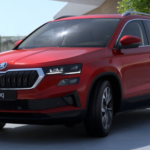 Skoda Karoq or VW T-Roc Australia: Which SUV Should You Choose?
It does not guarantee that five passengers can bring large luggage simultaneously.
Avis, for example, advertises its Australian Intermediate SUV category with capacity for two large and two small bags.
For an airport trip involving four or five adults with substantial luggage, moving to a larger SUV can be far more comfortable.
Is the Skoda Karoq Good for Australian Road Trips?
For most normal Australian road trips, yes.
The Karoq's manageable dimensions make it comfortable around Melbourne, Sydney, Brisbane or Adelaide, yet it still offers enough cargo space and highway comfort to make longer journeys practical.
The current 110TSI version has a 50-litre fuel tank and an official combined consumption figure of 6.6L/100km, while the 140TSI AWD uses a 55-litre tank and has an official combined figure of 7.2L/100km. Real-world consumption will naturally vary with traffic, load, weather, speed and driving conditions.
For paved-road touring, that makes the Karoq easy to live with.
Where we need to be careful is assuming SUV styling automatically means serious off-road ability.
Is Every Karoq or Similar Rental AWD?
Definitely not.
The Australian Karoq Select and 110TSI Sportline are front-wheel-drive models. Only the 140TSI Sportline 4x4 provides all-wheel drive in the current range.
This is particularly important when renting for snow regions, gravel routes or destinations where rental agreements impose restrictions on road types.
A photograph of a Karoq should never be interpreted as proof that our rental vehicle has AWD.
Check the rental category specification and booking conditions instead.
SUV and 4WD Are Not Synonyms
This distinction is easy to overlook.
An SUV describes a broad vehicle style. Four-wheel drive describes a drivetrain configuration.
The two often overlap, but one does not automatically imply the other.
If AWD or 4WD is essential to our journey, it should appear explicitly in the booking rather than being inferred from the vehicle pictured.
How Safe Is the Skoda Karoq in Australia?
The Karoq presents an unusual situation because its original five-star ANCAP rating was based on 2017 testing and has now expired under ANCAP's rating-validity rules.
CarExpert therefore describes the current model as officially unrated, although the historical five-star result included scores of 93 percent for adult occupant protection, 79 percent for child occupant protection, 73 percent for vulnerable road-user protection under the test terminology of the period, and 58 percent for safety assist.
Current Australian Karoq equipment nevertheless includes modern driver-assistance technologies such as autonomous emergency braking, adaptive cruise control, lane-keeping assistance, blind-spot monitoring, parking sensors and tyre-pressure monitoring, although equipment varies by grade.
The important point is not to describe an expired historical rating as if it were a current ANCAP rating.
What Is the Karoq Like to Drive?
The Karoq's personality is best described as straightforward.
That may sound like faint praise in an era where car advertising wants every family SUV to feel like a spaceship, but simplicity can be refreshing.
Recent Australian reviews praise the Karoq's predictable controls, relatively traditional interior layout and easy driving manners. CarExpert's 2026 Select review highlighted its simple operation, while noting limitations such as modest rear-seat room and technology that now feels older than newer competitors.
Physical controls remain easy to understand. Visibility is good. The steering does not demand much effort.
For a rental vehicle, these characteristics are arguably more important than dramatic styling. Nobody wants to spend twenty minutes in an airport car park discovering how to turn off a heated steering wheel.
Is the Karoq Still Competitive in Australia in 2026?
The answer depends heavily on what we value.
The Karoq is one of the older designs in its class. It first appeared internationally in 2017 and has evolved incrementally rather than being replaced by an all-new generation. Australian reviewers have noted that its interior technology and packaging can feel dated next to newer competitors.
Yet age also brings familiarity.
The controls are logical. The engines are conventional. There is no complicated plug-in routine. Cargo space remains strong.
Skoda Australia also provides a seven-year, unlimited-kilometre new-vehicle warranty, and current Karoq service intervals are 12 months or 15,000km.
That makes the Karoq more interesting than its age might initially suggest.
Best Skoda Karoq Similar Cars in Australia
For shoppers rather than renters, we would place the most relevant alternatives into slightly different groups:
- Nissan Qashqai: one of the closest overall matches in size and positioning, with the latest Australian range focusing strongly on e-POWER hybrid technology.
- Kia Seltos: slightly more small-SUV focused, but close to the Karoq dimensionally and often more value-oriented.
- Volkswagen T-Roc: a natural European alternative with related Volkswagen Group engineering.
- Toyota Corolla Cross: particularly appealing to drivers prioritising hybrid efficiency.
- Kia Sportage: larger than the Karoq but commonly representative of the intermediate-SUV rental category.
- Subaru Crosstrek or Forester: plausible alternatives in Australian rental fleets depending on the exact SUV class.
The interesting thing is that there is no universal definition of similar. A buyer normally defines similarity using price, dimensions, engine and features. A rental company defines it primarily through vehicle category and capacity.
Understanding that distinction saves a lot of confusion.
What Should You Check Before Booking a Karoq or Similar Rental?
Instead of focusing only on the photograph, we should inspect the actual category details.
Look at seating capacity, automatic versus manual transmission, number of bags, fuel type, drivetrain, kilometre allowance and any restrictions relevant to the journey.
This becomes particularly important for road trips involving remote areas.
If the booking says only “SUV”, we should not assume AWD. If it says “Karoq or similar,” we should not assume Skoda. And if the photo shows a high-spec Karoq Sportline, we should not assume every feature visible in that photograph will appear in the vehicle we collect.
Avis explicitly says the exact make and model can vary with location and availability.
That sentence is essentially the key to understanding the entire phrase.
Should You Choose a Skoda Karoq or a Larger SUV?
For two adults, a couple with children or a small group travelling light, a Karoq-sized SUV hits a sweet spot.
It is large enough to feel practical but small enough to avoid becoming cumbersome in underground car parks or tight urban streets.
Once four or five adults enter the equation with substantial luggage, the balance changes.
The Karoq has good boot space, but passengers need legroom too. Recent Australian testing has described the second row as relatively tight for a vehicle marketed in the medium-SUV segment.
A larger vehicle such as a Kia Sportage, Hyundai Tucson, Toyota RAV4 or Mazda CX-5 class SUV may make more sense for longer trips with several adults.
The slightly higher rental price can feel cheap after five hours of hearing suitcases rattle beside someone's shoulder.
Buying a Karoq vs Renting a Karoq or Similar
The buying decision and rental decision should be approached differently.
If we are buying, small differences matter enormously. Engine technology, warranty, servicing, resale value, infotainment, fuel economy and dealership access can affect years of ownership.
If we are renting for a week, our priorities become simpler.
Does everyone fit comfortably? Does the luggage fit? Is the vehicle automatic? Are unlimited kilometres included? Can we drive it where we plan to go?
The badge becomes surprisingly unimportant.
That is why the term Skoda Karoq or similar Australia makes perfect sense from a rental company's perspective even though it can frustrate customers who fall in love with the example vehicle.
Why the Skoda Karoq Works Well as a Rental-Class Benchmark
The Karoq occupies a convenient middle ground.
It is not enormous. It is not tiny. It seats five. It has five doors. It offers a useful boot. The entry Australian versions use front-wheel drive and an automatic transmission.
That makes it a practical reference point for an intermediate SUV.
Interestingly, overseas Enterprise listings explicitly place the Karoq in an Intermediate SUV category with five passengers and three bags, demonstrating how rental fleets commonly position the model internationally.
Australian fleets may use different example models, but the category logic is broadly similar.
So when we encounter a Karoq as the illustrative vehicle, we should picture a practical five-seat crossover rather than demand the exact Czech SUV shown on our screen.
Conclusion: What Does Skoda Karoq or Similar Really Mean in Australia?
Searching Skoda Karoq or similar Australia can lead us down two slightly different roads.
For buyers, the closest alternatives include vehicles such as the Nissan Qashqai, Kia Seltos, Volkswagen T-Roc and Toyota Corolla Cross, with larger models sometimes entering the comparison depending on budget and space requirements.
For renters, the meaning is much simpler: the Karoq is usually an example of a vehicle category, not a guaranteed model.
Australia's major rental operators commonly use “or similar” wording because fleet availability changes between branches and dates. Avis specifically states that it guarantees the vehicle category rather than the precise make and model on relevant Australian rental classes.
The current Karoq remains an appealing benchmark for that category. It provides five seats, a generous 521-litre boot, manageable exterior dimensions and conventional turbo-petrol powertrains. Australian MY26 pricing currently starts at $40,990 drive-away for the Select and rises to $54,990 for the Sportline 140TSI 4x4.
If we are renting, focus on the class specification.
If we are buying, focus on the individual vehicle.
Those three little words — or similar Australia — make all the difference.
FAQs About Skoda Karoq or Similar Australia
1. What does Skoda Karoq or similar mean when renting a car in Australia?
It normally means the rental company is offering a vehicle in the same category as the Skoda Karoq rather than guaranteeing an actual Karoq. The replacement should generally have comparable passenger capacity and vehicle size, although exact specifications and features can vary. Avis Australia explicitly states on several categories that the vehicle make and model depend on availability.
2. What cars are similar to a Skoda Karoq in Australia?
Some of the closest alternatives include the Nissan Qashqai, Kia Seltos, Volkswagen T-Roc and Toyota Corolla Cross. Depending on how a rental company defines its SUV classes, larger vehicles such as the Kia Sportage, Subaru Forester or Mazda CX-5 may also be supplied.
3. Is the Skoda Karoq considered a compact or medium SUV in Australia?
Australian automotive publications commonly place the Karoq in the medium-SUV category, although its relatively short dimensions make it comparable with several small SUVs. CarExpert describes the Qashqai and Seltos as particularly close rivals by size.
4. How much luggage can a Skoda Karoq carry?
The current Australian Karoq provides 521 litres of boot capacity with the rear seats upright and 1,630 litres with them folded. Actual suitcase capacity depends heavily on luggage shape and how many seats need to remain occupied.
5. Does Skoda Karoq or similar mean I will get a 4WD?
No. The current Australian Karoq range includes front-wheel-drive models as well as the 140TSI Sportline 4x4. Unless AWD or 4WD is explicitly included in the rental category, we should not assume the vehicle supplied will have it.
This content may interest you!Skoda Karoq or Peugeot 3008 Australia: 2026 Comparison
Leave a Reply