
Skoda Karoq vs Kushaq Australia: Which SUV Makes More Sense?

If you are searching for Skoda Karoq vs Kushaq Australia, you have probably discovered something slightly confusing. These two SUVs wear the same badge, use turbocharged petrol engines and share plenty of Škoda family DNA, yet they were developed for rather different markets.
And there is an even more important difference for Australian buyers.
As of September 2026, the Škoda Karoq is officially sold in Australia, while the Škoda Kushaq is not listed in Škoda Australia's current model range. The Australian Karoq line-up includes Select, Sportline 110TSI and Sportline 4x4 140TSI variants.
That means this is not quite the traditional head-to-head comparison we would make between two SUVs sitting beside each other in an Australian showroom.
Instead, we need to answer two questions.
How do the Karoq and Kushaq compare as vehicles? And, perhaps more importantly, which one makes practical sense if you actually live in Australia?
Let's dig in.
- Skoda Karoq vs Kushaq Australia: Quick Comparison
- What Is the Skoda Karoq?
- What Is the Skoda Kushaq?
- Skoda Karoq vs Kushaq Dimensions
- Interior Space and Passenger Comfort
- Skoda Karoq vs Kushaq Boot Space
- Skoda Karoq vs Kushaq Engines
- Kushaq 1.0 TSI vs Karoq
- Kushaq 1.5 TSI vs Karoq 1.4 TSI
- Front-Wheel Drive vs 4x4
- Fuel Economy
- Technology and Infotainment
- Safety Equipment
- Skoda Karoq Price in Australia
- Warranty and Servicing in Australia
- Karoq vs Kushaq for Australian Roads
- Which Has the Better Design?
- Skoda Karoq vs Kushaq Reliability
- Which One Is More Practical?
- Is the Kushaq a Cheaper Alternative to the Karoq?
- Karoq vs Kushaq: Which Is Better for Australians?
- Final Comparison
- Frequently Asked Questions
Skoda Karoq vs Kushaq Australia: Quick Comparison
Before getting into the details, here is the broad picture.
| Specification | Skoda Karoq Australia | Skoda Kushaq |
|---|---|---|
| Australian availability | Officially sold | Not in current Australian range |
| Length | Around 4,390 mm | 4,225 mm |
| Width | 1,841 mm | 1,760 mm |
| Wheelbase | Up to 2,638 mm | 2,651 mm |
| Boot capacity | 521 litres | Up to 491 litres |
| Petrol engines | 1.4 TSI / 2.0 TSI | 1.0 TSI / 1.5 TSI |
| Maximum power | 140 kW | 110 kW |
| Maximum torque | 320 Nm | 250 Nm |
| AWD available | Yes | No |
| Australian factory support | Yes | No official local model support |
The surprising part is that although the Kushaq is considerably shorter overall, its wheelbase is slightly longer than that of the mainstream Karoq variants.
That is one reason the smaller SUV can still provide reasonably useful passenger space.
The Karoq, however, offers considerably more width, more luggage capacity and, crucially for Australians, a locally supported ownership package.
What Is the Skoda Karoq?
The Karoq sits in the compact SUV section of Škoda Australia's range. It is larger than the Kamiq but smaller than the Kodiaq, making it a natural alternative to vehicles such as the Volkswagen T-Roc, Nissan Qashqai, Peugeot 3008 and other medium-small SUVs.
The MY26 Australian Karoq measures approximately 4,390 mm long in Select and Sportline 110TSI form, with a width of 1,841 mm and a 2,638 mm wheelbase. The Sportline 4x4 is fractionally shorter at 4,384 mm.
Its size hits a useful Australian sweet spot.
It is compact enough for supermarket car parks and inner-city streets without feeling like a miniature crossover once you start packing luggage for a weekend away.
Think of it as the middle bowl in Goldilocks' kitchen: not tiny, not enormous, but comfortably in between.
What Is the Skoda Kushaq?
The Kushaq is a compact SUV developed primarily around the requirements of the Indian market.
It uses Škoda's MQB-A0-IN architecture and measures approximately 4,225 mm long, 1,760 mm wide and 1,612 mm tall, with a wheelbase of 2,651 mm.
That makes it around 165 mm shorter and 81 mm narrower than a Karoq Select.
Despite the shorter body, however, its wheelbase is actually a little longer.
Clever packaging is clearly part of the recipe.
Škoda updated the Kushaq for 2026 with changes including new equipment, revised automatic transmission options and additional cabin technology. The latest model continues with 1.0-litre and 1.5-litre turbocharged petrol engines.
Is the Skoda Kushaq Sold in Australia?
This is the question Australian shoppers really need answered.
At the time of writing in September 2026, the Kushaq does not appear in Škoda Australia's official model range. The current Australian SUV range includes models such as the Kamiq, Karoq, Kodiaq, Elroq and Enyaq, but not the Kushaq.
Consequently, you cannot simply walk into an Australian Škoda dealership and configure a new Kushaq in the same way you can a Karoq.
That difference affects far more than the purchase price.
It affects warranty arrangements, servicing, parts availability, resale expectations, specification and potentially vehicle compliance requirements.
Skoda Karoq vs Kushaq Dimensions
The two SUVs look relatively similar in photographs, but put the measuring tape against them and their different missions become obvious.
Exterior Size
The Karoq Select measures:
- 4,390 mm long
- 1,841 mm wide
- 1,603 mm high
- 2,638 mm wheelbase
The Kushaq measures approximately:
- 4,225 mm long
- 1,760 mm wide
- 1,612 mm high
- 2,651 mm wheelbase
Škoda's current specifications confirm the MY26 Karoq dimensions, while the latest Kushaq documentation retains its compact 4,225 mm overall length.
Which Feels Easier Around Town?
On paper, the Kushaq has an obvious urban advantage.
Being roughly 16.5 cm shorter and more than 8 cm narrower can make squeezing into tight parking spaces easier.
Anyone who has tried negotiating an older multistorey car park knows that a few centimetres can suddenly feel like a few metres.
Yet the Karoq is hardly cumbersome.
At under 4.4 metres long, it remains a manageable compact SUV by Australian standards.
Interior Space and Passenger Comfort
Here things become more interesting.
You might assume the longer vehicle automatically has a much longer wheelbase. It does not.
The Kushaq's 2,651 mm wheelbase is actually slightly longer than the Karoq Select's 2,638 mm figure.
A long wheelbase relative to overall length can help create useful cabin space because more of the vehicle's footprint is devoted to passengers rather than long front or rear overhangs.
Nevertheless, the Karoq's greater overall width gives it an important advantage when carrying adults.
Three passengers across a rear bench generally appreciate shoulder room every bit as much as legroom.
Which Is Better for an Australian Family?
For regular family duties, we would lean toward the Karoq's packaging.
Its larger body gives it the feel of a more substantial SUV without pushing dimensions into seven-seat territory.
The Kushaq makes clever use of its smaller footprint, but it is fundamentally designed as a more compact product.
For couples or smaller families, that difference may barely matter.
Start adding child seats, sports equipment, shopping bags and holiday luggage, though, and the Karoq's extra volume begins earning its keep.
Skoda Karoq vs Kushaq Boot Space
Boot capacity is another meaningful distinction.
Current Australian MY26 Karoq specifications list 521 litres of luggage capacity with the rear seats in position and 1,630 litres with them folded.
The latest Kushaq is quoted with a 491-litre boot, expandable to around 1,405 litres with the rear seats folded.
That gives the Karoq an advantage of roughly 30 litres with the seats upright.
Thirty litres might not sound dramatic, but luggage space is a bit like kitchen cupboard space: we rarely complain about having too much of it.
Karoq Boot Advantages
The Karoq is particularly attractive if you regularly carry:
- large suitcases
- a pram
- golf equipment
- camping gear
- large grocery loads
- children's sporting equipment
- luggage for long interstate drives
The boxier proportions also help make the space genuinely useful rather than merely impressive on a specification sheet.
Skoda Karoq vs Kushaq Engines
Both SUVs rely heavily on Volkswagen Group TSI turbocharged petrol engines, but the Australian Karoq has the more powerful ceiling.
Karoq 1.4 TSI
Australian Karoq Select and Sportline 110TSI models use a 1.4-litre turbo petrol engine producing:
- 110 kW
- 250 Nm
- eight-speed automatic transmission
- front-wheel drive
Škoda lists a 0–100 km/h time of approximately 9.2 seconds and an official combined fuel consumption figure of 6.6 L/100 km.
This content may interest you!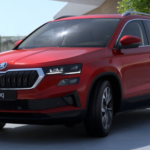 Skoda Karoq vs Toyota RAV4 Australia: Which SUV Is Better?
For everyday suburban driving, that combination provides a sensible balance between performance and fuel use.
It is unlikely to pin you into the seat like a performance SUV, but neither should merging onto a motorway feel like sending a formal invitation to the engine.
Karoq 2.0 TSI 4x4
Move up to the Karoq Sportline 4x4 140TSI and things become noticeably more serious.
Its 2.0-litre turbo engine produces:
- 140 kW
- 320 Nm
- seven-speed DSG
- four-wheel drive
Škoda quotes 0–100 km/h in around seven seconds and combined fuel consumption of 7.2 L/100 km.
That extra torque gives the Karoq considerably more effortless acceleration.
For Australian country roads, highway overtaking and drivers who simply enjoy having some reserve performance beneath their right foot, the 140TSI is the more interesting configuration.
Kushaq 1.0 TSI vs Karoq
The Kushaq's entry engine is a smaller 1.0-litre three-cylinder turbo petrol.
The latest specification produces approximately:
- 85 kW
- 178 Nm
The updated model can pair the 1.0 TSI with a six-speed manual or an eight-speed torque-converter automatic.
That engine suits the Kushaq's lighter, smaller character.
Around congested cities it should be perfectly adequate, but Australians accustomed to long motorway drives or high-speed regional roads may appreciate the Karoq's additional torque.
Kushaq 1.5 TSI vs Karoq 1.4 TSI
Here the comparison becomes far tighter.
The Kushaq 1.5 TSI produces:
- 110 kW
- 250 Nm
- seven-speed DSG
- front-wheel drive
Those headline outputs are essentially identical to the Karoq 1.4 TSI's 110 kW and 250 Nm.
Yet identical numbers do not mean identical driving experiences.
Vehicle weight, gearing, tyre specification, suspension tuning and sound insulation all influence how an engine feels from behind the wheel.
The Kushaq is smaller and relatively light, which helps the 1.5 TSI provide lively performance.
The Karoq, meanwhile, is the more substantial package.
Front-Wheel Drive vs 4x4
This is one area where the Karoq has an unquestionable hardware advantage.
Australian buyers can choose a Karoq Sportline 4x4, whereas the Kushaq sends its power to the front wheels.
Do most urban drivers need all-wheel drive?
Probably not.
But Australia is a huge country, and ownership patterns differ enormously between someone commuting through central Melbourne and someone regularly travelling on gravel roads outside a regional town.
Four-wheel drive can provide additional traction when surfaces become loose, wet or slippery.
It does not transform the Karoq into a hardcore off-roader, but it broadens its envelope.
Fuel Economy
Fuel consumption is tricky to compare directly because the vehicles are certified under different national testing procedures.
Australian Karoq figures are based on local ADR testing. The 110TSI is officially rated at 6.6 L/100 km combined, while the 140TSI 4x4 is listed at 7.2 L/100 km.
Indian Kushaq specifications quote fuel economy using Indian testing standards and commonly express results in kilometres per litre.
We therefore would not treat those laboratory numbers as a clean apples-to-apples Australian comparison.
In reality, driving style, traffic, temperature, tyre pressure and road conditions can easily move consumption away from published figures anyway.
Technology and Infotainment
The Karoq feels more aligned with what Australian buyers expect from a mainstream European compact SUV.
Depending on specification, available equipment includes technologies such as:
- Virtual Cockpit
- wireless smartphone connectivity
- wireless phone charging
- Matrix LED headlights
- navigation
- front and rear parking sensors
- reversing camera
- driver-assistance technology
Škoda Australia also lists Front Assist, Side Assist with Rear Traffic Alert and additional assistance systems across relevant Karoq specifications.
Kushaq Technology
The refreshed Kushaq has become increasingly sophisticated.
Depending on variant, features include a panoramic sunroof, ventilated electrically adjustable front seats, automatic climate control, digital technology, upgraded infotainment and a branded Škoda audio arrangement with subwoofer.
In other words, do not mistake "developed for India" for "basic".
Higher-specification Kushaq variants offer equipment that would not look strange in considerably more expensive SUVs.
Safety Equipment
Modern versions of both models provide extensive electronic safety equipment, although exact systems vary by trim and market.
The Australian Karoq includes features such as Front Assist, Lane Assist, Adaptive Cruise Control and parking assistance depending on specification.
The revised Kushaq is promoted in India with more than 25 safety features across its range.
Australian buyers should nevertheless remember that specifications from India cannot automatically be assumed to match Australian regulatory requirements or Australian-market equipment.
That distinction becomes important if you are investigating an imported vehicle.
Skoda Karoq Price in Australia
This is where the Australian-market reality returns to centre stage.
At the time of writing, Škoda Australia advertises the Karoq range from approximately:
- Karoq Select – $40,990 drive-away
- Karoq Sportline 110TSI – $46,990 drive-away
- Karoq Sportline 4x4 140TSI – $54,990 drive-away
These are advertised starting prices and can change with model year, location, stock and promotions.
How Much Would a Kushaq Cost in Australia?
There is no equivalent official Australian drive-away price because Škoda Australia does not currently sell the Kushaq.
Quoting its Indian retail price and simply converting rupees into Australian dollars would therefore be misleading.
A currency conversion ignores expenses that may arise from transport, taxes, compliance, registration, insurance, parts logistics and other factors associated with importing a vehicle.
So when comparing Skoda Karoq vs Kushaq Australia price, the honest answer is simple: there is currently no normal Australian showroom price for the Kushaq.
Warranty and Servicing in Australia
This might be the Karoq's biggest advantage of all.
Škoda Australia provides a seven-year, unlimited-kilometre warranty across its Australian new-vehicle range. Prepaid service packages are also available.
That means a locally purchased Karoq plugs directly into the Australian Škoda ownership ecosystem.
You have local dealerships, scheduled servicing arrangements, Australian specification information and a locally applicable factory-backed warranty structure.
The Kushaq Ownership Question
A privately sourced Kushaq creates more uncertainty.
Even though it carries the Škoda badge, buyers should not assume an overseas vehicle automatically receives the same warranty conditions or local support as an Australian-delivered Škoda.
Parts compatibility may also vary.
This content may interest you! Toyota HiLux Years to Avoid Australia: The Used Buyer’s Guide
That does not automatically make ownership impossible, but it introduces questions that simply do not exist with a locally delivered Karoq.
For most people, buying a car should not feel like starting an international logistics company.
Karoq vs Kushaq for Australian Roads
Australia exposes vehicles to an unusually broad mix of environments.
One week a car may spend its life crawling through Sydney traffic. The next it could be travelling hundreds of kilometres on open highways.
City Driving
For dense urban use, the Kushaq's smaller dimensions are appealing.
Its narrow body and shorter overall length could make parking easier, and its turbo engines provide plenty of performance for ordinary metropolitan driving.
The Karoq remains manageable, though.
Its larger dimensions are not excessive, and parking sensors plus a reversing camera help compensate.
Highway Driving
For regular long-distance touring, the Karoq's larger body and stronger available engines make more sense.
The 140TSI's 320 Nm of torque should be especially attractive when overtaking or travelling with passengers and luggage.
The broader cabin and larger boot also become more valuable after several hours on the road.
Regional and Rougher Roads
The availability of Karoq 4x4 adds another advantage outside major cities.
Neither vehicle is intended to behave like a LandCruiser in difficult terrain, but additional driven wheels can be reassuring on gravel, mud or slippery surfaces.
Which Has the Better Design?
This one depends entirely on taste.
The Karoq carries the proportions of a traditional European compact SUV: relatively broad, mature and understated.
The Kushaq looks leaner and slightly more youthful.
Its shorter body gives it a nimble visual character, while newer versions incorporate Škoda's evolving design language.
If the Karoq looks like it has arrived wearing a smart jacket, the Kushaq looks like its younger cousin has turned up in trainers.
Neither approach is inherently better.
Skoda Karoq vs Kushaq Reliability
Mechanically, both vehicles rely on technologies familiar within the wider Volkswagen Group ecosystem, including turbocharged direct-injection petrol engines.
However, Australians evaluating reliability should separate the engineering question from the ownership question.
A vehicle can be fundamentally dependable yet inconvenient to own if specialised parts are difficult to source locally.
That is why the Karoq's official Australian presence matters so much.
Even if we imagined both vehicles experiencing exactly the same mechanical issue, obtaining diagnostics, parts and warranty assistance for an Australian-delivered Karoq would generally be a much more straightforward process.
Which One Is More Practical?
Purely as vehicles, the answer depends on how much space you need.
Choose the Kushaq's philosophy if you value:
- compact exterior dimensions
- a long wheelbase relative to vehicle length
- smaller-engine efficiency
- easy urban manoeuvrability
The Karoq's philosophy suits buyers who prioritise:
- larger luggage capacity
- wider interior
- stronger available performance
- optional four-wheel drive
- Australian dealer support
- Australian warranty coverage
That last pair changes the equation dramatically.
Is the Kushaq a Cheaper Alternative to the Karoq?
In markets where both pricing structures can be compared normally, the Kushaq occupies a more value-focused position.
But that does not automatically make it a cheap Karoq alternative in Australia.
Once a vehicle needs to cross borders outside the manufacturer's normal sales channel, the sticker price back home tells only half the story.
Importation, compliance, transport and ownership considerations can quickly eat into any apparent saving.
Anyone investigating a Kushaq specifically for Australian use should therefore calculate the entire landed and registered cost rather than comparing overseas sticker prices.
Karoq vs Kushaq: Which Is Better for Australians?
If we remove market availability from the equation, the Kushaq has genuine attractions.
It is compact, cleverly packaged, available with punchy turbo engines and offers impressive equipment in higher trims.
For crowded cities, its dimensions are particularly appealing.
But Australian buyers cannot realistically remove market availability from the equation.
The Karoq is engineered into Škoda Australia's local product ecosystem. You can inspect one at an Australian dealership, buy it at an Australian drive-away price, service it through the official network and receive the brand's Australian seven-year unlimited-kilometre warranty.
That makes the Karoq dramatically simpler to own.
When Could the Kushaq Still Make Sense?
There are unusual circumstances where someone might still investigate a Kushaq.
Perhaps you already own one overseas. Perhaps you are relocating. Perhaps you simply have a strong interest in a specification unavailable here.
In those situations, research the legal, compliance, servicing, insurance and parts implications carefully before making financial assumptions.
For an ordinary Australian buyer walking into the market looking for a compact Škoda SUV, however, the Karoq is the directly supported choice.
Final Comparison
The Skoda Karoq vs Kushaq Australia comparison reveals two SUVs that share a badge but serve different purposes.
The Kushaq is the smaller vehicle. At roughly 4.23 metres long, it packages a surprisingly long wheelbase into a compact footprint and combines that with efficient turbocharged engines and plenty of modern equipment.
The Karoq moves the formula upward.
It is wider, longer and more spacious, offers 521 litres of boot capacity and gives Australian buyers engine options ranging from the 110 kW front-wheel-drive 110TSI to the 140 kW, 320 Nm Sportline 4x4.
Yet specifications tell only part of the story.
In Australia, the biggest distinction is not 30 litres of boot space or a few centimetres of body length. It is official market support.
The Karoq is sold, warrantied and supported by Škoda Australia.
The Kushaq currently is not part of the Australian model range.
That makes the Karoq the straightforward proposition for local buyers, while the Kushaq remains an interesting example of how Škoda approaches the compact SUV formula in another major market.
Frequently Asked Questions
Is the Skoda Kushaq available in Australia?
As of September 2026, the Kushaq is not listed in Škoda Australia's current official vehicle range. Australian Škoda buyers can instead choose SUVs including the Kamiq, Karoq and Kodiaq as well as electric models such as the Elroq and Enyaq.
Is the Skoda Karoq bigger than the Kushaq?
Yes. The Karoq Select is around 4,390 mm long and 1,841 mm wide, whereas the Kushaq measures around 4,225 mm long and 1,760 mm wide. Interestingly, the Kushaq's approximately 2,651 mm wheelbase is slightly longer than the Karoq Select's 2,638 mm wheelbase.
Which has more boot space, the Karoq or Kushaq?
The Karoq has the larger quoted luggage capacity. Current Australian Karoq specifications list 521 litres with the rear seats upright, while the latest Kushaq is quoted at up to 491 litres.
Does the Skoda Kushaq come with AWD?
No. The Kushaq is front-wheel drive. Australian buyers wanting all-wheel-drive capability can choose the Karoq Sportline 4x4 140TSI, which combines a 2.0-litre turbo engine with four-wheel drive.
Which is better for Australia, the Skoda Karoq or Kushaq?
The vehicles target slightly different needs. The Kushaq offers smaller dimensions and clever packaging, while the Karoq provides more luggage room, stronger available performance and optional 4x4. For Australian ownership, the major practical difference is that the Karoq is officially sold and supported by Škoda Australia, while the Kushaq is not currently part of the local range.
This content may interest you!Skoda Karoq vs Kodiaq Australia: Which SUV Is Better for You?
Leave a Reply