
Ford Everest Trend vs Sport: Which Is Better in Australia?

Choosing between the Ford Everest Trend vs Sport can feel a little like choosing between a well-equipped hiking boot and a premium adventure boot. Both are tough, comfortable and ready to leave the bitumen, but the Sport adds extra muscle, darker styling and a stronger sense of occasion.
For Australian buyers, however, the comparison needs a small disclaimer. The Everest range has changed over time. The Trend featured prominently in the 2025 and early-2026 Australian line-up, while Ford’s newer MY26.5 range replaced the Trend and Ambiente with the Active grade. Therefore, this guide mainly compares the widely available 2025-era Everest Trend 4x4 Bi-Turbo with the Everest Sport V6 4WD—the two models most shoppers will encounter when browsing dealer demonstrators and used examples.
At first glance, the decision seems simple. The Trend is cheaper and more economical. The Sport looks sharper and brings a larger V6 diesel engine. Yet the real answer depends on how we plan to use the vehicle.
Are we carrying children around Melbourne? Towing a large caravan across Western Australia? Commuting through Sydney traffic? Or escaping to a remote campsite every second weekend?
Let us dig into the details.
- Ford Everest Trend vs Sport at a Glance
- The Biggest Difference: Four-Cylinder vs V6
- Which Everest Is Faster?
- Fuel Economy: Does the Trend Save More Diesel?
- Four-Wheel-Drive Systems Compared
- Exterior Styling: Practical or Aggressive?
- Wheel Size and Ride Comfort
- Interior Quality and Cabin Atmosphere
- Infotainment and Connectivity
- Passenger Space and Seven-Seat Practicality
- Boot Space Comparison
- Towing Capacity: Trend vs Sport
- Off-Road Capability
- Safety and Driver Assistance
- Daily Driving and Urban Use
- Highway Touring
- Purchase Price and Value
- Running Costs and Maintenance
- Resale Value
- Ford Everest Trend Pros and Cons
- Ford Everest Sport Pros and Cons
- Who Should Buy the Ford Everest Trend?
- Who Should Buy the Ford Everest Sport?
- Ford Everest Trend vs Sport: Our Verdict
- Frequently Asked Questions
Ford Everest Trend vs Sport at a Glance
The Ford Everest Trend is positioned as the sensible, feature-rich family choice. It gives us the large touchscreen, seven-seat practicality, substantial safety technology and genuine four-wheel-drive capability without forcing us to pay for the V6 engine or sportier appearance.
The Everest Sport takes the same basic formula and turns up the volume. Its blacked-out exterior details, larger wheels and muscular V6 powertrain make it look and feel more expensive. It is the Everest for buyers who want their family SUV to possess a little more theatre.
Here is the broad comparison:
| Category | Ford Everest Trend 4x4 | Ford Everest Sport V6 4WD |
|---|---|---|
| Engine | 2.0-litre Bi-Turbo diesel | 3.0-litre V6 turbo-diesel |
| Power | 154kW | 184kW |
| Torque | 500Nm | 600Nm |
| Transmission | 10-speed automatic | 10-speed automatic |
| Four-wheel-drive system | Part-time 4x4 | Full-time 4WD with 4A |
| Seating | Seven seats | Seven seats |
| Braked towing capacity | Up to 3,500kg | Up to 3,500kg |
| Main appeal | Value and efficiency | Performance and style |
| Best suited to | Families and general touring | Towing and premium touring |
The 2025 Australian Everest used a 154kW/500Nm 2.0-litre Bi-Turbo diesel in the Trend and a 184kW/600Nm 3.0-litre V6 turbo-diesel in the Sport. Both were paired with a 10-speed automatic transmission.
The Biggest Difference: Four-Cylinder vs V6
The engine is the beating heart of this comparison.
Everest Trend 2.0-Litre Bi-Turbo Diesel
The Trend’s 2.0-litre diesel uses two turbochargers to deliver 154kW and 500Nm. On paper, those numbers may look modest beside the V6, but they are far from weak.
Around town, the Trend moves confidently. It has enough low-down torque to pull away from traffic lights without feeling strained, and the 10-speed automatic generally keeps the engine within its useful operating range.
On country roads, the four-cylinder remains capable. It can overtake slower vehicles, climb long hills and carry a full family without turning every journey into a struggle.
The Trend’s engine is like a dependable working dog. It may not make a grand entrance, but it gets the job done with energy to spare.
Everest Sport 3.0-Litre V6 Turbo-Diesel
The Sport’s V6 produces 184kW and 600Nm. That means it offers 30kW more power and 100Nm more torque than the Trend’s Bi-Turbo diesel.
Those differences are noticeable.
The Sport accelerates with less effort, especially when joining a motorway, overtaking at highway speeds or climbing while heavily loaded. The V6 does not merely make the Everest faster; it makes the vehicle feel more relaxed.
Instead of frequently calling on the transmission to find a lower gear, the V6 can often lean on its deeper reserve of torque. It feels as though someone has loosened the Everest’s collar and given it more room to breathe.
For buyers who tow regularly, carry heavy equipment or simply enjoy effortless performance, the Sport has a clear advantage.
Which Everest Is Faster?
Neither model is intended to behave like a hot hatch, but the Everest Sport V6 is unquestionably the stronger performer.
The V6 responds more decisively when we press the accelerator. Its extra torque is particularly useful from low and medium engine speeds, where large diesel SUVs spend most of their time.
The Trend is perfectly adequate during normal driving. However, with seven passengers, luggage and a trailer, it must work harder. The Sport handles the same load with greater composure.
That distinction matters because performance in a large SUV is not only about acceleration figures. It is about how much effort the vehicle appears to use.
The Trend says, “We can do this.”
The Sport says, “Is that all?”
Fuel Economy: Does the Trend Save More Diesel?
The Trend is usually the more economical choice.
Its smaller four-cylinder engine consumes less fuel under comparable conditions, particularly in suburban driving and on long, lightly loaded highway trips. Official and real-world consumption can vary according to tyres, accessories, traffic, towing weight and driving style, but the 2.0-litre drivetrain generally holds the efficiency advantage.
The V6 Sport’s additional capacity, full-time four-wheel-drive hardware and higher performance inevitably require more fuel.
Published figures for the broader 2025 Everest range extend from approximately 7.1L/100km to 9.5L/100km depending on the variant, while the V6 Sport has commonly been listed at around 8.5L/100km combined.
This content may interest you!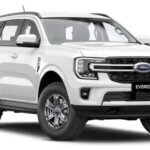 Is Ford Everest Reliable in Australia? Complete Ownership Guide
When the Difference Becomes Smaller
The efficiency gap may narrow when towing.
A smaller engine working hard can consume considerably more fuel than it does during unladen driving. Meanwhile, the V6 may maintain speed with less throttle and fewer downshifts.
That does not necessarily make the V6 more economical while towing, but it means the difference may be less dramatic than buyers expect.
For normal family use, the Trend wins on fuel costs. For frequent heavy towing, many owners may decide the Sport’s easier performance is worth the extra diesel.
Four-Wheel-Drive Systems Compared
Another important difference lies beneath the body.
Trend Part-Time 4x4
The 2025 Trend 4x4 uses a part-time four-wheel-drive system. Under normal sealed-road conditions, it operates primarily in two-wheel drive. We can select four-wheel-drive modes when the surface becomes loose or slippery.
Part-time 4x4 is robust and effective off-road, but traditional high-range locked four-wheel drive should not be used continuously on dry, high-grip bitumen because drivetrain wind-up can occur.
For most owners, this is not a major inconvenience. We simply leave the vehicle in its normal road setting and select the appropriate mode when entering sand, mud, gravel or a difficult track.
Sport Full-Time 4WD
The V6 Sport uses Ford’s more advanced full-time 4WD system, including an automatic 4A setting. This allows the vehicle to vary torque distribution and provide four-wheel-drive assistance on sealed roads when needed.
Ford describes the system as offering 2H, 4A, 4H and 4L modes, with 4A suitable for high-traction surfaces because the system can engage drive automatically rather than mechanically locking the axles together.
That can be valuable in heavy rain, on changing road surfaces or during long-distance touring. We do not need to wait until conditions deteriorate before gaining additional traction.
Which System Is Better?
The Sport’s full-time system is more versatile.
The Trend remains highly capable off-road, but the Sport provides an extra layer of confidence during mixed on-road conditions. For buyers who travel through wet mountain roads, gravel highways or unpredictable regional weather, 4A is a worthwhile benefit.
Exterior Styling: Practical or Aggressive?
The Trend and Sport share the same broad Everest shape, but their personalities differ.
Ford Everest Trend Design
The Trend has a relatively understated appearance. It looks modern and substantial without shouting for attention.
Its exterior treatment suits buyers who prefer a clean, conventional SUV. It looks equally appropriate outside a suburban school, an office building or a remote caravan park.
The Trend does not appear cheap. Rather, it avoids some of the visual drama applied to the Sport.
Ford Everest Sport Design
The Sport leans heavily into blacked-out styling. Dark grille elements, black accents and larger dark-finished wheels give it a broader, more imposing stance.
Current Everest Sport specifications continue to highlight a blacked-out grille and 20-inch matt-black alloy wheels, demonstrating the same visual philosophy used by earlier Sport variants.
The effect is similar to exchanging a practical jacket for a tailored black coat. The basic purpose remains, but the attitude changes immediately.
The Sport looks more expensive and more distinctive. Whether that is worth paying for depends on how much we value driveway appeal.
Wheel Size and Ride Comfort
Larger wheels can improve appearance, but they are not automatically better in every situation.
The Sport’s 20-inch wheels create a stronger visual presence. They fill the wheel arches nicely and complement the black styling package.
However, larger wheels generally require lower-profile tyres. That can make sharp road imperfections more noticeable and leave less rubber between the rim and a pothole, rock or corrugated track.
The Trend’s more conservative wheel-and-tyre combination can be attractive for:
- Rural roads
- Long-distance touring
- Replacement tyre affordability
- Off-road travel
- Ride comfort
- Reduced wheel-damage risk
The Sport is not uncomfortable, but the Trend may be the more sensible starting point for owners planning to replace the factory tyres with all-terrain rubber.
Interior Quality and Cabin Atmosphere
Inside, both models feel modern and thoughtfully designed.
The vertical dashboard, prominent central screen and broad centre console give the Everest a more sophisticated atmosphere than older ute-based SUVs. It still feels rugged, but it no longer feels like a commercial vehicle wearing a family-car costume.
Everest Trend Interior
The Trend’s cabin is functional, comfortable and well equipped. It provides the technology and seating flexibility most families actually need.
This content may interest you!Is Ford Everest a Good Car in Australia? An Honest Buyer’s GuideLeather-accented upholstery, a large touchscreen and seven-seat accommodation help the Trend feel significantly more premium than an entry-level SUV.
Ford’s 2025 model material identified third-row seating as standard on Trend and Sport models and listed a 12-inch touchscreen for both grades.
Everest Sport Interior
The Sport builds on that foundation with a darker, sportier presentation. Depending on the exact production year and specification, it may include model-specific stitching, embossed details and trim finishes that make the cabin feel more distinctive.
The functional difference is not enormous. The emotional difference is easier to notice.
The Trend feels like a highly equipped family vehicle.
The Sport feels like a vehicle we may occasionally turn around to admire after parking.
Infotainment and Connectivity
Both grades are strong in this area.
The large portrait-oriented touchscreen dominates the dashboard and gives the cabin a contemporary appearance. It provides access to navigation, media, smartphone connectivity, camera functions and vehicle settings.
A large screen can initially appear busy, but the layout becomes familiar relatively quickly. Physical controls remain available for several frequently used functions, which helps reduce the frustration caused by touchscreen-only interiors.
Because both Trend and Sport receive the main technology package buyers expect, infotainment alone is unlikely to justify the upgrade.
That is good news for Trend buyers. Choosing the cheaper model does not mean staring at a tiny screen surrounded by acres of blank plastic.
Passenger Space and Seven-Seat Practicality
The Trend and Sport use the same fundamental body, so neither grade has a major space advantage.
The Everest measures approximately 4,914mm long, 2,207mm wide including mirrors and 1,842mm tall, with a 2,900mm wheelbase in published 2025 specifications.
Those dimensions translate into generous first- and second-row accommodation. Adults can sit comfortably in the second row, while the third row is useful for children and occasional adult passengers.
Is the Third Row Actually Usable?
Yes, although expectations should remain realistic.
The Everest is a genuine seven-seat SUV rather than a five-seater with two emergency stools hidden beneath the floor. Ford also provides overhead ventilation for rear passengers, which matters during an Australian summer.
Still, the third row is not as spacious as the back of a full-sized people mover. Adults may be comfortable for shorter journeys, but children and teenagers will generally adapt more easily.
Since Trend and Sport offer the same seating layout, this category ends in a draw.
Boot Space Comparison
Cargo capacity is effectively identical between equivalent seven-seat Trend and Sport versions.
Published figures for the 2025 Everest include approximately:
- 259 litres with the third row raised
- 898 litres with the third row folded
- Up to roughly 1,823 litres with additional seating folded, depending on the measurement method and model specification
With all seven seats occupied, space behind the third row is useful but not enormous. A large family heading away for a week may need a roof platform, cargo box or trailer.
Fold the third row, however, and the Everest becomes a highly practical five-seat touring vehicle.
Towing Capacity: Trend vs Sport
Both the Trend 4x4 and Sport V6 can offer up to 3,500kg of braked towing capacity when correctly equipped.
That number looks identical on paper, but towing capacity does not tell the complete story.
Ford specifies a maximum braked towing capacity of up to 3,500kg for appropriately equipped Everest models, along with a maximum towball limit of 350kg when fitted with the relevant genuine tow equipment.
Why the Sport Is the Better Tow Vehicle
The V6 Sport’s additional 100Nm of torque makes it better suited to heavy caravans, horse floats and large boats.
Advantages include:
- Stronger acceleration while loaded
- Easier hill climbing
- More confident overtaking
- Less apparent engine strain
- Full-time 4WD traction
- Greater performance reserve
The Trend can legally tow the same maximum amount, but towing near the upper limit is not merely a legal exercise. We must also consider payload, gross vehicle mass, gross combined mass, towball download and passenger weight.
A caravan can consume available payload surprisingly quickly.
This content may interest you!Is Ford Everest Petrol or Diesel in Australia?Trend for Occasional Towing
The Trend is a sensible option for smaller campers, box trailers, boats and occasional caravan use.
Sport for Frequent Heavy Towing
The Sport is the better choice when towing is a central part of ownership rather than an occasional weekend requirement.
The Trend can lift the weight. The Sport lifts it with broader shoulders.
Off-Road Capability
Both vehicles are proper four-wheel-drive SUVs, not soft-road crossovers pretending to be adventurous in a gravel car park.
The third-generation Everest platform includes low-range gearing, selectable drive modes, underbody protection and a rear differential lock across relevant 4x4 versions. The Everest platform is also associated with an 800mm wading capability under suitable conditions.
Where the Trend Makes Sense Off-Road
The Trend’s smaller wheels and simpler part-time system can be appealing to traditional four-wheel-drive users. It provides the hardware needed for beach driving, muddy tracks and moderate rock work without adding unnecessary cosmetic upgrades.
It may also leave more money in the budget for:
- All-terrain tyres
- Bull bar
- Winch
- Snorkel
- Underbody protection
- Suspension upgrade
- Recovery equipment
Where the Sport Excels
The Sport’s V6 torque is excellent in soft sand, steep terrain and loaded touring conditions. Its 4A mode also adds flexibility on changing surfaces.
However, those stylish 20-inch wheels may not be our first choice for serious remote travel. Many dedicated tourers eventually fit smaller wheels with higher-profile tyres, where legally and technically compatible.
For factory-standard capability, the Sport has the performance advantage. For building a cost-effective touring rig, the Trend may be the smarter canvas.
Safety and Driver Assistance
Both grades benefit from the Everest’s broad suite of safety and driver-assistance technology.
Depending on production date and specification, equipment can include:
- Autonomous emergency braking
- Lane-keeping assistance
- Blind-spot monitoring
- Rear cross-traffic alert
- Adaptive cruise control
- Traffic-sign recognition
- Parking sensors
- Reversing camera
- Multiple airbags
- Trailer-related assistance features
The 2025 Everest range carried a five-star ANCAP safety rating, although buyers should always confirm the applicable rating date, variant coverage and exact equipment of the vehicle they are purchasing.
The Sport may gain additional convenience or camera equipment depending on its model year and option packs, but the Trend does not feel stripped of essential safety technology.
Daily Driving and Urban Use
In the city, the Trend may actually be the easier model to justify.
Its engine is strong enough for normal traffic, and its lower fuel consumption can reduce running costs. The smaller wheels may also be kinder over broken urban roads.
Both models are large. Narrow shopping-centre spaces and older inner-city streets will remind us that the Everest is nearly five metres long.
Thankfully, parking sensors, cameras and a high driving position reduce the stress. Once we adjust to the width, the Everest is surprisingly manageable.
The Sport’s V6 makes urban driving effortless, but we rarely need its full ability while crawling through traffic. Unless we value the stronger engine every time we accelerate, the Trend can feel like the more rational urban companion.
Highway Touring
The Sport begins to justify itself more clearly on open roads.
Its V6 settles into highway speeds with ease, and the extra torque makes overtaking feel less calculated. Add passengers, camping gear and a trailer, and the advantage grows.
The Trend remains an excellent touring vehicle. Its range and fuel efficiency can be especially appealing in regional Australia, where distances between fuel stops are significant.
The choice comes down to touring style:
- Choose the Trend for efficiency, lighter loads and relaxed family trips.
- Choose the Sport for towing, frequent overtaking and heavily loaded travel.
Purchase Price and Value
Price is one of the Trend’s strongest arguments.
For the 2025 Australian range, the Trend 4x4 Bi-Turbo was listed at approximately $67,040 before on-road costs, while later published 2026 pricing placed the Trend around $67,290 and the Sport V6 around $75,540 before on-road costs. Exact pricing varies by model year, dealer, options and registration location.
That creates a gap of roughly $8,000 before accessories and on-road expenses in some model-year comparisons.
The Sport upgrade buys us more than black trim. We gain the V6 engine, full-time 4WD system, stronger performance and sportier presentation.
Still, $8,000 can purchase a considerable amount of fuel, insurance, servicing or touring equipment.
The Trend Value Equation
The Trend makes sense when we want:
This content may interest you!Ford Everest Sport vs Platinum Australia: Which One Should We Buy?- Seven seats
- A large touchscreen
- Genuine 4x4 ability
- Strong diesel torque
- 3,500kg towing potential
- Lower purchase and fuel costs
The Sport Value Equation
The Sport makes sense when we value:
- V6 performance
- Full-time 4WD
- Stronger towing manners
- Distinctive black styling
- Larger wheels
- Better resale appeal among V6-focused buyers
Running Costs and Maintenance
Both engines use a 10-speed automatic transmission and require regular diesel-engine maintenance.
Published Everest service intervals are generally 12 months or 15,000km, whichever comes first. Ford’s new-vehicle warranty in Australia has commonly been listed as five years with unlimited kilometres, subject to the warranty’s terms and conditions.
The Trend should generally cost less to fuel. Tyre replacement may also be cheaper if it uses a smaller wheel size than the Sport.
The Sport may carry higher insurance premiums due to its price and V6 engine, although premiums depend heavily on our location, driving record, usage, age and insurer.
Long-term mechanical costs are harder to predict. A larger engine is not automatically less reliable, and a smaller engine is not automatically cheaper over its entire life. Service history and operating conditions matter more than simple cylinder count.
Resale Value
The Sport V6 is likely to remain highly desirable among Australian buyers who specifically want diesel torque and towing ability.
Large-capacity diesel four-wheel drives maintain a loyal following, particularly among caravan owners and regional drivers. The Sport badge and black styling may also help attract buyers in the used market.
The Trend should remain appealing because it offers a lower entry price and potentially lower running costs. Families who do not need a V6 may prefer the value of a well-maintained Trend.
Condition, kilometres, accessories and service history will ultimately have a greater effect than badge alone.
A heavily modified Sport with poor records may be less desirable than a spotless Trend with documented servicing.
Ford Everest Trend Pros and Cons
Trend Advantages
- Lower purchase price
- Better expected fuel economy
- Strong 500Nm torque output
- Seven-seat practicality
- Up to 3,500kg braked towing capacity
- Large infotainment screen
- Capable part-time four-wheel drive
- Potentially cheaper tyres
- Excellent base for touring modifications
Trend Disadvantages
- Less powerful than the V6
- No full-time 4A mode in the typical 2025 specification
- Works harder with heavy trailers
- More conservative styling
- May feel less special inside and outside
- Discontinued from the latest MY26.5 new-vehicle range
Ford Everest Sport Pros and Cons
Sport Advantages
- Strong 184kW and 600Nm V6
- Effortless highway performance
- Better suited to frequent heavy towing
- Full-time 4WD with 4A
- Sportier black exterior styling
- Strong showroom appeal
- Seven-seat versatility
- Up to 3,500kg braked towing capacity
- Likely strong demand from V6 buyers
Sport Disadvantages
- Higher purchase price
- Greater fuel consumption
- Larger wheels may be less suitable off-road
- Tyres may cost more
- Extra performance may be unnecessary for urban families
- Dark styling will not suit every buyer
Who Should Buy the Ford Everest Trend?
The Trend is ideal for families who want capability without excess.
It suits us when the Everest will spend most of its life commuting, completing school runs, travelling on highways and taking occasional camping trips.
It is also a strong choice for owners towing moderate loads rather than operating near the vehicle’s limit.
Buy the Trend when:
- Budget matters.
- Fuel economy is important.
- Heavy towing is occasional.
- We prefer smaller wheels.
- We intend to add touring accessories.
- We do not need the prestige of the V6 badge.
- Practicality matters more than appearance.
The Trend is not the inferior Everest. It is the Everest that focuses its money on what families use most.
Who Should Buy the Ford Everest Sport?
The Sport is the better choice for drivers who want stronger performance every day.
It suits caravan owners, long-distance tourers and buyers who frequently carry heavy loads. It also appeals to those who simply enjoy a vehicle that feels powerful and looks distinctive.
Buy the Sport when:
- We tow a large caravan or boat regularly.
- We want full-time 4WD.
- Highway overtaking performance matters.
- We frequently travel fully loaded.
- We prefer blacked-out styling.
- We plan to keep the vehicle for many years.
- The additional purchase price is manageable.
The Sport is not only a cosmetic package. Its V6 and more advanced drivetrain materially change the driving experience.
Ford Everest Trend vs Sport: Our Verdict
The Ford Everest Trend vs Sport comparison does not produce one universal winner.
The Everest Trend is the smarter value purchase. It delivers nearly all the family practicality, technology, towing capacity and off-road capability that make the Everest appealing. Its smaller diesel engine should use less fuel, and the money saved can fund accessories or family holidays.
The Everest Sport V6, however, is the model we would choose for regular towing and heavy-duty touring. Its 600Nm engine feels calmer under pressure, while full-time 4WD brings extra versatility on wet and changing surfaces. It also looks more distinctive and may be easier to desire over a long ownership period.
Our recommendation is straightforward:
- Choose the Trend for value, efficiency and everyday family use.
- Choose the Sport for V6 power, heavy towing and premium appeal.
Think of the Trend as the clever purchase made with a calculator. Think of the Sport as the purchase made after the calculator and the heart finally agree.
Frequently Asked Questions
1. Is the Ford Everest Sport worth more than the Trend?
The Sport is worth the additional cost when we regularly tow heavy trailers, value full-time 4WD or want the stronger 3.0-litre V6. For ordinary family driving and occasional towing, the Trend usually represents better value.
2. Does the Everest Trend have the same towing capacity as the Sport?
Equivalent 4x4 versions can offer up to 3,500kg of braked towing capacity when properly equipped. However, the Sport’s 600Nm V6 generally handles heavy loads with less effort than the Trend’s 500Nm four-cylinder engine.
3. Is the Everest Trend more fuel-efficient than the Sport?
Generally, yes. The Trend’s 2.0-litre Bi-Turbo diesel normally consumes less fuel than the Sport’s 3.0-litre V6, especially when the vehicles are not towing.
4. Is the Ford Everest Trend still available new in Australia?
The Trend belongs mainly to the 2025 and early-2026 range. Ford’s updated MY26.5 Australian line-up replaced the Trend and Ambiente with the Active grade, although dealer stock, demonstrators and used Trend models may still be available.
This content may interest you!Ford Everest Ambiente vs Trend: Australian Features Compared5. Which Ford Everest is best for a caravan?
The Everest Sport V6 is the stronger caravan-towing choice because its 600Nm engine provides more effortless acceleration and hill-climbing performance. Buyers must still calculate payload, towball mass, GVM and combined vehicle-and-trailer limits rather than relying only on the advertised 3,500kg towing figure.
Leave a Reply