
Is Ford Everest a Good Car in Australia? An Honest Buyer’s Guide

The Ford Everest has become one of Australia’s most talked-about large SUVs, and it is easy to understand why. It promises seven-seat practicality, serious towing muscle, genuine off-road ability, modern technology and enough comfort to make the school run feel less like a logistical military operation.
But is the Ford Everest a good car in Australia, or is it simply a Ranger ute wearing a more family-friendly suit?
For many Australian drivers, the answer is yes: the Ford Everest is a very good car. In fact, it is one of the most complete ladder-frame SUVs available locally. It combines the rugged foundations of the Ford Ranger with a quieter cabin, a properly enclosed luggage area and more passenger-friendly suspension.
That does not make it perfect. The Everest is large, relatively expensive, thirsty compared with a road-focused crossover and packed with technology that may concern buyers planning to own one well beyond the warranty period.
In this guide, we will look beyond the glossy advertising. We will explore how the Everest performs as a family vehicle, tow car, long-distance tourer, off-roader and daily driver in Australian conditions.
- Quick Verdict: Is the Ford Everest Worth Buying?
- What Kind of Vehicle Is the Ford Everest?
- Why Is the Ford Everest Popular in Australia?
- Ford Everest Engine Options in Australia
- Is the Ford Everest Comfortable to Drive?
- Is the Ford Everest Good for Australian Families?
- Is the Ford Everest Safe?
- How Good Is the Ford Everest for Towing?
- Is the Ford Everest Good Off Road?
- What Is the Ford Everest’s Fuel Economy Like?
- Is the Ford Everest Reliable?
- What Are the Ford Everest’s Main Disadvantages?
- Ford Everest Versus Toyota LandCruiser Prado
- Ford Everest Versus Isuzu MU-X
- Ford Everest Versus Mitsubishi Pajero Sport
- Which Ford Everest Variant Should We Buy?
- Should We Buy a New or Used Ford Everest?
- Who Should Buy the Ford Everest?
- Is the Ford Everest Good for Everyday Driving?
- Is the Ford Everest Good for Long Australian Road Trips?
- Does the Ford Everest Hold Its Value?
- Final Verdict: Is the Ford Everest a Good Car in Australia?
- Frequently Asked Questions
Quick Verdict: Is the Ford Everest Worth Buying?
Yes, the Ford Everest is worth considering when we need one vehicle to perform several demanding jobs.
It is particularly suitable for Australian buyers who:
- Need seven usable seats
- Regularly tow a caravan, boat or trailer
- Travel long distances
- Drive on gravel roads or rough tracks
- Want stronger off-road ability than a normal family SUV
- Prefer diesel torque and long-distance range
- Need a spacious vehicle without buying a dual-cab ute
The latest Everest can tow up to 3,500kg when correctly equipped, although actual legal towing capability depends on the specific variant, vehicle load, tow-ball mass and gross combination limits.
It also holds a five-star ANCAP safety rating across the current range. The rating applies to all Everest variants and includes scores of 86 per cent for adult occupant protection and 93 per cent for child occupant protection.
The Everest makes the most sense when we will use its capability. Someone who only drives around inner-city suburbs may be paying for strength, ground clearance and towing capacity they rarely need.
What Kind of Vehicle Is the Ford Everest?
The Ford Everest is a large, body-on-frame SUV closely related to the Ford Ranger.
Unlike a conventional crossover, where the body and chassis form one integrated structure, the Everest uses a separate ladder-frame chassis. This construction is common among vehicles designed for towing, off-road driving and heavy-duty use.
Think of it as the difference between a hiking boot and a running shoe. A crossover may feel lighter and more agile on smooth roads, while the Everest is engineered to carry weight, survive rough surfaces and travel beyond the bitumen.
Its primary Australian rivals include:
- Toyota LandCruiser Prado
- Isuzu MU-X
- Mitsubishi Pajero Sport
- Toyota Fortuner
- Land Rover Defender
- SsangYong Rexton
- Nissan Patrol, depending on budget and size requirements
The Everest is generally more refined than the ute-based SUVs of the previous generation. Nevertheless, it still feels like a substantial four-wheel drive rather than a soft urban crossover.
Why Is the Ford Everest Popular in Australia?
Australia is almost the ideal environment for a vehicle like the Everest.
Our driving conditions can include crowded urban streets, high-speed motorways, corrugated tracks, steep boat ramps, unsealed regional roads and vast distances between towns. A vehicle that feels comfortable in Melbourne traffic may feel completely out of its depth on a remote touring route.
The Everest appeals because it can handle these different environments without requiring major compromises.
It offers the cabin security of an SUV, the towing credentials of a capable four-wheel drive and much of the mechanical strength associated with the Ranger.
It is not a specialist tool with a single purpose. It is more like a sturdy Swiss Army knife—large and occasionally cumbersome, but remarkably useful when life becomes complicated.
Ford Everest Engine Options in Australia
Engine availability depends on the model year and variant, but recent Australian Everest ranges have primarily offered four-cylinder bi-turbo diesel and 3.0-litre V6 turbo-diesel powertrains.
The Four-Cylinder Bi-Turbo Diesel
The four-cylinder diesel is usually the sensible choice for buyers who want a lower purchase price and respectable fuel consumption.
It provides enough torque for normal family use, highway driving and moderate towing. It may not feel effortless when the vehicle is fully loaded, but it is far from underpowered in everyday conditions.
Its main advantages include:
- Lower entry price
- Potentially lower fuel consumption
- Adequate performance for ordinary driving
- Stronger value for buyers who do not tow heavy trailers
However, drivers who frequently tow close to the vehicle’s limits may prefer the more relaxed nature of the V6.
The 3.0-Litre V6 Turbo Diesel
The V6 is one of the Everest’s strongest selling points.
It offers smoother power delivery, stronger low-speed torque and more effortless acceleration. When merging onto a highway, climbing a steep hill or towing a large caravan, the V6 feels like it has taken a deep breath while the four-cylinder may already be rolling up its sleeves.
The V6 is not a sports-car engine. Its appeal comes from calm strength rather than dramatic speed.
Its disadvantages are equally clear:
- Higher purchase price
- Greater fuel consumption
- Potentially higher servicing and repair costs
- Availability limited to selected variants
For frequent towing and remote touring, the V6 is easy to recommend. For suburban duties and occasional holidays, the four-cylinder may be the more rational decision.
Is the Ford Everest Comfortable to Drive?
For a body-on-frame SUV, the Ford Everest is impressively comfortable.
Earlier ute-based four-wheel drives sometimes bounced and shuddered over broken roads, especially when lightly loaded. The current Everest feels considerably more polished. Its suspension is tuned for passenger comfort rather than carrying a heavy tray load.
On the highway, it feels stable and composed. The cabin is reasonably well isolated from diesel noise, wind and tyre roar, although large all-terrain tyres can increase road noise on certain variants.
Around town, the ride can still feel firmer than that of a car-based SUV. Sharp potholes and speed humps remind us that there is a rugged chassis underneath the cabin. Even so, it rarely feels crude.
A long-distance Australian tour is where the Everest begins to shine. The seating position is commanding, the engine does not need to work excessively hard, and the suspension handles imperfect country roads confidently.
Steering and Handling
The steering is light enough for city use but remains predictable at highway speeds.
We should not expect the Everest to corner like a Mazda CX-5 or Volkswagen Touareg. It is tall, heavy and designed around very different priorities. Body movement is noticeable when changing direction quickly.
This content may interest you!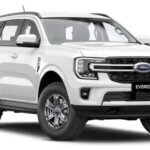 Which Ford Everest Is the Best in Australia?
Still, it feels secure rather than clumsy. The Everest is one of those vehicles that becomes smaller around the driver after a few days, although it never completely disguises its physical size.
Is the Ford Everest Good for Australian Families?
Yes, the Everest can be an excellent family vehicle, especially for households that travel, camp or carry substantial amounts of equipment.
The cabin provides the elevated seating position many families enjoy, while the enclosed cargo area offers better weather protection and security than the open tray of a ute.
There are also plenty of practical details, depending on the variant:
- Multiple storage compartments
- Large door pockets
- USB charging points
- Rear climate-control vents
- Cupholders across several rows
- Smartphone connectivity
- A large central touchscreen
- Driver-assistance technology
- Available powered seating and premium trim
The interior is more sophisticated than we might expect from a vehicle with workhorse foundations. One Australian review found that an extensively used press vehicle retained solid build quality without obvious loose trim, squeaks or rattles.
Is the Second Row Spacious?
The second row is generally roomy enough for adults and growing teenagers.
Legroom and headroom are suitable for long journeys, while the wide body makes it easier to carry three passengers across the bench than in a smaller medium SUV. Fitting three bulky child seats may still require careful measurement, so families should test their specific restraints before purchasing.
The high floor can make the seating position slightly knees-up for some passengers, but the overall environment is comfortable.
Is the Third Row Actually Usable?
The third row is more useful than the occasional-use seats found in many compact seven-seat SUVs.
Children should be comfortable, and smaller adults can manage shorter journeys. Full-sized adults may find access tight and legroom limited when the second row is positioned far back.
That is normal for the class. The Everest is a seven-seater, but it does not provide the walk-through space of a dedicated people mover.
What Happens to the Boot With Seven Seats Raised?
Cargo room becomes more limited when all three rows are in use.
There should still be enough space for groceries, school bags or a few soft travel bags, but a seven-person holiday may require roof storage, a trailer or highly disciplined packing.
With the third row folded, the Everest becomes far more practical. Fold the second row as well, and the interior provides a broad cargo area suitable for camping equipment, bicycles and bulky household items.
One Australian off-road review reported substantially more maximum luggage capacity than the Toyota Fortuner, citing 1,823 litres for the Everest with the rear seats folded. Exact measurements and testing methods can vary, so buyers should compare the specifications of the precise model year being considered.
Is the Ford Everest Safe?
Safety is one of the Everest’s major strengths.
The current generation received a five-star ANCAP rating when introduced in Australia and New Zealand in August 2022. The Everest’s rating was based partly on Ranger crash testing, supported by technical evidence demonstrating that the results were applicable to the SUV.
Depending on the model and specification, safety equipment may include:
- Autonomous emergency braking
- Pedestrian and cyclist detection
- Lane-keeping assistance
- Lane-departure warning
- Adaptive cruise control
- Blind-spot monitoring
- Rear cross-traffic alert
- Traffic-sign recognition
- Front and rear parking sensors
- Surround-view cameras
- Trailer-related driver assistance
- Multiple airbags
Safety technology can never replace an attentive driver. Some assistance systems can also feel intrusive on narrow rural roads, especially when road markings are inconsistent. Fortunately, settings can usually be adjusted, although certain systems may reactivate when the vehicle is restarted.
How Good Is the Ford Everest for Towing?
Towing is one of the strongest reasons to buy an Everest.
Properly equipped current models can offer a maximum braked towing capacity of up to 3,500kg. That headline figure places the Everest among Australia’s most capable mainstream seven-seat tow vehicles.
However, the number on the brochure does not tell the entire story.
Understanding the Real Towing Limit
When towing, we must consider:
- The vehicle’s maximum braked towing capacity
- Gross vehicle mass
- Gross combination mass
- Maximum tow-ball download
- Axle-load limits
- Passenger and luggage weight
- Accessories such as bull bars and roof racks
- The weight of fuel, tools and recovery equipment
A caravan may weigh less than 3,500kg yet still push the combination beyond another legal weight limit once passengers and cargo are added.
Therefore, buyers planning to tow a large caravan should obtain accurate loaded weights rather than relying on advertised tare figures.
Does the Everest Feel Stable While Towing?
The Everest’s long wheelbase, diesel torque and electronic towing aids make it a confident tow vehicle.
The V6 is particularly appealing because it can maintain speed with less apparent effort. The four-cylinder can also tow effectively, but drivers may notice more engine activity on steep climbs or during overtaking.
A genuine tow package, correctly adjusted mirrors, an appropriate brake controller and careful weight distribution remain essential.
The Everest is capable, but it cannot rewrite physics. A heavy trailer will always increase stopping distances, fuel consumption and sensitivity to crosswinds.
Is the Ford Everest Good Off Road?
The Everest offers genuine off-road ability rather than merely adventurous styling.
Four-wheel-drive versions can provide low-range gearing, selectable drive modes, substantial ground clearance and an electronically controlled rear differential lock, depending on the variant.
These features allow it to tackle:
- Muddy tracks
- Sand
- Rocky trails
- Steep climbs
- Rutted access roads
- River crossings within the vehicle’s approved limits
- Corrugated outback routes
Its electronic systems make off-road driving easier for less experienced drivers, but tyres remain crucial. Highway-focused factory tyres may become the weak link on slippery or sharp terrain.
Everest Tremor for More Serious Adventures
The Everest Tremor is aimed at buyers who want stronger off-road credentials without immediately turning to aftermarket modifications.
Ford states that current Tremor models combine the V6 diesel with off-road-oriented equipment while retaining a maximum braked towing rating of up to 3,500kg when properly configured.
The Tremor can be appealing for remote travel, but buyers should consider whether they genuinely need its specialised hardware. More aggressive tyres and suspension may add cost or affect on-road refinement.
For beach trips, gravel touring and moderate trails, a standard four-wheel-drive Everest may already provide more capability than most owners will ever use.
This content may interest you!Is Ford Everest Petrol or Diesel in Australia?What Is the Ford Everest’s Fuel Economy Like?
Fuel economy is acceptable for a large diesel four-wheel drive, but it will not resemble that of a hybrid crossover.
Official figures vary by engine, variant, tyre package and model year. Real-world consumption also changes dramatically with traffic, speed, terrain, accessories and trailer weight.
In ordinary use, we should expect the four-cylinder to consume less fuel than the V6. The difference may be modest on relaxed country roads but more noticeable in urban driving.
Towing can raise fuel consumption significantly. A vehicle that appears reasonably efficient when travelling solo may use much more fuel when pushing a large caravan through wind or climbing mountain roads.
The Everest is best understood as efficient relative to its capability—not efficient in an absolute sense.
Can Fuel Costs Become Expensive?
Yes, especially for buyers who:
- Drive mainly in congested city traffic
- Choose the V6
- Fit heavy accessories
- Install aggressive all-terrain tyres
- Tow frequently
- Carry roof-mounted equipment
- Travel at higher highway speeds
Tyre replacement costs also deserve attention. Large SUV tyres, particularly premium all-terrain models, can be expensive.
Is the Ford Everest Reliable?
The Everest has the fundamentals of a durable touring vehicle, but reliability is more complicated than simply asking whether the engine is strong.
Modern Everests combine diesel engines, turbochargers, emissions-control equipment, complex automatic transmissions, large touchscreens, cameras, sensors and numerous electronic modules. This technology improves performance and comfort, but it also creates more potential failure points than we would find in an older, simpler four-wheel drive.
There is not yet enough long-term evidence to make an absolute judgement about very high-kilometre durability of the newest generation. Early reviews have generally praised build quality and capability, but a professional inspection and complete service history remain essential when buying used.
Factors That Can Affect Long-Term Reliability
The Everest is more likely to provide dependable service when owners:
- Follow the correct maintenance schedule
- Use the specified oil and fluids
- Avoid repeatedly interrupting diesel particulate filter regeneration
- Service the transmission as recommended
- Keep software updates current
- Repair small leaks or warning lights promptly
- Clean the vehicle after beach driving
- Inspect the underbody after off-road use
- Avoid exceeding towing and payload limits
A vehicle used for constant short trips may encounter different issues from one driven regularly on open roads. Modern diesel engines generally prefer reaching full operating temperature.
Should We Buy an Extended Warranty?
An extended warranty may provide peace of mind for buyers intending to keep a highly specified Everest for many years.
Before purchasing one, we should examine:
- What components are covered
- Whether electronics are included
- Claim limits
- Service-location requirements
- Exclusions for towing or off-road use
- Whether the policy is transferable
- The provider’s reputation
A warranty is only valuable when its wording matches the way the vehicle will actually be used.
What Are the Ford Everest’s Main Disadvantages?
No honest review should treat the Everest like a flawless mechanical superhero.
1. It Is a Large Vehicle
Its size can become tiring in tight shopping-centre car parks, narrow streets and older garages.
Parking cameras and sensors help, but they do not physically shrink the vehicle. Buyers should measure their garage rather than assuming it will fit.
2. Purchase Prices Can Rise Quickly
Higher trim levels, the V6 engine, tow equipment and optional accessories can push the final cost well beyond the attractive entry price.
A heavily optioned Everest may overlap with more premium vehicles.
3. Running Costs Are Not Small-SUV Costs
Fuel, tyres, registration, insurance and servicing can all be more expensive than for a medium crossover.
4. The Third Row Reduces Cargo Space
Seven seats are useful, but using every seat leaves less room for luggage.
5. Technology Adds Complexity
Large screens, digital controls and advanced driver-assistance systems improve convenience but can be expensive to diagnose outside warranty.
6. It Can Feel Too Heavy for Urban-Only Driving
A buyer who never tows, never leaves sealed roads and rarely fills the third row may be better served by a lighter, more economical SUV.
Ford Everest Versus Toyota LandCruiser Prado
The Everest and Prado are natural rivals, but they have slightly different personalities.
The Everest generally feels modern, powerful and technology-rich. The Prado emphasises brand reputation, resale strength and established long-distance credentials.
A new-generation Prado may appeal to buyers who value Toyota’s extensive regional support and conservative image. The Everest may appeal to those seeking stronger value, energetic engine performance and a more contemporary cabin.
Neither is automatically superior. Availability, price, dealer support and intended use should decide the outcome.
Ford Everest Versus Isuzu MU-X
The Isuzu MU-X is one of the Everest’s toughest competitors.
The MU-X is often chosen for its relatively straightforward diesel powertrain, reputation for durability and value. The Everest generally counters with more polished driving manners, stronger engine choices and a more sophisticated interior.
We can think of the MU-X as the dependable work boot and the Everest as the premium hiking boot. Both can cross rough ground, but one provides a little more cushioning and technology.
Buyers prioritising simplicity may favour the Isuzu. Those prioritising refinement and performance may lean toward the Ford.
Ford Everest Versus Mitsubishi Pajero Sport
The Pajero Sport is usually more affordable and remains capable off road.
However, its cabin, third-row packaging and overall presentation can feel less spacious and contemporary than those of the Everest. The Ford also tends to offer a broader sense of refinement.
The Mitsubishi can be a clever value purchase, especially on the used market. The Everest is the more complete all-rounder when the budget allows.
Which Ford Everest Variant Should We Buy?
The best version depends more on intended use than badge prestige.
Best for Value
A lower or mid-range four-cylinder model can make sense for families who want space and capability without paying for every luxury feature.
This content may interest you!Ford Everest Models in Order Australia: Complete 2026.5 Range GuideBest for Family Touring
A mid-range four-wheel-drive variant often provides the strongest balance of comfort, safety, towing equipment and price.
Best for Heavy Towing
A V6 version is the natural choice for frequent caravan or boat towing. It provides stronger and smoother performance under load.
Best for Serious Off-Road Driving
The Tremor deserves attention when rough tracks are a regular part of ownership rather than an occasional fantasy inspired by weekend advertisements.
Best for Luxury
Top-specification models provide premium upholstery, additional convenience features and stronger visual presence. Buyers should still ask whether those features justify the higher price and possible replacement costs.
Should We Buy a New or Used Ford Everest?
Buying new provides the latest safety features, a full factory warranty and the opportunity to select the preferred engine and specification.
A used Everest may offer much better value, but condition matters more than age alone.
Used Ford Everest Inspection Checklist
Before buying, check:
- Complete servicing records
- Evidence of regular oil changes
- Outstanding recalls or software updates
- Automatic transmission behaviour
- Turbocharger noise or smoke
- Warning lights
- Diesel particulate filter history
- Underbody damage
- Corrosion after beach use
- Uneven tyre wear
- Tow-bar condition
- Signs of excessive towing
- Operation of cameras and sensors
- Touchscreen and connectivity functions
- Air-conditioning performance
- Water leaks around the cabin or tailgate
A pre-purchase inspection by a mechanic familiar with modern diesel four-wheel drives can save thousands of dollars.
A low-kilometre vehicle is not automatically the best example. An Everest that has travelled regular highway kilometres and received excellent maintenance may be healthier than one used exclusively for short, cold urban trips.
Who Should Buy the Ford Everest?
The Everest is a strong match for:
- Touring families
- Caravan owners
- Rural households
- Camping enthusiasts
- Drivers who need seven seats
- Buyers who want genuine four-wheel-drive capability
- People replacing a dual-cab ute with something more comfortable
- Owners who frequently carry equipment in a secure cargo area
It is less suitable for:
- Drivers seeking minimum fuel consumption
- Buyers with a very tight garage
- Urban motorists who rarely carry passengers
- People who prefer small, agile vehicles
- Owners looking for the simplest possible long-term mechanical package
- Buyers who do not need towing or off-road ability
Is the Ford Everest Good for Everyday Driving?
It can be, provided we accept the compromises that come with its size.
The high seating position provides excellent forward visibility, while the automatic transmission and light steering reduce effort in traffic. Driver-assistance technology also makes long motorway journeys less tiring.
The challenges appear when streets become narrow or parking spaces shrink. A large turning circle, wide body and tall bonnet require concentration.
After a compact hatchback, the Everest can initially feel like steering a small apartment building. After a week, most drivers adapt.
Still, capability has a cost. Carrying a heavy chassis and four-wheel-drive hardware through stop-start traffic is unnecessary if our most adventurous weekly journey is the supermarket ramp.
Is the Ford Everest Good for Long Australian Road Trips?
This is arguably where the Everest makes the strongest case for itself.
The cabin is comfortable, the diesel engines suit long-distance driving and the suspension copes well with regional road surfaces. There is space for family luggage, and the elevated driving position helps us scan far down the road.
Fuel availability is also easier to manage than with some petrol-powered large SUVs, although remote-area travellers should always plan distances carefully.
For outback travel, we should carry:
- Drinking water
- A first-aid kit
- Basic tools
- Tyre-repair equipment
- A suitable spare tyre
- Recovery equipment
- Offline maps
- Emergency communication equipment
- Additional fuel only in approved containers and where appropriate
The Everest’s ability can create confidence, but confidence should not become carelessness. Remote travel demands preparation regardless of the badge on the bonnet.
Does the Ford Everest Hold Its Value?
Resale value depends on age, engine, trim, mileage, condition, service history and the state of the broader used-car market.
Four-wheel-drive Everests with complete maintenance records, popular specifications and sensible accessories are generally easier to sell than neglected or heavily modified examples.
The V6 may remain desirable among towing buyers, while efficient four-cylinder versions may appeal to families concerned about running costs.
Modifications can help or hurt resale. A quality tow package may add practical appeal. Cheap suspension lifts, oversized tyres or questionable electrical work can scare careful buyers away.
Final Verdict: Is the Ford Everest a Good Car in Australia?
Yes, the Ford Everest is a good car for Australia—and for many buyers, it is one of the best all-round large SUVs available.
It succeeds because it does not force us to choose between family comfort and serious capability. It can carry seven people, tow a substantial trailer, cross rough terrain and settle into a long motorway journey without feeling like specialised industrial equipment.
Its strongest qualities include:
- Powerful diesel engine choices
- Excellent towing capability
- Genuine off-road performance
- A spacious and modern cabin
- Strong safety credentials
- Good long-distance comfort
- Practical family versatility
Its weaknesses include:
- Considerable size
- Higher fuel and tyre costs
- Expensive upper variants
- Reduced luggage room with seven seats occupied
- Mechanical and electronic complexity
- More capability than urban-only buyers may need
The Everest is not the cheapest, lightest or simplest SUV. It is good because it brings several abilities together in one convincing package.
For a family that tows a caravan, explores regional Australia or needs one vehicle to manage school runs and remote holidays, the Everest makes enormous sense.
For someone who only drives through central Sydney, Melbourne or Brisbane with one passenger, it may feel like wearing hiking boots to walk across the living room.
The smartest decision is to buy according to real use, not imagined adventure. Choose the right engine, calculate towing weights honestly, compare insurance and servicing costs, and test every seating row with the people who will actually use it.
Do that, and the Ford Everest can be a comfortable family car during the week and a powerful escape machine when the open road calls.
Frequently Asked Questions
1. Is the Ford Everest reliable in Australia?
The Everest can be reliable when serviced correctly and used within its load limits. Its engines and chassis are designed for demanding use, but modern diesel emissions equipment, electronics and automatic transmissions require proper maintenance. A complete service history is especially important when buying used.
2. Is the Ford Everest better than the Toyota Prado?
The Everest often provides stronger performance, modern technology and competitive value. The Prado counters with strong resale value, broad regional support and Toyota’s established reputation. The better choice depends on price, towing requirements, dealer access and personal priorities.
3. Is the Ford Everest good for towing a caravan?
Yes. Properly equipped current Everests can tow up to 3,500kg braked. However, buyers must calculate payload, tow-ball mass, axle limits, gross vehicle mass and gross combination mass rather than relying only on the advertised maximum towing figure.
This content may interest you!Ford Everest Reliability Australia: Is It a Dependable SUV?4. Is the four-cylinder or V6 Ford Everest better?
The four-cylinder is better for buyers focused on value and lower fuel consumption. The V6 is better for frequent heavy towing, effortless acceleration and fully loaded touring. The V6 costs more to purchase and generally uses more fuel.
5. Is the Ford Everest suitable for city driving?
Yes, but its large dimensions can make narrow streets and parking areas challenging. Cameras, parking sensors and light steering help considerably. Buyers who rarely tow, travel off road or use seven seats may find a smaller crossover more economical and convenient.
Leave a Reply