
Kia Tasman Fuel Tank Capacity: How Far Can You Drive on a Full Tank?

The Kia Tasman fuel tank capacity is 80 litres across the Australian diesel range, making it a practical option for drivers who need a ute for daily commuting, long-distance travel, towing, or off-road adventures.
Fuel tank size is particularly important in Australia, where long distances between towns, remote highways, and demanding driving conditions can make fuel range just as important as engine performance.
The Kia Tasman enters the Australian ute market with a 2.2-litre turbocharged diesel engine, an eight-speed automatic transmission, and a fuel tank designed to support both everyday driving and demanding work.
But how far can the Kia Tasman travel on one tank? Is its 80-litre capacity enough for Australian road trips? And does fuel consumption change between the S, SX, SX+, X-Line, and X-Pro variants?
In this guide, we'll examine the Kia Tasman's fuel tank specifications, estimated driving range, diesel economy, towing consumption, and running costs.
- What Is the Kia Tasman Fuel Tank Capacity?
- Kia Tasman Fuel Tank Capacity by Model
- How Far Can a Kia Tasman Travel on a Full Tank?
- Kia Tasman Highway Fuel Range
- Kia Tasman City Fuel Consumption
- Kia Tasman Fuel Tank Capacity When Towing
- How Much Does It Cost to Fill a Kia Tasman Fuel Tank?
- Does the Kia Tasman Have a Larger Fuel Tank Than Its Competitors?
- Can You Install a Larger Fuel Tank in the Kia Tasman?
- How to Improve Kia Tasman Fuel Efficiency
- Should You Buy the Kia Tasman for Long-Distance Driving?
- Frequently Asked Questions About Kia Tasman Fuel Tank Capacity
- Conclusion: Is the Kia Tasman Fuel Tank Big Enough?
What Is the Kia Tasman Fuel Tank Capacity?
The Australian-specification Kia Tasman comes with an 80-litre diesel fuel tank.
This capacity applies to the 2026 model-year dual-cab pick-up range, including both rear-wheel-drive and four-wheel-drive configurations.
Here are the main fuel system specifications:
| Specification | Kia Tasman |
|---|---|
| Fuel tank capacity | 80 litres |
| Fuel type | Diesel |
| Engine | 2.2L turbo diesel |
| Transmission | 8-speed automatic |
| Combined fuel consumption | 7.4–8.1 L/100km |
| Estimated full-tank range | 988–1,081 km |
| Drivetrain options | 4x2 and 4x4 |
The estimated range figures are calculated using official combined-cycle fuel consumption ratings. Actual driving range will depend on driving conditions, vehicle load, terrain, and the amount of fuel used before refuelling.
An 80-litre tank is a useful size for a mid-sized ute, particularly one intended to compete with established models such as the Toyota HiLux, Ford Ranger, Isuzu D-Max, and Mitsubishi Triton.
Kia Tasman Fuel Tank Capacity by Model
One advantage of the Kia Tasman is that buyers don't need to select a more expensive variant to obtain a larger fuel tank.
All Australian dual-cab pick-up variants share the same 80-litre capacity.
However, fuel economy varies slightly depending on drivetrain, equipment, and configuration.
| Kia Tasman variant | Fuel tank | Combined consumption |
|---|---|---|
| Tasman S 4x2 | 80L | 7.4 L/100km |
| Tasman S 4x4 | 80L | 7.6 L/100km |
| Tasman SX 4x4 | 80L | 7.6 L/100km |
| Tasman SX+ 4x4 | 80L | 7.6 L/100km |
| Tasman X-Line 4x4 | 80L | 7.8 L/100km |
| Tasman X-Pro 4x4 | 80L | 8.1 L/100km |
These are the official Australian combined-cycle figures for the MY26 dual-cab pick-up range.
Does the Kia Tasman X-Pro Have a Bigger Fuel Tank?
No. The Kia Tasman X-Pro has the same 80-litre fuel tank as the other variants.
Although the X-Pro is designed for more demanding off-road driving, Kia hasn't increased its standard tank capacity.
Its additional off-road equipment and all-terrain tyres contribute to a higher official fuel consumption figure of 8.1 L/100km.
Consequently, the X-Pro offers a slightly shorter estimated driving range than the more road-focused Tasman variants.
Does the Kia Tasman Cab Chassis Have an 80-Litre Tank?
Yes. The Australian MY26 Kia Tasman dual-cab chassis also uses an 80-litre fuel tank.
This is useful for commercial buyers choosing a tray-back configuration rather than the conventional pick-up body.
However, the practical fuel range of a cab-chassis vehicle can vary significantly depending on the tray, accessories, equipment, and payload installed.
How Far Can a Kia Tasman Travel on a Full Tank?
One of the most important questions for Australian buyers is how many kilometres the Kia Tasman can travel before needing to refuel.
Using the official combined-cycle consumption figures and its 80-litre tank, the theoretical driving range is approximately 988 to 1,081 kilometres.
The calculation is straightforward:
Driving range = Fuel tank capacity ÷ Fuel consumption × 100
For example, the Kia Tasman SX uses a claimed 7.6 litres of diesel per 100 kilometres.
80 ÷ 7.6 × 100 = approximately 1,053 kilometres.
The following table shows the calculated range for every Australian dual-cab pick-up variant.
| Variant | Fuel economy | Theoretical range |
|---|---|---|
| S 4x2 | 7.4 L/100km | 1,081 km |
| S 4x4 | 7.6 L/100km | 1,053 km |
| SX 4x4 | 7.6 L/100km | 1,053 km |
| SX+ 4x4 | 7.6 L/100km | 1,053 km |
| X-Line 4x4 | 7.8 L/100km | 1,026 km |
| X-Pro 4x4 | 8.1 L/100km | 988 km |
These numbers represent mathematical estimates based on consuming the entire nominal tank capacity at the official combined fuel economy.
They should not be interpreted as guaranteed distances between refuelling stops.
Real-World Kia Tasman Driving Range
In real driving conditions, fuel economy may be higher than the official figures.
Factors such as traffic, hills, headwinds, tyre choice, driving speed, and vehicle weight can increase diesel consumption.
For example, if a Kia Tasman averages:
- 8 L/100km: approximately 1,000 km from 80 litres.
- 9 L/100km: approximately 889 km.
- 10 L/100km: approximately 800 km.
- 11 L/100km: approximately 727 km.
- 12 L/100km: approximately 667 km.
These are illustrative calculations rather than measured Tasman test results.
For everyday driving, we'd recommend estimating your range using your own average fuel consumption instead of relying entirely on the official figure.
It's also sensible to refuel before the tank is nearly empty, especially when travelling through remote parts of Australia.
Kia Tasman Highway Fuel Range
Highway driving is generally more fuel-efficient than urban driving, particularly when speeds remain consistent.
According to Kia's Australian specifications, the Tasman has the following extra-urban fuel consumption ratings:
| Variant | Extra-urban consumption |
|---|---|
| S 4x2 | 6.4 L/100km |
| S 4x4 | 6.6 L/100km |
| SX 4x4 | 6.6 L/100km |
| SX+ 4x4 | 6.6 L/100km |
| X-Line 4x4 | 6.8 L/100km |
| X-Pro 4x4 | 7.3 L/100km |
At 6.6 L/100km, an 80-litre tank would theoretically provide approximately 1,212 kilometres of range.
However, the official extra-urban test cycle isn't a guarantee of consumption during an Australian highway journey.
Driving at sustained high speeds, encountering strong headwinds, or carrying heavy equipment can result in considerably greater fuel consumption.
Is the Kia Tasman Suitable for Long Australian Road Trips?
Yes. The Kia Tasman's 80-litre diesel tank and relatively economical engine make it well suited to extended road trips.
For example, drivers travelling between major cities or across regional highways may be able to cover substantial distances between fuel stops.
Nevertheless, trip planning becomes particularly important in remote locations.
Some stretches of Australian roads have limited fuel availability, and service stations can have reduced operating hours or temporary fuel shortages.
This content may interest you!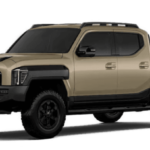 Kia Tasman Fuel Economy Australia: Diesel Consumption, Real-World Range and Running Costs
Rather than attempting to achieve the maximum theoretical range, we recommend leaving a reasonable fuel margin and checking the availability of diesel along your planned route.
Kia Tasman City Fuel Consumption
Although the Kia Tasman can be economical on longer journeys, city driving generally increases fuel consumption.
According to Kia's MY26 Australian figures, the urban consumption ratings are:
| Variant | Urban fuel consumption |
|---|---|
| S 4x2 | 9.1 L/100km |
| S 4x4 | 9.3 L/100km |
| SX 4x4 | 9.3 L/100km |
| SX+ 4x4 | 9.3 L/100km |
| X-Line 4x4 | 9.5 L/100km |
| X-Pro 4x4 | 9.4 L/100km |
Urban driving involves frequent acceleration, braking, and idling, which increases fuel usage.
A driver using the Tasman primarily in congested areas such as Sydney, Melbourne, Brisbane, or Perth may therefore achieve a shorter range than someone spending most of their time on open highways.
Why Does Fuel Consumption Increase in Traffic?
Several factors influence diesel consumption during city driving.
Frequent acceleration requires additional energy, particularly in a relatively heavy ute.
Stop-start traffic also reduces average speed, while air conditioning and other electrical systems contribute to energy demand.
Short journeys can affect efficiency because the engine may not operate at its optimal temperature for long.
Maintaining correct tyre pressures and avoiding unnecessary weight can help reduce fuel consumption.
Kia Tasman Fuel Tank Capacity When Towing
Towing is another important consideration for Australian ute buyers.
The Kia Tasman has a maximum braked towing capacity of 3,500 kg under the manufacturer's specified conditions.
However, towing a caravan, boat, horse float, or loaded trailer can significantly increase fuel consumption.
The 80-litre tank remains unchanged, meaning the vehicle's driving range decreases as the engine uses more diesel.
Estimated Kia Tasman Towing Range
The following examples demonstrate how towing consumption can affect range.
| Average consumption | Theoretical 80L range |
|---|---|
| 10 L/100km | 800 km |
| 12 L/100km | 667 km |
| 14 L/100km | 571 km |
| 16 L/100km | 500 km |
| 18 L/100km | 444 km |
These figures are hypothetical scenarios, not official Kia Tasman towing test results.
Actual consumption depends on factors including trailer weight, aerodynamic drag, gradients, vehicle speed, and weather conditions.
For example, towing a large caravan against a strong headwind may use substantially more diesel than towing a small trailer on flat roads.
Is an 80-Litre Tank Enough for Caravan Towing?
For many caravan owners, an 80-litre diesel tank will be adequate for regular touring.
However, drivers planning long-distance towing through remote Australia may want additional range.
A touring setup with high fuel consumption could require more frequent refuelling stops than expected.
Before travelling, we recommend estimating fuel usage with the caravan attached rather than relying on the vehicle's normal consumption.
It is also important to respect the Tasman's towing, payload, towball download, and gross combined mass limits.
How Much Does It Cost to Fill a Kia Tasman Fuel Tank?
The cost of filling the Kia Tasman's 80-litre fuel tank depends on the local diesel price.
Diesel prices vary across Australia, with regional and remote locations sometimes being more expensive than metropolitan areas.
Here are some illustrative calculations:
| Diesel price per litre | Cost for 80 litres |
|---|---|
| $1.60 | $128 |
| $1.70 | $136 |
| $1.80 | $144 |
| $1.90 | $152 |
| $2.00 | $160 |
| $2.10 | $168 |
| $2.20 | $176 |
These prices are examples for budgeting, not current retail diesel quotations.
For instance, if diesel costs $1.90 per litre, filling the entire nominal tank capacity would cost approximately $152.
In practice, a normal refuelling stop usually costs less because some diesel remains in the tank.
Kia Tasman Fuel Cost per 100 Kilometres
Fuel tank capacity is only one part of the running-cost calculation.
Fuel efficiency determines how much you'll spend for every kilometre travelled.
At an illustrative diesel price of $1.90 per litre:
- Tasman S 4x2 at 7.4 L/100km: approximately $14.06 per 100 km.
- Tasman S 4x4 at 7.6 L/100km: approximately $14.44 per 100 km.
- Tasman X-Line at 7.8 L/100km: approximately $14.82 per 100 km.
- Tasman X-Pro at 8.1 L/100km: approximately $15.39 per 100 km.
These calculations use official combined consumption ratings and do not include insurance, servicing, tyres, registration, or other ownership expenses.
Does the Kia Tasman Have a Larger Fuel Tank Than Its Competitors?
The Kia Tasman competes with some of Australia's most popular dual-cab utes.
Its main rivals include:
- Toyota HiLux
- Ford Ranger
- Isuzu D-Max
- Mitsubishi Triton
- Nissan Navara
An 80-litre tank puts the Tasman in a competitive position within the traditional diesel ute segment.
However, fuel tank capacity alone doesn't determine which vehicle can travel the furthest.
A ute with a smaller tank but better efficiency may achieve a comparable driving range.
Likewise, a vehicle with a larger tank may consume more fuel because of additional weight, engine characteristics, or off-road equipment.
What Matters More: Fuel Tank Size or Fuel Economy?
Both are important, but they serve different purposes.
Fuel tank capacity determines how much fuel the vehicle can carry.
Fuel economy determines how efficiently the engine uses that fuel.
For example, consider two hypothetical utes:
| Specification | Ute A | Ute B |
|---|---|---|
| Fuel tank | 80L | 75L |
| Fuel consumption | 7.5 L/100km | 8.5 L/100km |
| Theoretical range | 1,067 km | 882 km |
Despite carrying only five litres more fuel, Ute A achieves a substantially longer theoretical range because it uses less diesel.
For buyers choosing a touring vehicle, it's worth considering both specifications rather than focusing exclusively on tank size.
This content may interest you!Kia Tasman Towing Capacity Australia: How Much Can It Really Tow?Can You Install a Larger Fuel Tank in the Kia Tasman?
Some Australian ute owners consider installing an aftermarket long-range fuel tank.
This modification can be attractive for drivers who regularly travel through remote areas where diesel stations are widely spaced.
However, compatibility must be confirmed for the specific vehicle and configuration.
An aftermarket tank must not interfere with the exhaust system, suspension, drivetrain, or safety-related equipment.
Things to Consider Before Installing a Long-Range Tank
Before modifying a Kia Tasman, consider several important factors.
Vehicle compatibility: Not every aftermarket tank is suitable for every variant, particularly when comparing 4x2, 4x4, and off-road configurations.
Additional weight: Carrying more diesel increases vehicle weight and reduces available payload.
Ground clearance: Tank placement and protection are important for off-road driving.
Legal compliance: Fuel-system modifications must comply with applicable Australian standards and state or territory requirements.
Warranty implications: Certain modifications may affect warranty coverage where a failure is attributable to the modification.
We recommend using an appropriately qualified installer and confirming engineering or approval requirements before fitting an aftermarket fuel tank.
How to Improve Kia Tasman Fuel Efficiency
Although the Tasman has a reasonably generous fuel tank, small changes in driving habits can help improve its practical range.
1. Maintain Correct Tyre Pressures
Incorrect tyre pressures can increase rolling resistance and fuel consumption.
Check pressures regularly and follow the manufacturer's recommendations for normal driving and different load conditions.
2. Avoid Carrying Unnecessary Weight
Additional tools, equipment, and accessories increase the vehicle's overall mass.
Removing equipment you don't need can help reduce fuel usage.
3. Drive Smoothly
Rapid acceleration and aggressive braking generally increase diesel consumption.
Smooth acceleration and maintaining a consistent speed can improve efficiency.
4. Reduce Aerodynamic Drag
Roof racks, oversized accessories, and bulky loads can create additional drag.
This becomes particularly noticeable during highway travel.
5. Maintain the Engine Properly
Regular servicing helps keep the engine operating as intended.
Follow the manufacturer's maintenance schedule and use the correct fluids, filters, and replacement components.
6. Monitor Your Real Fuel Consumption
The vehicle's trip computer can provide useful fuel-economy information.
For a longer-term comparison, calculate your consumption from the litres purchased and kilometres travelled between comparable fill-ups.
Using several tanks of fuel will usually provide a more meaningful average than relying on a single short journey.
Should You Buy the Kia Tasman for Long-Distance Driving?
The Kia Tasman offers several characteristics that make it appealing for Australian drivers who regularly travel long distances.
Its 80-litre tank provides useful fuel storage, while the 2.2-litre turbo diesel engine offers a balance of efficiency and performance.
The official combined fuel consumption ratings also suggest that many owners should be able to cover considerable distances between refuelling stops.
However, the ideal variant depends on how the ute will be used.
Best Kia Tasman Variant for Fuel Efficiency
The Kia Tasman S 4x2 is the most economical MY26 Australian dual-cab pick-up variant on the official combined test cycle.
At 7.4 L/100km, it offers the longest calculated driving range from the standard 80-litre tank.
For buyers who don't need four-wheel drive, this configuration is worth considering.
Best Kia Tasman Variant for Touring and Off-Road Use
Drivers who regularly explore unsealed roads or require four-wheel drive may prefer the S 4x4, SX, SX+, X-Line, or X-Pro.
The X-Pro provides more specialised off-road capability but has the highest official combined fuel consumption in the dual-cab pick-up range.
We would prioritise the drivetrain and equipment needed for the intended terrain rather than selecting a variant purely on fuel range.
Frequently Asked Questions About Kia Tasman Fuel Tank Capacity
1. How many litres is the Kia Tasman fuel tank?
The Australian Kia Tasman has an 80-litre diesel fuel tank. This applies to all MY26 dual-cab pick-up variants, including the S, SX, SX+, X-Line, and X-Pro. The MY26 dual-cab chassis also has an 80-litre tank.
2. How many kilometres can a Kia Tasman travel on a full tank?
Based on official combined-cycle fuel economy, the Kia Tasman has a theoretical full-tank range of approximately 988 to 1,081 kilometres, depending on the variant. Real-world range will vary with speed, load, traffic, terrain, and driving habits.
3. What fuel does the Kia Tasman use in Australia?
The Australian Kia Tasman uses diesel fuel. Its 2.2-litre turbocharged diesel engine is paired with an eight-speed automatic transmission. Drivers should use fuel that meets the manufacturer's requirements.
4. Does the Kia Tasman X-Pro have a bigger fuel tank?
No. The Kia Tasman X-Pro has the same 80-litre tank as the rest of the Australian dual-cab pick-up range. Its official combined fuel consumption is 8.1 L/100km, compared with 7.4 L/100km for the S 4x2.
5. Is the Kia Tasman's 80-litre fuel tank enough for towing?
An 80-litre fuel tank should be sufficient for many normal towing situations. However, towing heavy caravans or trailers can substantially increase fuel consumption and reduce driving range. Drivers planning remote journeys should calculate their towing range conservatively and plan refuelling stops.
Conclusion: Is the Kia Tasman Fuel Tank Big Enough?
The Kia Tasman fuel tank capacity of 80 litres provides a practical balance between fuel storage, vehicle weight, and long-distance driving capability.
Across the Australian MY26 dual-cab pick-up range, official combined diesel consumption varies from 7.4 to 8.1 L/100km. This produces a calculated full-tank range of approximately 988 to 1,081 kilometres under the specified test consumption figures.
For everyday commuting, highway travel, and regular work duties, this is a useful combination.
Drivers who regularly tow heavy caravans or explore remote Australian regions will need to account for greater fuel consumption and maintain a sensible refuelling margin.
Overall, the Kia Tasman's 80-litre tank makes it a competitive option in the Australian ute market, especially when combined with its efficient turbo diesel engine and available four-wheel-drive configurations.
This content may interest you!Kia Tasman Weight: Kerb Weight, GVM, Payload and Towing Limits in Australia
Leave a Reply