
Kia Tasman X-Line vs X-Pro Australia: Which 4x4 Ute Should You Buy?

The Kia Tasman X-Line vs X-Pro comparison is particularly interesting for Australian buyers looking for a premium dual-cab ute. Both versions offer a powerful enough turbo-diesel engine for everyday duties, modern technology, impressive towing capacity and a comfortable interior. However, they target slightly different types of drivers.
The Kia Tasman X-Line focuses on combining premium equipment, practicality and everyday driving comfort. Meanwhile, the Kia Tasman X-Pro takes things further with additional off-road equipment, greater ground clearance and more luxury features.
But is the X-Pro worth the extra money? Or does the X-Line offer everything most Australian drivers actually need?
In this comprehensive comparison, we'll explore the differences in specifications, performance, fuel consumption, towing capacity, interior features, off-road capability and overall value.
- Kia Tasman X-Line vs X-Pro: Quick Comparison
- Kia Tasman X-Line vs X-Pro Price in Australia
- Engine and Performance: Are the X-Line and X-Pro Different?
- Kia Tasman X-Line vs X-Pro: Off-Road Capability
- Kia Tasman X-Line vs X-Pro Wheels and Tyres
- Interior Comparison: Which Kia Tasman Is More Luxurious?
- Kia Tasman X-Line vs X-Pro Fuel Consumption
- Towing Capacity: Kia Tasman X-Line vs X-Pro
- Payload and Practicality
- Kia Tasman X-Line vs X-Pro Driving Comfort
- Safety and Driver Assistance
- Exterior Design: X-Line vs X-Pro
- Ownership Costs, Warranty and Servicing
- Kia Tasman X-Line Pros and Cons
- Kia Tasman X-Pro Pros and Cons
- Which Kia Tasman Is Better for Different Australian Drivers?
- Kia Tasman X-Line vs X-Pro: Which Should You Buy?
- Frequently Asked Questions
- 1. What is the difference between the Kia Tasman X-Line and X-Pro?
- 2. Is the Kia Tasman X-Pro worth buying in Australia?
- 3. Does the Kia Tasman X-Pro have more power than the X-Line?
- 4. Which Kia Tasman is better for towing a caravan?
- 5. Which Kia Tasman has better fuel economy, the X-Line or X-Pro?
- Final Verdict: Kia Tasman X-Line vs X-Pro Australia
Kia Tasman X-Line vs X-Pro: Quick Comparison
Before examining each model in detail, let's compare their main specifications.
| Specification | Kia Tasman X-Line | Kia Tasman X-Pro |
|---|---|---|
| Engine | 2.2L turbo-diesel | 2.2L turbo-diesel |
| Power | 154 kW | 154 kW |
| Torque | 440 Nm | 440 Nm |
| Transmission | 8-speed automatic | 8-speed automatic |
| Drivetrain | 4x4 | 4x4 |
| Ground clearance | 224 mm | 252 mm |
| Wheels | 18-inch alloys | 17-inch black alloys |
| Tyres | Highway-oriented | All-terrain |
| Rear differential lock | Mechanical | Selectable electronic |
| Terrain modes | Snow, Sand, Mud | Snow, Sand, Mud, Rock |
| X-Trek off-road mode | No | Yes |
| Braked towing capacity | 3,500 kg | 3,500 kg |
| Fuel consumption (combined) | 7.8 L/100 km | 8.1 L/100 km |
| Fuel tank | 80 litres | 80 litres |
| Payload (standard versions) | Approx. 1,027 kg | Approx. 1,013 kg |
| Heated front seats | Yes | Yes |
| Ventilated front seats | No | Yes |
| Sunroof | No | Yes |
| Premium Harman Kardon audio | No | Yes |
| Original Australian list price | $67,990 | $74,990 |
Prices are indicative original Australian manufacturer list prices before on-road costs. Actual 2026 dealer pricing, promotions and specifications may vary.
The main takeaway is simple: both models share the same engine and towing capability, but the X-Pro offers additional off-road hardware and premium equipment.
Kia Tasman X-Line vs X-Pro Price in Australia
Price is one of the first considerations when choosing between these two models.
At their original Australian launch pricing, the Kia Tasman X-Line and X-Pro were positioned as follows:
- Kia Tasman X-Line: $67,990 before on-road costs.
- Kia Tasman X-Pro: $74,990 before on-road costs.
- Price difference: $7,000.
This means buyers considering the X-Pro originally needed to spend approximately $7,000 more than they would on the X-Line.
The additional money pays for mechanical off-road upgrades and a more extensive equipment package.
Is the Kia Tasman X-Pro Worth the Extra $7,000?
The answer depends on how you intend to use your ute.
If you mainly drive on highways, suburban roads and occasional gravel tracks, the X-Line already provides a generous level of equipment.
However, drivers who regularly explore challenging Australian terrain may find the X-Pro's additional ground clearance, all-terrain tyres and electronic rear differential lock worthwhile.
The X-Pro also includes comfort upgrades that make it more appealing as a premium family vehicle.
Nevertheless, buying the more expensive model doesn't necessarily mean getting the better ute for your needs.
Engine and Performance: Are the X-Line and X-Pro Different?
Under the bonnet, the Kia Tasman X-Line and X-Pro are essentially identical.
Both use a 2.2-litre four-cylinder turbocharged diesel engine.
Engine Specifications
| Engine Specification | X-Line | X-Pro |
|---|---|---|
| Engine displacement | 2,151 cc | 2,151 cc |
| Configuration | 4-cylinder turbo-diesel | 4-cylinder turbo-diesel |
| Maximum power | 154 kW | 154 kW |
| Maximum torque | 440 Nm | 440 Nm |
| Transmission | 8-speed automatic | 8-speed automatic |
| Fuel type | Diesel | Diesel |
The engine produces 154 kW of power and 440 Nm of torque, providing sufficient performance for daily driving, highway cruising and towing.
Both versions also feature an eight-speed automatic transmission designed to deliver smooth gear changes.
Which Kia Tasman Is Faster?
Neither model has a meaningful engine performance advantage.
They share the same power and torque figures, although differences in weight, tyres and rolling resistance can influence real-world acceleration.
The X-Pro's all-terrain tyres are designed to provide additional traction on challenging surfaces rather than improve acceleration on sealed roads.
For buyers looking for extra engine power, upgrading from the X-Line to the X-Pro won't deliver that benefit.
This content may interest you! Mazda CX-5 vs Subaru Outback: Which One Fits Real Life Better?
Instead, the advantages of the X-Pro become more noticeable when driving off-road.
Kia Tasman X-Line vs X-Pro: Off-Road Capability
Off-road capability is arguably the most important difference between these two Australian Tasman variants.
Although both models feature four-wheel drive, the X-Pro receives equipment specifically designed for more demanding terrain.
Kia Tasman X-Line Off-Road Features
The X-Line is not simply a road-focused ute with four-wheel-drive styling.
It offers genuine 4x4 capability, including:
- Four-wheel-drive high and low-range operation.
- Automatic 4WD engagement mode.
- Mechanical rear differential locking.
- Snow, Sand and Mud terrain modes.
- 224 mm ground clearance.
- Hill descent assistance.
- Electronic traction and stability control.
These features make the X-Line suitable for gravel roads, camping trips, muddy conditions and many recreational 4WD tracks.
For Australian families who occasionally travel beyond sealed roads, its capabilities should be more than sufficient in many situations.
Kia Tasman X-Pro Off-Road Features
The X-Pro builds on the X-Line's equipment with several important upgrades.
These include:
- Greater ground clearance.
- 17-inch wheels with all-terrain tyres.
- Selectable electronic rear differential lock.
- Additional Rock terrain mode.
- X-Trek low-speed off-road driving assistance.
- Ground View Monitor.
- Additional fuel tank underbody protection.
- Dedicated off-road driving information display.
These upgrades are particularly useful for drivers tackling rocky tracks, uneven terrain and challenging off-road conditions.
Ground Clearance Comparison
Ground clearance is one of the clearest differences.
| Model | Ground Clearance |
|---|---|
| Kia Tasman X-Line | 224 mm |
| Kia Tasman X-Pro | 252 mm |
The X-Pro provides 28 mm more ground clearance.
This additional height helps reduce the likelihood of the underside contacting rocks, ruts or uneven ground.
It can be especially valuable when exploring more demanding sections of Australian 4WD tracks.
However, ground clearance alone doesn't determine off-road performance. Tyre grip, driver experience, vehicle weight and suspension articulation also matter.
Which Model Is Better for Australian Off-Road Driving?
For occasional camping and gravel-road adventures, we'd generally choose the X-Line.
For regular off-road exploration, especially on rocky or deeply rutted tracks, we'd favour the X-Pro.
Its factory-fitted all-terrain tyres and dedicated off-road equipment make it more suitable for demanding recreational use without requiring as many aftermarket modifications.
Kia Tasman X-Line vs X-Pro Wheels and Tyres
Another significant difference involves wheel and tyre selection.
Kia Tasman X-Line Wheels
The X-Line comes with 18-inch alloy wheels paired with highway-oriented tyres.
This combination is intended to balance:
- Everyday road handling.
- Highway comfort.
- Fuel efficiency.
- Steering response.
- Light off-road capability.
Highway-oriented tyres generally work well for drivers who spend most of their time on sealed Australian roads.
Kia Tasman X-Pro Wheels
The X-Pro receives 17-inch black alloy wheels with all-terrain tyres.
This setup provides several advantages when driving away from sealed roads.
This content may interest you!Toyota LandCruiser Engine Oil: The Complete Selection and Maintenance GuideAll-terrain tyres are designed to handle a wider variety of surfaces, including dirt, gravel and rocky tracks.
The smaller wheel diameter also allows for a different tyre sidewall configuration, which can be beneficial off-road.
However, all-terrain tyres may generate additional road noise and rolling resistance compared with highway tyres.
For drivers who rarely leave the bitumen, the X-Line's tyre package may be the more sensible choice.
Interior Comparison: Which Kia Tasman Is More Luxurious?
Both variants offer a modern cabin that feels more sophisticated than many traditional work-focused utes.
The X-Line is already generously equipped, but the X-Pro introduces several additional luxury features.
Kia Tasman X-Line Interior Features
The X-Line includes:
- Large 12.3-inch infotainment touchscreen.
- 12.3-inch digital instrument display.
- Additional climate-control display.
- Wireless Apple CarPlay and Android Auto.
- Dual wireless smartphone charging.
- Heated front seats.
- Power-adjustable driver's seat.
- Artificial leather upholstery.
- Reclining and sliding rear seats.
- Dual-zone automatic climate control.
- Ambient interior lighting.
- Rear passenger air vents.
- Column-mounted gear selector.
- Steering-wheel paddle shifters.
This is an impressive equipment list for a dual-cab ute.
The cabin is suitable for commuting, family transport and long-distance Australian road trips.
Kia Tasman X-Pro Interior Upgrades
The X-Pro adds several desirable features, including:
- Ventilated front seats.
- Heated rear seats.
- Heated steering wheel.
- Electric passenger seat adjustment.
- Driver's seat memory settings.
- Premium Harman Kardon sound system.
- Sunroof.
- Expanded ambient lighting.
These additions make the X-Pro feel more like a premium SUV.
Which Interior Is Better?
The X-Pro clearly wins when comparing standard luxury equipment.
Ventilated seats are particularly appealing during hot Australian summers, especially for drivers travelling through Queensland, Western Australia or the Northern Territory.
The upgraded audio system and additional passenger comfort features also make longer journeys more enjoyable.
However, the X-Line already offers most of the important everyday conveniences.
If you don't particularly value ventilated seats, a sunroof or premium audio, the X-Line may represent better value.
Kia Tasman X-Line vs X-Pro Fuel Consumption
Fuel economy is another consideration, particularly for Australians who regularly travel long distances.
Despite sharing the same engine, the two models have slightly different official fuel consumption figures.
Official Fuel Economy
| Model | Combined Fuel Consumption |
|---|---|
| Kia Tasman X-Line | 7.8 L/100 km |
| Kia Tasman X-Pro | 8.1 L/100 km |
The X-Line is slightly more fuel-efficient.
This difference can be partly attributed to variations in tyre specification, vehicle weight and off-road equipment.
Fuel Cost Comparison
Let's imagine driving 20,000 kilometres annually with diesel priced at $2.00 per litre.
| Annual Fuel Expense | X-Line | X-Pro |
|---|---|---|
| Distance | 20,000 km | 20,000 km |
| Fuel consumed | 1,560 litres | 1,620 litres |
| Estimated fuel cost | $3,120 | $3,240 |
Under these assumptions, the X-Line would save approximately $120 per year.
That's a relatively small difference compared with the purchase price of either vehicle.
Of course, real-world consumption will depend on traffic, driving style, tyre pressure, towing and road conditions.
This content may interest you!
The official figures should be treated as standardised comparisons rather than guaranteed everyday results.
Which Kia Tasman Has Better Driving Range?
Both models have an 80-litre fuel tank.
Using their official combined fuel consumption figures, the theoretical driving ranges are:
- X-Line: Approximately 1,026 km.
- X-Pro: Approximately 988 km.
These figures are mathematical estimates based on the complete 80-litre tank capacity, not guaranteed usable driving ranges.
Actual driving distances between refuelling stops will usually be lower, especially when towing or travelling off-road.
Towing Capacity: Kia Tasman X-Line vs X-Pro
For many Australian ute buyers, towing performance matters just as much as comfort and off-road capability.
Fortunately, both Tasman variants share the same headline towing specifications.
Towing Specifications
| Specification | X-Line | X-Pro |
|---|---|---|
| Braked towing capacity | 3,500 kg | 3,500 kg |
| Unbraked towing capacity | 750 kg | 750 kg |
| Rated maximum towball download | 350 kg | 350 kg |
| Gross Vehicle Mass | 3,250 kg | 3,250 kg |
| Gross Combination Mass | 6,200 kg | 6,200 kg |
| Integrated trailer brake controller | Yes | Yes |
Both models can tow up to 3,500 kg with an appropriately braked trailer, subject to their operating weight limits.
That puts them in the same headline towing category as popular Australian utes such as the Ford Ranger, Toyota HiLux and Isuzu D-Max.
Is the X-Pro Better for Towing Caravans?
Not necessarily.
The X-Pro's additional off-road equipment doesn't increase its maximum rated towing capacity.
Both models use the same engine and transmission, meaning neither receives a significant powertrain advantage when pulling a caravan.
The X-Line may be preferable for buyers who mainly tow on sealed highways because of its road-oriented tyres and marginally better official fuel economy.
The X-Pro becomes more attractive if your caravan adventures frequently involve challenging off-road tracks.
Important Towing Weight Considerations
Buyers should remember that the maximum 3,500 kg towing capacity cannot automatically be combined with the vehicle's maximum GVM.
Because the Tasman's Gross Combination Mass is 6,200 kg, a trailer weighing 3,500 kg leaves a maximum of 2,700 kg for the loaded vehicle.
That includes the vehicle itself, occupants, accessories, cargo and applicable towball load.
Carefully checking the vehicle's weight, axle ratings and trailer specifications is essential before undertaking heavy towing.
Payload and Practicality
The Kia Tasman is designed to be a practical ute, whether used for work, recreational activities or family travel.
Both X-Line and X-Pro versions feature a substantial cargo tub and a payload rating around one tonne.
Payload Comparison
The standard one-tonne versions have approximately:
- X-Line: 1,027 kg payload.
- X-Pro: 1,013 kg payload.
These figures may differ with specific configurations, optional equipment or alternative payload specifications.
The X-Line has a small advantage due to its lower vehicle weight.
However, the difference is unlikely to be significant for most everyday buyers.
This content may interest you!
Cargo Tub Dimensions
Both variants share the same basic cargo tub dimensions:
| Dimension | Measurement |
|---|---|
| Tub length | 1,512 mm |
| Tub width | 1,572 mm |
| Width between wheel arches | 1,186 mm |
| Tub depth | 540 mm |
The Tasman also features practical equipment such as an assisted tailgate, rear bumper steps, tie-down provisions and a tub liner.
A 240V power outlet in the cargo area increases convenience for camping and certain work applications, within its rated electrical capacity.
Which Is Better for Work?
For tradespeople who mainly work on urban construction sites, highways and established rural roads, the X-Line offers a practical balance.
The X-Pro may be useful for workers regularly travelling through rough properties, construction access tracks or remote areas.
However, neither premium variant is necessarily the most economical choice for purely commercial duties.
Lower Tasman grades may provide similar towing and work capabilities at a substantially lower purchase price.
Kia Tasman X-Line vs X-Pro Driving Comfort
On-road comfort is an important consideration because many Australian dual-cab utes spend more time on highways than dirt tracks.
Both Tasman versions benefit from suspension tuning developed with Australian driving conditions in mind.
The vehicles use a conventional ute arrangement with front double-wishbone suspension and a rear leaf-spring setup.
X-Line on Australian Roads
The X-Line is likely to appeal to drivers prioritising everyday use.
Its road-oriented tyres are better suited to regular commuting and highway travel.
Advantages may include:
- Lower tyre noise on smooth roads.
- More road-focused tyre characteristics.
- Slightly better official fuel economy.
- A comfortable cabin for long journeys.
- Easier everyday use for drivers who rarely venture off-road.
For city and highway driving, there's little reason to choose the X-Pro solely for improved engine performance.
X-Pro on Australian Roads
The X-Pro remains perfectly suitable for everyday driving.
However, its all-terrain tyres and additional off-road hardware are primarily designed to improve performance beyond sealed roads.
Depending on the road surface, tyre condition and speed, drivers may notice differences in tyre noise and ride characteristics.
The X-Pro also sits slightly higher, which can affect how it feels when entering and exiting the cabin.
Ultimately, we'd recommend test-driving both models over similar roads before making a decision.
Safety and Driver Assistance
The Kia Tasman X-Line and X-Pro share a substantial package of safety and driver-assistance technologies.
These include features such as:
- Autonomous emergency braking.
- Adaptive cruise control.
- Lane keeping assistance.
- Blind-spot monitoring.
- Rear cross-traffic safety systems.
- Front and rear parking sensors.
- Surround View Monitor.
- Blind-spot View Monitor.
- Parking collision avoidance assistance.
- Trailer sway control.
The X-Pro additionally offers the Ground View Monitor, which is intended to help drivers assess nearby obstacles during off-road driving.
Does the Kia Tasman X-Line or X-Pro Have a Five-Star ANCAP Rating?
An important distinction for Australian buyers is that the Tasman's five-star ANCAP rating applies to the S 4x4, SX and SX+ variants.
The X-Line and X-Pro are not covered by that five-star rating.
This content may interest you!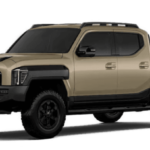 Kia Tasman Fuel Tank Capacity: How Far Can You Drive on a Full Tank?
This doesn't mean those models lack advanced safety equipment, but buyers shouldn't assume the five-star assessment automatically applies to every variant.
It's worth checking the applicable ANCAP assessment and vehicle specification before purchasing.
Exterior Design: X-Line vs X-Pro
The Kia Tasman has one of the more distinctive exterior designs in Australia's dual-cab ute market.
Its upright front end, prominent wheel-arch treatment and unconventional styling create a strong visual identity.
Kia Tasman X-Line Exterior
The X-Line adopts a premium, rugged appearance with:
- 18-inch alloy wheels.
- Prominent wheel-arch styling.
- LED projector headlights.
- Roof rails.
- Privacy glass.
- Integrated storage in the rear wheel-arch flare on eligible exterior colours.
Its appearance balances SUV-like sophistication with traditional ute practicality.
Kia Tasman X-Pro Exterior
The X-Pro looks more adventurous.
Its main visual differences include:
- 17-inch black alloy wheels.
- All-terrain tyres.
- Greater ride height.
- More prominent off-road stance.
- X-Pro-specific badging.
For buyers prioritising appearance, the X-Pro delivers a more purposeful off-road look.
However, styling remains subjective, and some Australian buyers may prefer the X-Line's slightly more road-oriented presentation.
Ownership Costs, Warranty and Servicing
Both Tasman variants benefit from Kia's Australian warranty and servicing arrangements.
For eligible private use, the Tasman comes with a seven-year, unlimited-kilometre warranty.
Commercial-use vehicles are subject to different kilometre conditions, generally seven years or 150,000 km.
Scheduled servicing is required every 12 months or 15,000 km, whichever comes first, under the normal maintenance schedule.
Kia also offers capped-price servicing and prepaid servicing arrangements.
Which Version Is Cheaper to Maintain?
The X-Line may offer slightly lower everyday running costs, mainly because of its better official fuel economy.
Tyre replacement costs can also differ, depending on the brand, size and type of tyre fitted.
The X-Pro's all-terrain tyres and additional off-road equipment may result in different maintenance or replacement expenses.
However, purchasing the X-Pro doesn't automatically mean substantially higher routine servicing costs.
For either model, regular off-road use can increase wear on tyres, brakes, suspension components and underbody protection.
Kia Tasman X-Line Pros and Cons
Advantages
- Lower purchase price than the X-Pro.
- Same 154 kW diesel engine.
- Same 3,500 kg braked towing capacity.
- Slightly better fuel economy.
- Premium interior with heated front seats.
- Modern infotainment and safety technology.
- Genuine 4WD capability.
- Good suitability for family use and everyday driving.
Disadvantages
- Less ground clearance than the X-Pro.
- No factory all-terrain tyres.
- No dedicated Rock terrain mode.
- No X-Trek system.
- No ventilated front seats.
- No premium Harman Kardon audio system.
Kia Tasman X-Pro Pros and Cons
Advantages
- 252 mm ground clearance.
- Factory-fitted all-terrain tyres.
- Selectable electronic rear differential lock.
- Rock terrain mode.
- X-Trek low-speed off-road assistance.
- Additional underbody protection.
- Ventilated front and heated rear seats.
- Heated steering wheel and sunroof.
- Premium audio system.
- More comprehensive luxury equipment.
Disadvantages
- Higher purchase price.
- Slightly higher official fuel consumption.
- All-terrain tyres may create additional road noise.
- Marginally lower payload.
- No additional engine power.
- No increase in towing capacity over the X-Line.
Which Kia Tasman Is Better for Different Australian Drivers?
The ideal model depends on your driving habits, budget and intended use.
Best for Daily Driving: Kia Tasman X-Line
If your normal driving involves commuting, shopping, school runs and highway journeys, the X-Line makes more financial sense.
You still receive plenty of technology, comfort and genuine four-wheel-drive capability.
Best for Serious Off-Road Driving: Kia Tasman X-Pro
The X-Pro is the stronger choice for drivers regularly exploring challenging trails.
This content may interest you!Kia Tasman Wheel Size Australia: Complete Tyre and Rim GuideIts higher ground clearance, all-terrain tyres, electronic differential lock and X-Trek system provide useful off-road advantages.
Best for Towing: Kia Tasman X-Line
For highway-based caravan towing, we'd generally choose the X-Line.
Both versions offer the same rated towing capacity, while the X-Line has a small advantage in official fuel consumption.
Nevertheless, the X-Pro makes sense when towing is combined with frequent off-road travel.
Best for Luxury: Kia Tasman X-Pro
The X-Pro clearly offers the more comprehensive luxury package.
Ventilated seats, a sunroof, premium audio and additional electric seat adjustments provide a more premium ownership experience.
Best Value for Money: Kia Tasman X-Line
For most buyers who won't regularly use the X-Pro's specialist off-road hardware, the X-Line is the better-value option.
It delivers much of the same experience while keeping the original purchase price approximately $7,000 lower.
Kia Tasman X-Line vs X-Pro: Which Should You Buy?
After comparing both variants, we believe the Kia Tasman X-Line is the better choice for most Australian buyers.
It offers an excellent balance of performance, equipment, practicality and everyday usability.
The fact that it shares the same engine, transmission and maximum towing capacity as the X-Pro makes it particularly attractive.
Its 224 mm ground clearance and standard four-wheel-drive system also mean it remains capable of handling many recreational off-road activities.
However, the Kia Tasman X-Pro is the better choice for buyers who regularly venture onto challenging 4WD tracks.
The additional ground clearance, all-terrain tyres and electronic locking differential provide genuine mechanical improvements rather than simply cosmetic upgrades.
Its extra luxury equipment is another reason to consider spending more.
Ultimately, the X-Pro is not necessarily the better ute for everyone. It's the better-equipped off-road ute.
Frequently Asked Questions
1. What is the difference between the Kia Tasman X-Line and X-Pro?
The main differences are off-road capability, interior luxury and price. The X-Pro adds 252 mm ground clearance, all-terrain tyres, a selectable electronic rear differential lock, Rock terrain mode, X-Trek assistance and additional luxury features. The X-Line offers similar engine performance and towing capacity at a lower price.
2. Is the Kia Tasman X-Pro worth buying in Australia?
Yes, particularly for buyers who regularly drive on challenging off-road tracks or value premium features such as ventilated seats and a sunroof. However, drivers who mainly use their ute on sealed roads may find the X-Line provides better value for money.
3. Does the Kia Tasman X-Pro have more power than the X-Line?
No. Both models use the same 2.2-litre turbo-diesel four-cylinder engine producing 154 kW and 440 Nm. Both also use an eight-speed automatic transmission.
4. Which Kia Tasman is better for towing a caravan?
Both models have a maximum rated braked towing capacity of 3,500 kg. The X-Line may be preferable for regular highway towing because of its road-oriented tyres and slightly better official fuel economy. The X-Pro may be more suitable when caravan trips include challenging off-road conditions.
5. Which Kia Tasman has better fuel economy, the X-Line or X-Pro?
The Kia Tasman X-Line is slightly more fuel-efficient, with an official combined figure of 7.8 L/100 km compared with 8.1 L/100 km for the X-Pro. Actual fuel consumption depends on driving conditions, vehicle load, tyres and towing.
Final Verdict: Kia Tasman X-Line vs X-Pro Australia
The Kia Tasman X-Line and X-Pro are two appealing options for Australian drivers who want a modern, comfortable and practical four-wheel-drive ute.
Both share the same diesel engine, eight-speed automatic transmission, substantial towing capability and advanced technology.
The biggest difference is their intended purpose.
This content may interest you!Kia Tasman Models Australia 2026: Complete Guide to All Variants and DifferencesThe X-Line is the more balanced everyday ute, combining premium features, good fuel efficiency and genuine 4WD capability without the X-Pro's higher purchase price.
The X-Pro is the more specialised off-road ute, offering additional ground clearance, all-terrain tyres and advanced off-road systems alongside extra interior luxury.
If we were buying a Tasman primarily for commuting, family travel and occasional camping, we'd choose the X-Line.
But if regular off-road adventures were part of our lifestyle, the X-Pro's additional equipment would make the extra investment easier to justify.
The best decision is ultimately the one that matches how you actually drive, rather than simply choosing the most expensive version.
Leave a Reply