
Skoda Karoq or VW T-Roc Australia: Which SUV Should You Choose?

Choosing between the Skoda Karoq or VW T-Roc in Australia is trickier than it first appears. These two European SUVs share plenty of Volkswagen Group DNA, offer similar petrol engines, and sit close enough on price that many buyers naturally place them on the same shopping list. Yet once we look beyond the badges, they have quite different personalities.
The Volkswagen T-Roc is the more compact of the pair. It is easier to place in tight city streets, looks sportier, and offers slightly better official fuel economy in comparable 110TSI form. The Skoda Karoq, meanwhile, stretches the formula towards practicality. It has a significantly larger boot, a longer Australian warranty and the kind of sensible cabin touches that make everyday ownership easier.
There is another factor Australian buyers need to know in 2026: the T-Roc currently on sale is approaching the end of its Australian lifecycle. Volkswagen has already revealed the second-generation T-Roc, with an Australian launch planned for the first half of 2027.
So, should we buy the Skoda Karoq or Volkswagen T-Roc now? Let’s compare them properly.
- Skoda Karoq vs VW T-Roc Australia at a Glance
- Skoda Karoq or VW T-Roc Price in Australia
- Size and Dimensions: Karoq Is Noticeably Bigger
- Boot Space: Skoda Karoq Has the Clear Advantage
- Engine Performance: Surprisingly Similar
- Fuel Economy: T-Roc Has a Small Edge
- Interior and Everyday Comfort
- Technology and Infotainment
- Safety: An Important ANCAP Detail
- Warranty: Skoda Karoq Wins on Duration
- Servicing Costs in Australia
- Skoda Karoq vs T-Roc for Families
- Skoda Karoq vs T-Roc for City Driving
- What About Resale Value?
- Should You Wait for the New Volkswagen T-Roc?
- Karoq Sportline 4x4 vs T-Roc R-Line
- Main Pros and Cons
- Skoda Karoq or VW T-Roc Australia: Which One Makes More Sense?
- Conclusion
- Frequently Asked Questions
Skoda Karoq vs VW T-Roc Australia at a Glance
At their core, both SUVs follow a very similar mechanical recipe. Entry-level versions use a turbocharged 1.4-litre four-cylinder petrol engine producing 110kW and 250Nm, paired with an eight-speed automatic and front-wheel drive. Higher-performance versions step up to a 2.0-litre turbo engine with 140kW and 320Nm, a seven-speed dual-clutch transmission and all-wheel drive.
| Specification | Skoda Karoq 110TSI | VW T-Roc 110TSI |
|---|---|---|
| Engine | 1.4L turbo petrol | 1.4L turbo petrol |
| Power | 110kW | 110kW |
| Torque | 250Nm | 250Nm |
| Transmission | 8-speed automatic | 8-speed automatic |
| Drive | Front-wheel drive | Front-wheel drive |
| Claimed fuel use | 6.6L/100km | 6.3L/100km |
| Boot capacity | 521L | 445L |
| Length | 4390mm | 4251mm |
| Warranty | 7 years/unlimited km | 5 years/unlimited km |
The similarities are obvious, but those figures also reveal the main difference. The Karoq prioritises space, while the T-Roc prioritises compact dimensions.
Skoda Karoq or VW T-Roc Price in Australia
Price is one of the first places where the comparison becomes interesting.
For MY26 vehicles, Škoda Australia lists the Karoq Select from $40,990 drive-away, the Sportline 110TSI from $46,990, the 130 Years Edition from $49,990 and the Sportline 4x4 140TSI from $54,990 drive-away. These are recommended drive-away prices and can vary depending on location and dealer.
Current T-Roc pricing varies according to state and dealer charges. CarExpert's Sydney-based 2026 drive-away figures place the CityLife around $42,909, the Style around $45,999 and the R-Line around $54,526.
That means the gap is surprisingly small.
Rather than deciding purely by the advertised figure, we would compare actual dealer quotes. Temporary Volkswagen and Škoda promotions can move these numbers enough to change the value equation considerably.
Which Offers More for Around $40,000?
Around the lower end of the range, the Karoq Select presents an interesting proposition because its official recommended drive-away price sits close to $41,000.
Standard equipment includes 18-inch alloy wheels, LED lighting, dual-zone climate control, an 8.25-inch digital instrument display, an 8.0-inch infotainment screen and wireless Apple CarPlay and Android Auto.
The T-Roc CityLife counters with a slightly smaller body and a familiar Volkswagen cabin experience. Its biggest advantage may be that it feels more like a traditional small SUV, whereas the Karoq straddles the gap between small and medium SUV categories.
For buyers who need to fit a vehicle into a narrow garage or regularly negotiate inner-city parking, that difference matters more than a few hundred dollars.
Size and Dimensions: Karoq Is Noticeably Bigger
This is probably the most important distinction in the whole comparison.
The Karoq measures approximately:
- 4390mm long
- 1841mm wide
- 1603mm tall
- 2638mm wheelbase
The current T-Roc is around:
- 4251mm long
- 1819mm wide
- 1599mm tall
That makes the Karoq roughly 139mm longer.
On paper, 139mm does not sound dramatic. In the real world, though, it is enough to influence both luggage capacity and how the vehicle feels when parking.
Which Is Better for Australian Cities?
For Sydney, Melbourne, Brisbane or other dense urban areas, the T-Roc's shorter footprint is attractive.
Think of the two cars like backpacks. The T-Roc is the compact daypack: easier to carry, easier to store and large enough for most daily jobs. The Karoq is the slightly larger travel backpack: still manageable, but designed to swallow more when life gets complicated.
If our driving revolves around apartment garages, shopping-centre car parks and narrow suburban streets, we would appreciate those smaller T-Roc dimensions.
For families regularly carrying prams, sports bags, luggage or bulky shopping, the equation swings towards the Karoq.
Boot Space: Skoda Karoq Has the Clear Advantage
Boot capacity provides one of the strongest arguments for choosing the Karoq.
Škoda quotes 521 litres with the rear seats upright and as much as 1,630 litres with them folded.
The front-wheel-drive T-Roc offers around 445 litres, expanding to approximately 1,290 litres with the rear seats down. The AWD R-Line loses some capacity, dropping to around 392 litres behind the rear seats.
| Cargo capacity | Skoda Karoq | VW T-Roc |
|---|---|---|
| Rear seats upright | 521L | Up to 445L |
| Rear seats folded | 1630L | Up to 1290L |
For anyone searching Skoda Karoq vs T-Roc boot space, the difference is substantial.
Why That Extra Space Matters
Boot figures can feel abstract until we actually live with a vehicle.
A stroller, weekly groceries and several school bags can quickly turn a theoretically spacious SUV into a game of Tetris. That extra 76 litres behind the second row gives the Karoq more breathing room before we need to start stacking things vertically.
Škoda also builds its brand around practical “Simply Clever” features. Depending on variant, these can include storage bins, luggage hooks and other small touches that become more valuable after six months of ownership than they seem during a ten-minute showroom visit.
This content may interest you!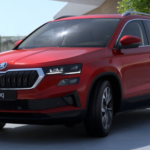 Skoda Karoq or Peugeot 3008 Australia: 2026 Comparison
Engine Performance: Surprisingly Similar
If we compare Karoq 110TSI vs T-Roc 110TSI, there is almost nothing separating them on raw engine output.
Both produce:
110kW of power and 250Nm of torque.
Both also use an eight-speed automatic transmission and front-wheel drive in their mainstream configurations.
That is good news because neither model feels drastically compromised by choosing the more affordable engine.
The 250Nm torque figure arrives relatively low in the rev range, giving both SUVs enough punch for merging, overtaking and everyday suburban driving without needing a huge engine.
What About the 140TSI Versions?
Move higher in the range and both models offer a 2.0-litre turbocharged engine producing 140kW and 320Nm, combined with all-wheel drive and a seven-speed dual-clutch transmission.
These variants make more sense if performance is high on our priority list, or if we regularly drive in conditions where AWD adds useful traction.
For typical Australian suburban use, however, the 110TSI engine is probably the sweet spot. It keeps the purchase price lower while retaining enough performance for everyday duties.
Fuel Economy: T-Roc Has a Small Edge
Fuel consumption matters even more when both vehicles require premium petrol.
Volkswagen quotes combined consumption across the mainstream current T-Roc range of around 6.3 to 7.3L/100km, depending on variant.
The front-wheel-drive Karoq 110TSI is rated at approximately 6.6L/100km, while the 140TSI AWD versions move higher.
So, at least on official figures, the T-Roc 110TSI has a modest advantage.
Would we choose one SUV purely because it uses around 0.3L/100km less? Probably not. Real-world fuel consumption varies enormously with traffic, air-conditioning, driving style, load and journey length.
Over tens of thousands of kilometres, though, small efficiency advantages eventually add up.
Interior and Everyday Comfort
Neither vehicle is a rolling technology laboratory. In fact, that may be part of their charm.
The Karoq's interior belongs to an older generation of Volkswagen Group design, meaning we still get plenty of familiar controls rather than having every function buried inside a giant touchscreen.
Some drivers will see that as dated. Others will see it as common sense.
The current Karoq Select has an 8.0-inch infotainment touchscreen, an 8.25-inch digital instrument cluster and wireless smartphone integration.
The T-Roc's cabin generally feels sportier and more compact. Its dashboard presentation suits buyers who want something closer to a raised Volkswagen hatchback than a conventional family SUV.
Which Feels More Spacious?
The Karoq's larger body pays dividends inside, particularly when we consider cargo capacity and overall cabin usefulness.
That does not mean the second row is enormous. Australian reviews have noted that rear-seat space can still feel relatively tight compared with larger medium SUVs.
The T-Roc is smaller again, so neither vehicle should be treated as an alternative to a large family SUV.
For one or two adults, occasional rear passengers and weekend luggage, either works.
For parents who regularly carry teenagers or rear-facing child seats, we would physically test both before buying. Seat position can change the experience far more than a specification sheet suggests.
Technology and Infotainment
Technology is one area where the age of these cars is starting to show.
That does not automatically make them bad. Sometimes a familiar infotainment system with physical controls works better day-to-day than a flashy screen requiring four taps to adjust the temperature.
The current Karoq offers wireless Apple CarPlay and Android Auto in Australian specification, along with digital instrumentation and USB-C connectivity. Higher variants add more premium equipment.
Volkswagen's T-Roc similarly combines touchscreen infotainment with its Digital Cockpit concept and IQ.DRIVE assistance technology.
The bigger question is not which current vehicle has the flashiest screen. It is whether we are comfortable buying the present T-Roc shortly before the technologically newer second-generation model reaches Australia.
Safety: An Important ANCAP Detail
This section deserves careful attention because older five-star marketing references can easily cause confusion.
This content may interest you!Skoda Karoq or Nissan Qashqai Australia: Which SUV Should You Choose?The Karoq received a five-star ANCAP rating under 2017 testing criteria, but that rating expired at the end of December 2023. ANCAP currently lists the older rating as expired.
Similarly, T-Rocs built before January 2024 were covered by an earlier five-star rating, but ANCAP currently lists T-Roc vehicles built from January 2024 onwards as unrated.
Being unrated does not mean ANCAP has declared the vehicles unsafe. It means buyers should not treat the old five-star scores as if they were current ratings under today's more demanding protocols.
What Safety Equipment Do They Have?
Current Karoq equipment includes technologies such as autonomous emergency braking, adaptive cruise control, lane-keeping assistance, blind-spot monitoring, parking sensors and a reversing camera, with additional systems offered on higher variants.
Volkswagen also equips the T-Roc with its IQ.DRIVE suite, including systems such as adaptive cruise control, Lane Assist, Front Assist and parking assistance depending on specification.
We would therefore compare the exact variant's equipment rather than simply looking for an old star rating.
Warranty: Skoda Karoq Wins on Duration
This is one of the easiest differences to understand.
Škoda Australia covers new Karoqs with a seven-year, unlimited-kilometre warranty for eligible private and general-use vehicles.
Volkswagen provides a five-year, unlimited-kilometre warranty on new vehicles.
That gives the Karoq two additional years of manufacturer warranty coverage.
For someone planning to replace the vehicle after three or four years, that difference may not matter much.
For someone intending to keep an SUV for seven or eight years, it becomes much more significant. The transferable remaining warranty could also be useful when selling the Karoq within that period.
Servicing Costs in Australia
The servicing picture has improved for MY26 vehicles.
Škoda currently lists a five-year service pack for MY26 Karoq 2WD models at $2,590, while the AWD version costs $2,990. Seven-year plans are $3,490 and $3,990 respectively.
Volkswagen's current published care-plan pricing lists the MY26 T-Roc 110kW five-year plan at $2,752, while the 140kW version is $3,352.
That makes the Karoq surprisingly competitive here.
| MY26 five-year prepaid servicing | Cost |
|---|---|
| Karoq 2WD | $2,590 |
| Karoq 4x4 | $2,990 |
| T-Roc 110kW | $2,752 |
| T-Roc 140kW | $3,352 |
Prices and service programs can change, so these figures should be checked again before signing a purchase contract.
Skoda Karoq vs T-Roc for Families
If our main goal is family practicality, the Karoq makes a strong case.
That 521-litre boot is the headline number, but its advantage is broader than one specification. The Karoq behaves more like a conventional family SUV: taller, longer and more focused on making storage easy.
The seven-year warranty also fits the family-car mindset nicely. Buy it when the children are young and much of their primary-school years could potentially pass before the original manufacturer warranty expires.
The T-Roc can still work perfectly well for a small family, particularly when most journeys are urban and luggage requirements are moderate.
Its compact footprint may actually make it easier to live with if parking space at home is limited.
Skoda Karoq vs T-Roc for City Driving
Reverse the priorities and the T-Roc becomes much more attractive.
At 4251mm long, it is around 14cm shorter than the Karoq. That might not sound like much until we find the only available parking space on a crowded street.
Its slightly lower official fuel consumption in 110TSI form also suits commuter use.
The T-Roc therefore occupies an appealing middle ground between a traditional hatchback and a larger SUV. We get the elevated seating position and SUV styling without dragging a huge body through the city every day.
If our lifestyle is mostly two people, city commuting and occasional road trips, we may never use the Karoq's extra cargo capacity.
What About Resale Value?
Resale values are difficult to predict precisely because future used-car prices depend on supply, mileage, condition, interest rates and what new cars are available when we eventually sell.
Volkswagen has considerably stronger T-Roc sales volumes in Australia than the Karoq. CarExpert reports 5,159 T-Roc registrations during 2025, compared with 470 Karoq sales.
Higher sales volume can mean greater recognition among used-car shoppers, but scarcity can also work in different ways. We would therefore avoid assuming either vehicle is automatically guaranteed to depreciate less.
The upcoming generation change is another consideration for T-Roc buyers because today's model will soon visually and technologically sit beside a much newer replacement.
This content may interest you!Skoda Karoq vs Kamiq Australia: Which SUV Makes More Sense?Should You Wait for the New Volkswagen T-Roc?
This question matters enormously in late 2026.
Volkswagen has already unveiled the second-generation T-Roc. It is longer, introduces a significantly updated cabin and newer infotainment technology, and will eventually offer electrified powertrains. Volkswagen Australia has confirmed the new model for the first half of 2027, with mild-hybrid engines planned locally.
The next-generation vehicle is also substantially more practical, with Volkswagen quoting a larger 475-litre boot for the new model.
So should we wait?
If we need a car immediately and can negotiate an attractive deal on the outgoing T-Roc, buying now can still make sense.
If we are not in a hurry and want the latest technology, fresher styling and mild-hybrid power, the 2027 model fundamentally changes the calculation.
Does the Upcoming T-Roc Make the Karoq More Attractive Today?
In an odd way, yes.
The Karoq is also an ageing design, but there is no pretending otherwise. Its appeal rests on what it already does well: practicality, straightforward controls, competitive MY26 drive-away pricing and that seven-year warranty.
The outgoing T-Roc, meanwhile, sits in an awkward transition period. Buyers choosing one today know a substantially redesigned successor is approaching.
That does not make the current T-Roc a poor purchase. It simply means discount and deal quality become more important.
A strong end-of-generation offer could make the T-Roc appealing. Paying close to full retail just months before the replacement arrives requires more thought.
Karoq Sportline 4x4 vs T-Roc R-Line
At the upper end, the comparison becomes remarkably close.
Both use a 2.0-litre turbo petrol engine with 140kW and 320Nm, a seven-speed dual-clutch transmission and all-wheel drive.
Current advertised drive-away figures also put them in roughly the mid-$50,000 range, depending on location and offer.
Here the decision becomes less about performance and more about packaging.
The Karoq Sportline 4x4 preserves the model's practicality advantage and long warranty.
The T-Roc R-Line delivers the more compact, sporty crossover character.
For someone wanting a fast-enough European SUV without stepping into a full performance model, both occupy a surprisingly similar niche.
Main Pros and Cons
Skoda Karoq Pros
- Larger 521L boot
- Seven-year unlimited-kilometre warranty
- Competitive MY26 prepaid servicing
- Practical cabin and storage details
- 110kW and 140kW powertrain choices
- 4x4 option available
Skoda Karoq Cons
- Older interior architecture
- Larger footprint than the T-Roc
- No hybrid powertrain
- Current ANCAP rating has expired
Volkswagen T-Roc Pros
- Compact city-friendly dimensions
- Slightly better claimed fuel economy in 110TSI form
- Sportier crossover styling
- Same useful 110kW/250Nm entry powertrain
- 140kW AWD R-Line available
- Stronger Australian sales presence
Volkswagen T-Roc Cons
- Smaller boot than the Karoq
- Five-year warranty versus seven years for Škoda
- Current post-2023 vehicles are unrated by ANCAP
- Current generation is being replaced in Australia in 2027
Skoda Karoq or VW T-Roc Australia: Which One Makes More Sense?
There is no need to overcomplicate this comparison.
Choose the Skoda Karoq if our priorities are cargo space, long-term ownership, warranty coverage and everyday family practicality. Its 521-litre luggage capacity versus the T-Roc's 445 litres is meaningful, and Škoda's seven-year warranty gives us two extra years compared with Volkswagen.
Choose the Volkswagen T-Roc if our priorities are compact dimensions, city driving, slightly lower claimed fuel consumption and a sportier crossover character.
And there is a third option: wait.
With the all-new Australian T-Roc due during the first half of 2027, buyers who are not under pressure to purchase today have a genuine reason to see what the new mild-hybrid model brings.
The funny thing is that these SUVs are like two siblings wearing different clothes. Their engines and engineering share plenty of DNA, yet one became the practical member of the family while the other chased a more youthful, urban personality.
Conclusion
The Skoda Karoq vs VW T-Roc Australia comparison ultimately comes down to how we intend to use the vehicle.
For carrying luggage, keeping the car long-term and maximising usable SUV space without moving into something significantly larger, the Karoq is particularly compelling. Its large boot, practical design, seven-year warranty and competitive MY26 servicing costs give it a logical appeal that is easy to underestimate.
The current T-Roc counters with a smaller body, slightly better official fuel efficiency in its 110TSI configuration and a more compact urban personality. It is particularly appealing when garage space and manoeuvrability matter more than ultimate cargo capacity.
But timing matters in 2026. The all-new T-Roc arriving in Australia in 2027 will bring newer technology and mild-hybrid engines, so anyone considering today's T-Roc should factor that transition into the price they are willing to pay.
Neither SUV wins every category. Instead, they answer slightly different versions of the same question: do we want our compact European SUV to feel more like a practical family tool or a raised city car?
Frequently Asked Questions
Is the Skoda Karoq bigger than the VW T-Roc?
Yes. The current Australian Karoq is approximately 4390mm long compared with around 4251mm for the T-Roc. The Karoq also offers considerably more luggage space, with 521 litres behind the rear seats versus up to 445 litres in the front-wheel-drive T-Roc.
Do the Skoda Karoq and VW T-Roc have the same engine?
Comparable Australian 110TSI versions are extremely similar mechanically. Both use a 1.4-litre turbocharged petrol four-cylinder producing 110kW and 250Nm, connected to an eight-speed automatic. Higher Karoq and T-Roc variants also offer 140kW/320Nm 2.0-litre turbo engines with AWD.
This content may interest you!Skoda Karoq vs Toyota RAV4 Australia: Which SUV Is Better?Which has the bigger boot, Skoda Karoq or T-Roc?
The Karoq. It offers 521 litres with the rear seats up and as much as 1,630 litres with them folded. The front-wheel-drive T-Roc provides around 445 litres with the seats up and approximately 1,290 litres folded.
Which has the longer warranty in Australia?
The Skoda Karoq has the longer manufacturer warranty. Škoda provides seven years/unlimited kilometres for eligible new vehicles, while Volkswagen's new-vehicle warranty lasts five years/unlimited kilometres.
Should I buy the current T-Roc or wait for the new one?
Buyers who need a vehicle now may find the current T-Roc attractive, particularly if dealer discounts are available. Buyers who can wait should know that Volkswagen Australia has confirmed the new-generation T-Roc for the first half of 2027, with mild-hybrid powertrains planned for the local range.
Leave a Reply