
Toyota LandCruiser Towing Capacity Australia: Complete Guide

Few vehicles are woven into Australian life quite like the Toyota LandCruiser. We see them pulling caravans across the Nullarbor, hauling boats toward remote boat ramps, towing machinery between rural properties, and disappearing down corrugated tracks with a camper trailer following faithfully behind.
But reputation alone does not tell us how much a LandCruiser can legally and safely tow.
The headline figure sounds simple: most current Australian Toyota LandCruiser models can tow up to 3,500kg with trailer brakes. However, that number is only the beginning of the story. Payload, tow-ball download, Gross Vehicle Mass, Gross Combination Mass, passengers, accessories and trailer loading can all reduce what we can realistically carry.
In this guide, we break down the Toyota LandCruiser towing capacity in Australia, explain the differences between the 300 Series, Prado and 70 Series, and show why a vehicle rated to tow 3.5 tonnes may not always be able to tow a fully loaded 3.5-tonne caravan while carrying a family and a boot full of equipment.
- What Is the Toyota LandCruiser Towing Capacity in Australia?
- Braked Versus Unbraked Towing Capacity
- Toyota LandCruiser 300 Series Towing Capacity
- Toyota LandCruiser Prado Towing Capacity
- Toyota LandCruiser 70 Series Towing Capacity
- Which Australian LandCruiser Is Best for Towing?
- Why a 3,500kg Rating Does Not Tell the Whole Story
- Essential Towing Weight Terms Explained
- LandCruiser 300 Towing Calculation Example
- Can a LandCruiser Tow a 3,500kg Caravan?
- How Much Towing Margin Should We Leave?
- Tow-Ball Download and Rear-Axle Load
- Accessories That Reduce Available Payload
- How to Weigh a LandCruiser and Caravan
- LandCruiser Towing Performance on Australian Roads
- Towing Safety Checklist
- Choosing a Caravan for a Toyota LandCruiser
- Does Towing Affect Fuel Consumption?
- Do We Need an Electric Brake Controller?
- Can We Increase LandCruiser Towing Capacity?
- Common LandCruiser Towing Mistakes
- Is the Toyota LandCruiser a Good Tow Vehicle?
- Conclusion: Understanding Toyota LandCruiser Towing Capacity Australia
- Frequently Asked Questions
What Is the Toyota LandCruiser Towing Capacity in Australia?
Current Australian-market LandCruiser models generally have the following maximum towing limits:
| Toyota LandCruiser model | Braked towing capacity | Unbraked towing capacity |
|---|---|---|
| LandCruiser 300 Series | 3,500kg | 750kg |
| LandCruiser Prado | 3,500kg | 750kg |
| LandCruiser 70 Series | 3,500kg | 750kg |
Toyota Australia confirms a 3,500kg braked towing capacity across the LandCruiser 300 Series range. The latest Prado also offers 3,500kg, representing a 500kg improvement over the previous-generation Prado. The current 70 Series maintains the same 3,500kg maximum.
The current 300 Series specification table lists both a 3,500kg braked limit and a 750kg unbraked limit across its grades.
That gives us a neat answer on paper. Yet towing in the real world is less like reading one number and more like balancing several plates at once. Every kilogram added to the LandCruiser or trailer affects another limit.
Braked Versus Unbraked Towing Capacity
Before comparing models, we need to understand the difference between braked and unbraked trailers.
Braked Towing Capacity
A braked trailer has its own braking system. These brakes activate when the tow vehicle slows down, helping control the combined weight of the vehicle and trailer.
The 3,500kg LandCruiser towing figure applies to a correctly equipped trailer with functioning brakes.
Heavy caravans, horse floats, large boats and substantial equipment trailers almost always use a braked setup.
Unbraked Towing Capacity
An unbraked trailer relies entirely on the LandCruiser’s brakes to slow both the vehicle and the trailer.
The maximum unbraked towing capacity is normally 750kg. That may be sufficient for:
- A small box trailer
- A lightweight garden trailer
- Certain compact boat trailers
- A small motorcycle trailer
- An empty or lightly loaded utility trailer
We must include everything carried on the trailer when calculating its weight. A trailer weighing 400kg empty may quickly exceed 750kg after we add camping gear, tools, water or a motorcycle.
Toyota LandCruiser 300 Series Towing Capacity
The current Toyota LandCruiser 300 Series has a maximum braked towing capacity of 3,500kg across the range. Its unbraked towing limit is 750kg.
This applies across familiar grades such as:
- GX
- GXL
- VX
- Sahara
- Sahara ZX
- GR Sport
Toyota’s current specification information also includes the newer Performance Hybrid versions within the 300 Series range. Although kerb weight and Gross Vehicle Mass can differ between grades and powertrains, the listed maximum braked towing capacity remains 3,500kg.
Why the 300 Series Works Well as a Tow Vehicle
The 300 Series is designed as a large, long-distance four-wheel drive rather than a soft urban SUV wearing hiking boots.
Its towing strengths include:
- A ladder-frame platform
- Strong low-speed torque
- A substantial wheelbase
- Full-time four-wheel drive
- Low-range gearing
- Trailer sway control
- A strong automatic transmission
- High-speed touring comfort
- Effective cooling systems
- Stable highway manners
Toyota describes the 300 Series as using a rigid ladder-frame architecture and gives it a 3,500kg braked capacity across the range.
The diesel-powered model uses a 3.3-litre twin-turbo V6 producing 700Nm, while current specification material also lists a Performance Hybrid powertrain with higher combined output.
Power matters, but towing confidence is not simply a horsepower contest. Chassis balance, cooling, suspension behaviour, transmission calibration and braking control are equally important when several tonnes are following behind us.
LandCruiser 300 Payload Differences
Here is where buyers need to slow down and study the numbers.
Toyota’s published figures show that kerb weight varies by grade. A heavier luxury grade naturally leaves less available payload when its GVM is similar to that of a lighter grade.
For example, the published diesel figures indicate approximately:
| 300 Series grade | Approximate kerb weight | GVM | Theoretical payload |
| GX | 2,480kg | 3,280kg | 800kg |
| GXL | 2,545kg | 3,280kg | 735kg |
| VX | 2,620kg | 3,280kg | 660kg |
| Sahara | 2,620kg | 3,280kg | 660kg |
| Sahara ZX diesel | 2,600kg | 3,280kg | 680kg |
| GR Sport diesel | 2,600kg | 3,280kg | 680kg |
These are theoretical calculations based on published approximate kerb weight and GVM figures. The actual vehicle can weigh more after options, accessories and modifications are fitted.
A GX may therefore offer more practical payload than a heavily equipped luxury grade. That difference becomes important when we add a bullbar, roof rack, fridge, second battery, drawers, passengers and a heavy caravan’s tow-ball download.
Toyota LandCruiser Prado Towing Capacity
The current-generation Toyota LandCruiser Prado offers a maximum 3,500kg braked towing capacity in Australia.
That is a major improvement over the outgoing Prado, which was generally limited to 3,000kg in later automatic versions. Toyota confirms that the latest model gained an additional 500kg of braked towing capacity.
Is the Prado as Capable as the 300 Series?
On the brochure, both can tow 3,500kg. In practice, they do not necessarily feel identical when attached to the same trailer.
The Prado is narrower, lighter and powered by a smaller 2.8-litre four-cylinder turbo-diesel. It can be an excellent tow vehicle, particularly for family caravans and touring trailers, but a 3,500kg rating does not erase the physical differences between it and the larger 300 Series.
The 300 Series generally provides:
- More engine torque
- Greater physical mass
- A broader stance
- A more substantial touring feel
- More relaxed performance with very heavy trailers
The Prado can offer:
- Lower purchase and operating costs
- Easier urban manoeuvrability
- Better suitability for narrower tracks
- Family-friendly practicality
- Genuine off-road ability
- The same headline 3.5-tonne towing rating
We should choose according to the trailer’s real loaded weight rather than chasing the maximum rating. A Prado towing a 2,500kg caravan may feel composed and comfortable. Asking it to operate permanently near every legal limit creates a different experience.
Who Should Consider the Prado for Towing?
The Prado makes sense for drivers who want one vehicle to handle school runs, city parking, remote-area touring and holiday towing.
It may be particularly suitable for:
- Medium to large caravans
- Camper trailers
- Horse floats within weight limits
- Family boats
- Off-road trailers
- Touring setups that do not overload the vehicle
Toyota LandCruiser 70 Series Towing Capacity
The Toyota LandCruiser 70 Series has a maximum braked towing capacity of 3,500kg, with an unbraked limit of 750kg.
Depending on availability and configuration, the Australian 70 Series family includes variants such as:
- Single-Cab Cab-Chassis
- Double-Cab Cab-Chassis
- Wagon
- Troop Carrier
Toyota has maintained the 3,500kg braked rating across 70 Series models, including versions powered by the 2.8-litre four-cylinder turbo-diesel.
Why the 70 Series Is Popular for Work and Remote Touring
The 70 Series is less like a luxury lounge and more like a steel-capped work boot. It is valued for durability, straightforward construction and its ability to carry serious equipment.
Its appeal includes:
- Strong ladder-frame construction
- Heavy-duty suspension
- Low-range four-wheel drive
- Practical cab-chassis configurations
- Good modification potential
- Suitability for rural and remote work
- A 3,500kg braked towing limit
- High payload potential in selected variants
A cab-chassis model also allows owners to choose a tray, canopy or service body suited to their work.
However, every tray, toolbox, canopy, spare wheel carrier and water tank consumes payload. A beautifully built touring canopy can be a small house on wheels, but it may also weigh several hundred kilograms before we place anything inside it.
Which Australian LandCruiser Is Best for Towing?
There is no single winner for everyone.
Best for Heavy Caravan Touring: LandCruiser 300
The 300 Series is generally the most comfortable choice for towing a large caravan over long distances.
Its size, torque, road manners and cabin comfort make it well suited to hours of highway driving. It may also feel more settled when crosswinds, road trains and uneven surfaces enter the picture.
Best All-Round Family Option: LandCruiser Prado
The Prado offers a useful middle ground. It can tow up to 3,500kg while remaining easier to use around town than the larger 300 Series.
For families towing a caravan below the maximum limit, it can provide a strong blend of practicality, comfort and off-road capability.
Best for Payload and Work: LandCruiser 70 Series
For rural work, equipment transport and custom touring builds, the 70 Series remains difficult to ignore.
The right cab-chassis configuration can carry tools, fuel, camping equipment and specialised bodies. Nevertheless, buyers must calculate the finished vehicle weight after every modification.
Why a 3,500kg Rating Does Not Tell the Whole Story
The biggest towing mistake is treating maximum towing capacity as the only number that matters.
Toyota specifically advises owners to consider towing capacity, GVM, GCM, kerb weight, axle limits, passengers, luggage, accessories and tow-ball download.
Think of the vehicle’s weight limits as the walls of a room. We cannot push through one wall simply because there appears to be space near another.
Essential Towing Weight Terms Explained
Tare Mass
Tare mass generally describes the vehicle or trailer in a largely empty condition, based on the applicable definition and specification.
For a caravan, tare mass does not represent what it will weigh when prepared for a holiday.
Gas bottles, water, food, bedding, solar equipment, batteries and personal belongings all add weight.
Kerb Weight
Kerb weight is the approximate weight of the vehicle in running condition with standard equipment and fluids, but without occupants or luggage.
Toyota notes that payload calculations and actual vehicle mass are affected by equipment, passengers and accessories.
Payload
Payload is broadly the difference between the vehicle’s GVM and its kerb weight.
Payload must accommodate items such as:
- Driver and passengers
- Tow-ball download
- Bullbar
- Winch
- Roof rack
- Drawers
- Fridge
- Additional battery
- Recovery equipment
- Luggage
- Food and water
- Aftermarket fuel tanks
- Tools
- Cargo
Why Tow-Ball Weight Matters
Tow-ball download is the downward force the trailer places on the towbar.
That force becomes load carried by the LandCruiser. It therefore uses part of the vehicle’s payload and affects axle loads.
A heavy caravan with a 300kg tow-ball download may consume nearly half the remaining payload of certain LandCruiser configurations before we seat a single passenger.
Gross Vehicle Mass
Gross Vehicle Mass, or GVM, is the maximum permitted weight of the loaded vehicle.
It includes:
- The LandCruiser
- Occupants
- Fuel
- Accessories
- Cargo
- Tow-ball download
Toyota defines GVM as the total permissible vehicle weight including occupants, fuel and cargo.
Aggregate Trailer Mass
Aggregate Trailer Mass, or ATM, is the trailer’s maximum permissible total loaded mass when it is not connected to the tow vehicle.
A caravan advertised with a 3,500kg ATM cannot legally exceed that figure.
Gross Trailer Mass
Gross Trailer Mass, or GTM, is the loaded weight supported by the trailer’s wheels while it is connected to the vehicle.
Because some weight rests on the towball, GTM is generally lower than ATM.
Gross Combination Mass
Gross Combination Mass, or GCM, is the maximum permitted combined mass of the loaded LandCruiser and loaded trailer.
Toyota defines GCM as the permissible combined weight of the vehicle and trailer, including fuel, occupants and cargo.
The 300 Series specification table lists a GCM of 6,750kg across the current range.
LandCruiser 300 Towing Calculation Example
Let us imagine a diesel LandCruiser 300 VX with an approximate kerb weight of 2,620kg and a GVM of 3,280kg.
Its theoretical payload is:
3,280kg − 2,620kg = 660kg
This content may interest you!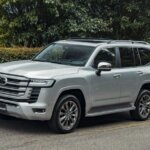 Toyota LandCruiser Weight: Kerb Weight, GVM, Payload and Towing Explained
Now we add:
- Driver: 90kg
- Passenger: 70kg
- Two children: 80kg combined
- Bullbar: 70kg
- Roof rack: 30kg
- Fridge and drawers: 70kg
- Luggage and equipment: 80kg
- Caravan tow-ball download: 280kg
Total added load:
700kg
That theoretical setup exceeds the 660kg payload before accounting for possible differences between published kerb weight and the vehicle’s actual weight.
The caravan itself may still be below the 3,500kg towing limit, but the LandCruiser could exceed its GVM.
This is why “it can tow 3.5 tonnes” is not enough.
Can a LandCruiser Tow a 3,500kg Caravan?
Yes, a properly specified current LandCruiser can be rated to tow a caravan with an ATM of up to 3,500kg.
But doing so legally requires us to remain within every relevant limit:
- Maximum braked towing capacity
- Vehicle GVM
- Vehicle GCM
- Trailer ATM
- Trailer GTM
- Front axle limit
- Rear axle limit
- Towbar limit
- Tow-ball download limit
- Tyre load ratings
A caravan with a 3,500kg ATM may not actually weigh 3,500kg on every trip. Conversely, a caravan advertised with a tare weight of 2,800kg can approach 3,500kg surprisingly quickly after water, batteries, food and accessories are added.
How Much Towing Margin Should We Leave?
Australian law does not create a universal rule saying every driver must tow a fixed percentage below the manufacturer’s rating. Still, operating with some margin can make practical sense.
A margin may help account for:
- Inaccurate estimates
- Water and fuel added during a journey
- Extra holiday luggage
- Uneven trailer loading
- Strong winds
- Mountain roads
- High temperatures
- Emergency equipment
- Future accessories
A vehicle running below its absolute limits often feels less strained and leaves us more flexibility.
That does not mean a LandCruiser is incapable near its published rating. It means the driving experience at 2,500kg is not the same as the experience at 3,500kg.
Tow-Ball Download and Rear-Axle Load
Tow-ball download deserves special attention because it acts behind the rear axle.
Like pressing down on the handle of a wheelbarrow, trailer leverage can increase load at the rear axle while reducing weight over the front axle.
Too much rear loading may affect:
- Steering feel
- Headlight aim
- Braking balance
- Rear suspension height
- Tyre loading
- Stability
- Front-wheel grip
A weight-distribution system may help in appropriate circumstances, but it does not increase the vehicle’s legal GVM, GCM, axle ratings or towing capacity.
Toyota recommends considering a Load Distribution Hitch when towing loads greater than half of the vehicle’s GVM or as specified in the owner’s manual. Toyota also notes that such a hitch may not suit every road condition.
Accessories That Reduce Available Payload
LandCruisers invite modification. That is part of their charm, but every accessory brings weight.
Common additions include:
- Steel bullbar
- Electric winch
- Driving lights
- Underbody protection
- Dual-battery system
- Roof platform
- Awning
- Long-range fuel tank
- Rear drawers
- Fridge slide
- Cargo barrier
- Spare-wheel carrier
- Canopy
- Water tank
- Recovery equipment
A build can gain 300kg or more before passengers climb aboard.
We should keep a running weight spreadsheet rather than guessing. The vehicle does not care whether the extra kilograms are essential recovery gear or decorative accessories. Weight is weight.
How to Weigh a LandCruiser and Caravan
The most reliable approach is to use a certified public weighbridge or a reputable mobile weighing service.
Ideally, we should measure:
- The fully loaded LandCruiser without the trailer
- The connected vehicle and trailer combination
- The LandCruiser’s front axle
- The LandCruiser’s rear axle
- The trailer axle group
- The caravan independently, where possible
- The actual tow-ball download
Prepare the vehicle exactly as it will travel:
- Fill the fuel tank
- Load water
- Pack food
- Add luggage
- Carry normal passengers
- Include pets
- Install all accessories
- Load the caravan
- Carry generators, bikes and outdoor furniture
Weighing an empty setup provides comforting numbers that may disappear on departure morning.
LandCruiser Towing Performance on Australian Roads
Australia presents towing conditions that are difficult to recreate in a showroom.
A LandCruiser may face:
- Long highway distances
- Intense summer heat
- Steep alpine climbs
- Corrugated outback roads
- Soft sand
- Crosswinds
- Road trains
- Remote fuel availability
- Dust and water crossings
Highway Towing
The 300 Series is generally the most relaxed highway tow vehicle in the range. Its torque and substantial body help it feel planted with a large caravan.
The Prado is also capable but may require more thoughtful speed management with a very heavy trailer.
The 70 Series feels purposeful and robust, though its ride, steering and cabin refinement are more utilitarian.
Mountain Driving
On steep descents, we should use lower gears and engine braking rather than relying continuously on the service brakes.
Maintaining a safe speed before entering a descent is far easier than attempting to recover control halfway down.
Corrugated Roads
Corrugations generate heat and repeated shock loads. Tyres, suspension, towbar components and trailer couplings work harder than they do on smooth bitumen.
Speeds that feel comfortable without a trailer may be excessive with one attached.
Sand and Off-Road Towing
Towing in sand drastically increases resistance. A trailer that rolls easily on a highway can feel like an anchor on a beach.
Lower tyre pressures may improve flotation when appropriate, but we must reduce speed and reinflate before returning to sealed roads.
Not every load-distribution hitch should remain connected during severe articulation or off-road use. Follow the hitch manufacturer’s directions and Toyota’s guidance.
Towing Safety Checklist
Before leaving, we should inspect:
- Trailer coupling engagement
- Safety chains
- Breakaway cable
- Electrical plug
- Brake controller operation
- Trailer lights
- Tyre condition
- Tyre pressures
- Wheel-nut security
- Mirrors
- Load distribution
- Caravan doors and hatches
- Gas bottles
- Jockey wheel
- Handbrake release
- Towbar and tongue ratings
- Suspension height
- Registration and insurance
After driving a short distance, stop and recheck the coupling, tyres and load.
Choosing a Caravan for a Toyota LandCruiser
The ideal caravan is not automatically the heaviest trailer the vehicle can legally tow.
A lighter caravan can offer:
- Easier acceleration
- Shorter stopping distances
- Lower fuel use
- Less strain on components
- More payload flexibility
- Better performance in sand
- Easier reversing
- Reduced sensitivity to crosswinds
- More relaxed touring
Check ATM, Not Just Tare Weight
Dealers often promote tare weight because it looks attractive. However, ATM and actual loaded weight matter more for real travel.
A caravan with:
- 2,750kg tare
- 3,500kg ATM
has a nominal payload allowance of 750kg.
Once batteries, water tanks, gas bottles, air-conditioning, solar upgrades and personal belongings are included, that allowance may shrink quickly.
Ask for the Actual Delivered Weight
Factory options can change the finished caravan’s tare weight. Ask for the compliance plate details and consider weighing it after delivery.
Does Towing Affect Fuel Consumption?
Absolutely.
A LandCruiser towing a large caravan must overcome added mass, rolling resistance and aerodynamic drag. The caravan’s frontal area can matter as much as its weight, particularly at highway speeds.
Fuel consumption may rise because of:
- Trailer weight
- Wind resistance
- Headwinds
- Road speed
- Tyre pressure
- Terrain
- Roof accessories
- Driving style
- Stop-start traffic
- Engine load
Reducing cruising speed can produce a noticeable improvement. Pushing a tall caravan through the air at high speed is like carrying a wardrobe into a gale.
Do We Need an Electric Brake Controller?
Heavy braked trailers commonly require an appropriate brake-control system.
The exact equipment needed depends on the trailer, its braking system and the applicable Australian requirements.
A properly adjusted controller should provide smooth assistance without locking the trailer wheels or leaving the LandCruiser to perform most of the braking.
Professional installation is sensible because the system is safety-critical.
Can We Increase LandCruiser Towing Capacity?
Aftermarket modifications may alter certain weight ratings when professionally engineered and legally certified, but we should never assume that fitting upgraded suspension increases towing capacity.
Heavy-duty springs can improve ride height. They do not automatically change:
- Manufacturer towing capacity
- GCM
- Axle ratings
- Towbar rating
- Chassis limits
- Legal compliance
Some engineered GVM upgrades may increase how much the vehicle can carry, but they can also interact with GCM calculations and state registration requirements.
Get written advice from a qualified engineer and the relevant registration authority before relying on modified ratings.
Common LandCruiser Towing Mistakes
Even experienced travellers can fall into familiar traps:
- Looking only at the 3,500kg headline figure
- Using caravan tare weight instead of loaded weight
- Forgetting tow-ball download
- Ignoring rear-axle limits
- Estimating accessory weight
- Carrying full water tanks unnecessarily
- Loading too much behind the caravan axles
- Assuming upgraded springs increase legal limits
- Failing to test the brake controller
- Using incorrect tyre pressures
- Driving too fast in crosswinds
- Packing heavy objects on the roof
- Never visiting a weighbridge
The cure is not complicated: measure the setup, read the plates and calculate every limit.
Is the Toyota LandCruiser a Good Tow Vehicle?
Yes. The LandCruiser remains one of Australia’s most capable towing platforms when it is properly selected, loaded and driven.
The 300 Series offers the most refined heavy-towing experience. The Prado provides an appealing family-friendly balance, while the 70 Series remains a serious tool for work and remote touring.
All three can carry the same 3,500kg headline braked towing rating in current Australian specifications. Their payloads, dimensions, engines and driving characteristics, however, are different.
We should therefore ask a better question than “How much can it tow?”
The better question is:
How much can this exact LandCruiser tow while carrying our passengers, accessories and equipment without exceeding any weight limit?
That answer belongs on a weighbridge, not in a sales brochure.
Conclusion: Understanding Toyota LandCruiser Towing Capacity Australia
The maximum Toyota LandCruiser towing capacity in Australia is generally 3,500kg for a braked trailer and 750kg for an unbraked trailer across the current 300 Series, Prado and 70 Series ranges.
That makes the LandCruiser suitable for large caravans, boats, horse floats, work trailers and serious touring equipment.
Yet maximum capacity is only one piece of the puzzle. GVM, GCM, payload, axle ratings, trailer ATM and tow-ball download must all remain within their limits simultaneously.
A carefully loaded LandCruiser can feel as dependable as an old stockman’s saddle. An overloaded one can become unstable, illegal and unnecessarily hard on its tyres, suspension and brakes.
Choose the correct LandCruiser, leave sensible weight margins, weigh the complete setup and treat every kilogram as part of the journey.
Frequently Asked Questions
1. What is the maximum Toyota LandCruiser towing capacity in Australia?
Current LandCruiser 300 Series, Prado and 70 Series models are generally rated to tow up to 3,500kg with a braked trailer. The typical unbraked towing limit is 750kg.
2. Can a Toyota LandCruiser tow a 3.5-tonne caravan?
Yes, provided the exact vehicle and towing equipment are rated appropriately and the setup remains within its GVM, GCM, axle, towbar and trailer limits. Passengers, accessories, cargo and tow-ball download must also be included.
3. Which LandCruiser is best for towing a caravan?
The 300 Series is generally the most comfortable option for a large caravan and long highway trips. The Prado is a strong family all-rounder, while the 70 Series suits work, payload-focused builds and remote travel.
4. Does tow-ball weight count as LandCruiser payload?
Yes. The downward load placed on the towball contributes to the load carried by the vehicle. It can reduce available payload and increase rear-axle loading.
This content may interest you!Toyota LandCruiser 200 Series Towing Capacity Australia: Complete Guide5. Does a suspension upgrade increase LandCruiser towing capacity?
Not automatically. Stronger springs may improve ride height or load control, but they do not by themselves increase the legal towing capacity, GVM, GCM or axle ratings. Any certified upgrade should be assessed by a qualified engineer.
Leave a Reply